
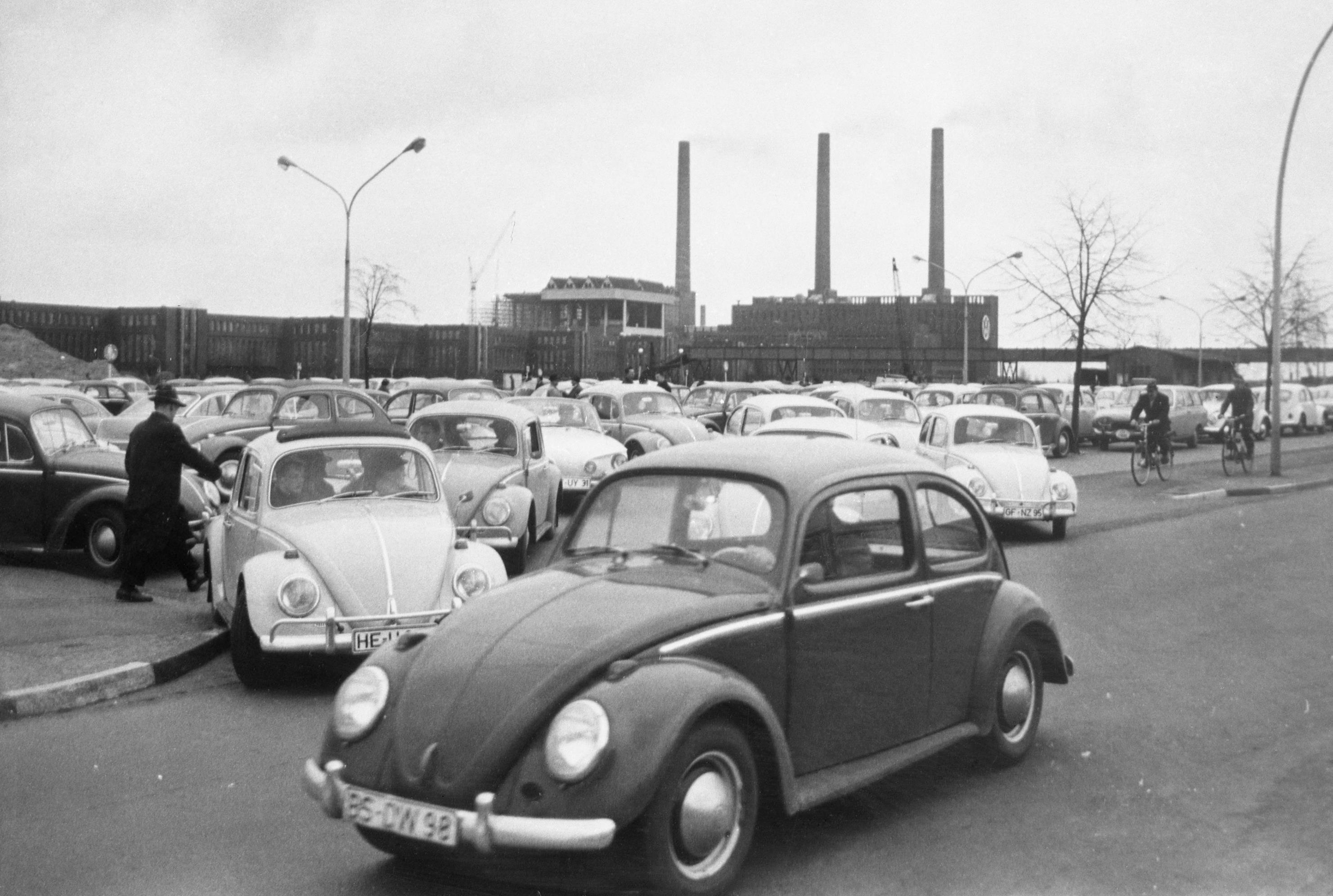
 FILE – In this April 27, 1966 file photo, Volkswagen workers drive their Beetle cars from the parking lot on their way home at the end of a days work at the world’s largest single auto plant, the Volkswagen factory (seen in background) in Wolfsburg, Germany. Volkswagen is halting production of the last version of its Beetle model in July 2019 at its plant in Puebla, Mexico, the end of the road for a vehicle that has symbolized many things over a history spanning eight decades since 1938.(AP Photo, file)
FRANKFURT, Germany (AP) – Volkswagen is halting production of the last version of its Beetle model this week at its plant in Puebla, Mexico. It’s the end of the road for a vehicle that has symbolized many things over a history spanning eight decades since 1938.
It has been: a part of Germany’s darkest hours as a never-realized Nazi prestige project. A symbol of Germany’s postwar economic renaissance and rising middle-class prosperity. An example of globalization, sold and recognized all over the world. An emblem of the 1960s counterculture in the United States. Above all, the car remains a landmark in design, as recognizable as the Coca-Cola bottle.
The car’s original design – a rounded silhouette with seating for four or five, nearly vertical windshield and the air-cooled engine in the rear – can be traced back to Austrian engineer Ferdinand Porsche, who was hired to fulfill Adolf Hitler’s project for a “people’s car” that would spread auto ownership the way the Ford Model T had in the U.S.
Aspects of the car bore similarities to the Tatra T97, made in Czechoslovakia in 1937, and to sketches by Hungarian engineer Bela Barenyi published in 1934. Mass production of what was called the KdF-Wagen, based on the acronym of the Nazi labor organization under whose auspices it was to be sold, was cancelled due to World War II. Instead, the massive new plant in what was then countryside east of Hanover turned out military vehicles, using forced laborers from all over Europe under miserable conditions.
Re-launched as a civilian carmaker under supervision of the British occupation authorities, the Volkswagen factory was transferred in 1949 to the Germany government and the state of Lower Saxony, which still owns part of the company. By 1955, the millionth Beetle – officially called the Type 1 – had rolled off the assembly line in what was now the town of Wolfsburg.