
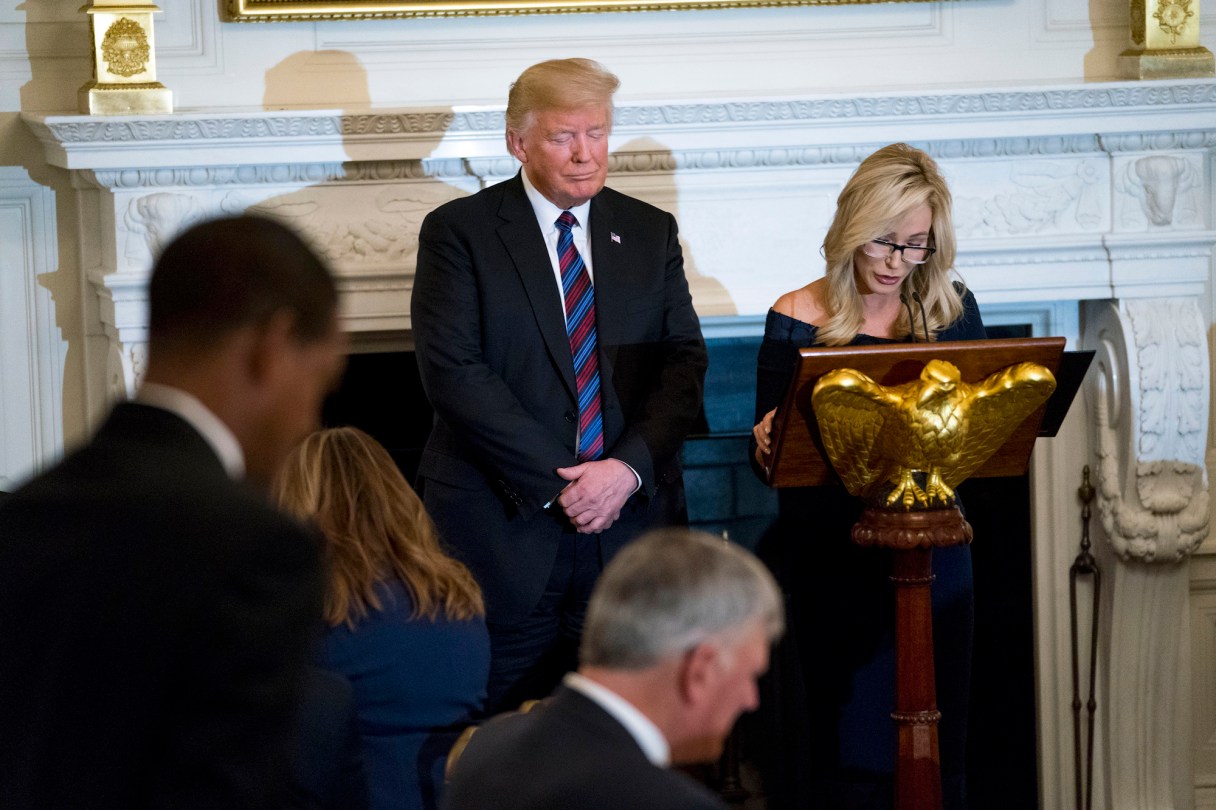
WASHINGTON – When Paula White, who’s often described as President Trump’s personal spiritual adviser, railed in her invocation at his reelection kickoff last week against “every demonic network who has aligned itself” against Trump, her words bothered me, personally and spiritually.
I’ve written critically about Trump, but I don’t consider myself a tool of the devil, and I didn’t like it when a prominent religious leader seemed to be making that accusation about millions of Americans.
But it’s a good rule in journalism (and in politics and religion, too) to try to understand what motivates disturbing comments. And as it happens, I know a faithful supporter of Pastor Paula, as her followers call her, who could explain her theology. He’s the Rev. Paul F.M. Zahl, an Episcopal minister who was my closest friend in high school. He is a frequent attender of Pastor Paula’s services.
So with my friend Zahl’s permission, I want to share our conversation over the past few days.
The first thing to recognize about Pastor Paula, said my friend, is that she speaks the language of the Pentecostal Church. Though she’s a white woman, most of her parishioners have been African American, and she became famous as a television preacher with a show on BET. (According to Pastor Paula, Trump saw her on TV in the early 2000s and called her, saying “You’re fantastic; you’ve got the ‘it’ factor.”)
If you watch YouTube clips of Pastor Paula preaching, you’ll see an ebullient, modern evangelist. She’ll tell parishioners to “high five” their neighbors or “slap them upside the head.” But there’s a darker side to her theology, too: She speaks often about the devil in her sermons, and she believes, Zahl says, that “this present world is under the power of Satan,” in politics and every other aspect of life.
Now to Trump, the unlikely, thrice-married vessel for evangelical hopes. “Paula would say that Donald Trump has somehow and almost by accident exposed a kind of stranglehold of secular thinking” on mainstream culture, Zahl argues. As examples, he cites challenges to “the traditional Christian view of marriage” and the “gender/sexuality ‘confusion,’ as we see it, of our present age.”
What’s hard for liberals to understand is that in these debates, conservatives feel victimized – shamed and excluded by what they regard as a cultural elite. Explains Zahl: “Those millions feel muzzled and unable to say what they think, for fear of being labeled, shunned and even physically attacked. That can create a kind of ‘pressure-cooker’ that can result in an ‘earthquake’ at the ballot box.”
These are the religious roots of Trump’s war against the liberal elites. “‘Liberal’ itself is always a good word!” says Zahl. “But its ideological hardening has produced a degree of intolerance, especially in relation to ‘deplorables’ like myself, that is breathtaking in its ability to silence the opposition.”
Mind you, if the question is intolerance, I think Pastor Paula needs to examine her claim that “demonic networks” are combating Trump and that the president “will overcome every strategy from hell” to win reelection.
We are a country where people are angry at each other, yes, but also feel their core beliefs are under attack. The more each side tries to defend itself, the more the other feels that its identity is demeaned and defamed.
I came away from this exchange more worried about the depth of America’s divisions, but also more convinced of the need to talk across the divide. Here’s what Zahl wrote to me after hours of back and forth: “If liberals who are appalled by Paula White would just take the time to try and understand her and show some empathy for what she and millions (and millions) of our fellow citizens sincerely hold dear, we would not be in this mess.”
A last word: When it was time for the baptism of my first grandchild last year, I asked my friend Zahl to perform the service. We’ve been disagreeing about politics since we were 13, but that hasn’t dimmed our friendship.
Washington Post Writers Group