
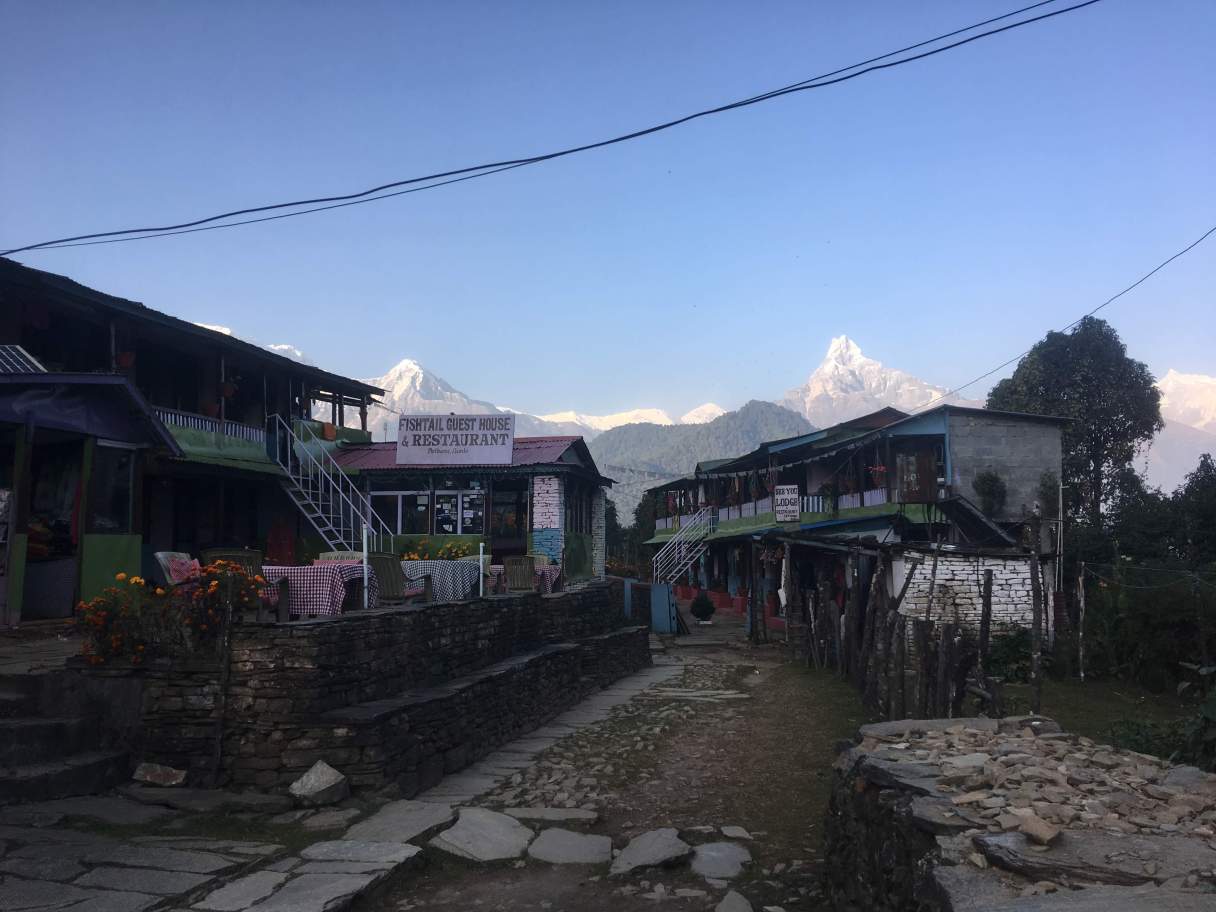
Last fall, my adventure partner and I decided to travel to the other side of the world to kayak new rivers fed by monsoons and Himalayan snowmelt, and to explore the illustrious mountain range.
Nepal had been on our minds since earlier that summer. While kayaking in Idaho, we had overheard rumblings of a crew going to Nepal in October during high-water season. After talking with Gerry Moffatt, an Idaho based friend who also happens to be a world-renowned expedition kayaker, specifically in the Himalayas, we ordered a Nepal whitewater guidebook.
Two days later, we bought plane tickets and began making lists of rivers to run, routes to trek and villages to visit.
GETTING THERE
Our plane tickets were expensive, but a 20-plus-hour flight to the other side of the world is hard to find for less than $1,000. It took 12 hours from Atlanta to Istanbul, then a little over eight hours to Kathmandu, the gateway to the Himalayas.
Like most of the other tourists in Nepal, we based out of Pokhara, located along Phewa Lake. Pokhara is considered the tourism capital of Nepal. The town is the hub for the Annapurna circuit, a popular Himalayan trek. It’s also popular for paragliding. Some days we would count 50-plus wings over the lake. But our interest was mostly in the country’s rivers. Right outside of the city center there were many Class 3+/4- rivers.
THE LOCAL LOGISTICS
In Pokhara you can find all the luxuries of city living: grocery stores; gear rental shops; even a small climbing gym. Since this city is a tourist destination, costs are generally higher. But in Pokhara you also can find hole-in-the-wall restaurants where you can eat authentic Nepali food for a more authentic Nepali price.
The Nepalese currency is rupees, and for anywhere between 70 and 250 rupees (~$0.70 to $2.50 American) you can get a delicious meal of a number of different culturally rich dishes, such as dal bhat, which is rice, lentils, greens, potatoes and veggies – and which they will keep bringing to you until you are full.
The hostels are affordable, too, averaging around $5-$10 per night for a room.
Nepal is quite easy to navigate. It is a small country about the size of Tennessee and South Carolina combined, but with a lot more people. Though while the bus rides are affordable, typically between $2.50-$10, they are long and rough along dirt, pothole-riddled roads. Even going a short 60 miles to the river put-in or trailhead usually takes four to six hours.
OUR FIRST NEPALI TREK
The most expensive part of the trip is the transportation and permits, which are required for trekking and paragliding. They are required for kayaking only if you plan to run the larger rivers in the more remote western province, such as the infamous Tulle Berry – first descended by the aforementioned Gerry Moffatt – or the Humla Karnali River.
Typically, permits should be bought once you arrive in Nepal, because they cost less at the government-run Kathmandu or Pokhara offices than they do anywhere else, including online. The permits for our four-day trek ended up costing us each around $100 total.
Let’s say you don’t have the proper permits and you go through a checkpoint – which has happened to a few people we know. For trekking you can buy the permit at the checkpoint, but it will cost you twice as much than if you’d gotten it beforehand. For paragliding or kayaking, you could be detained for a few hours, which, again, has happened to people we know.
Our four-day trek was within the Annapurna sanctuary. It ended up costing us around $50 per person, in addition to the permits. That cost included our accommodations at tea houses, which are mountain shelters located along trekking routes; food, which is a bit more expensive along the trek since it must all be hiked in by donkey; and transportation to and from the trail via a taxi.
The experience was well worth the cost. It was the most beautiful and difficult hike I’d ever completed. Though, the terrain wasn’t the only hard part. Mountains aside, the most difficult part of Nepal was keeping good hygiene and staying healthy.
The toilets are holes in the ground and toilet paper does not exist, so locals use their hands and water to clean. It is certainly beneficial to bring hand sanitizer, and our most prized possession was some Aquamira water treatment drops.
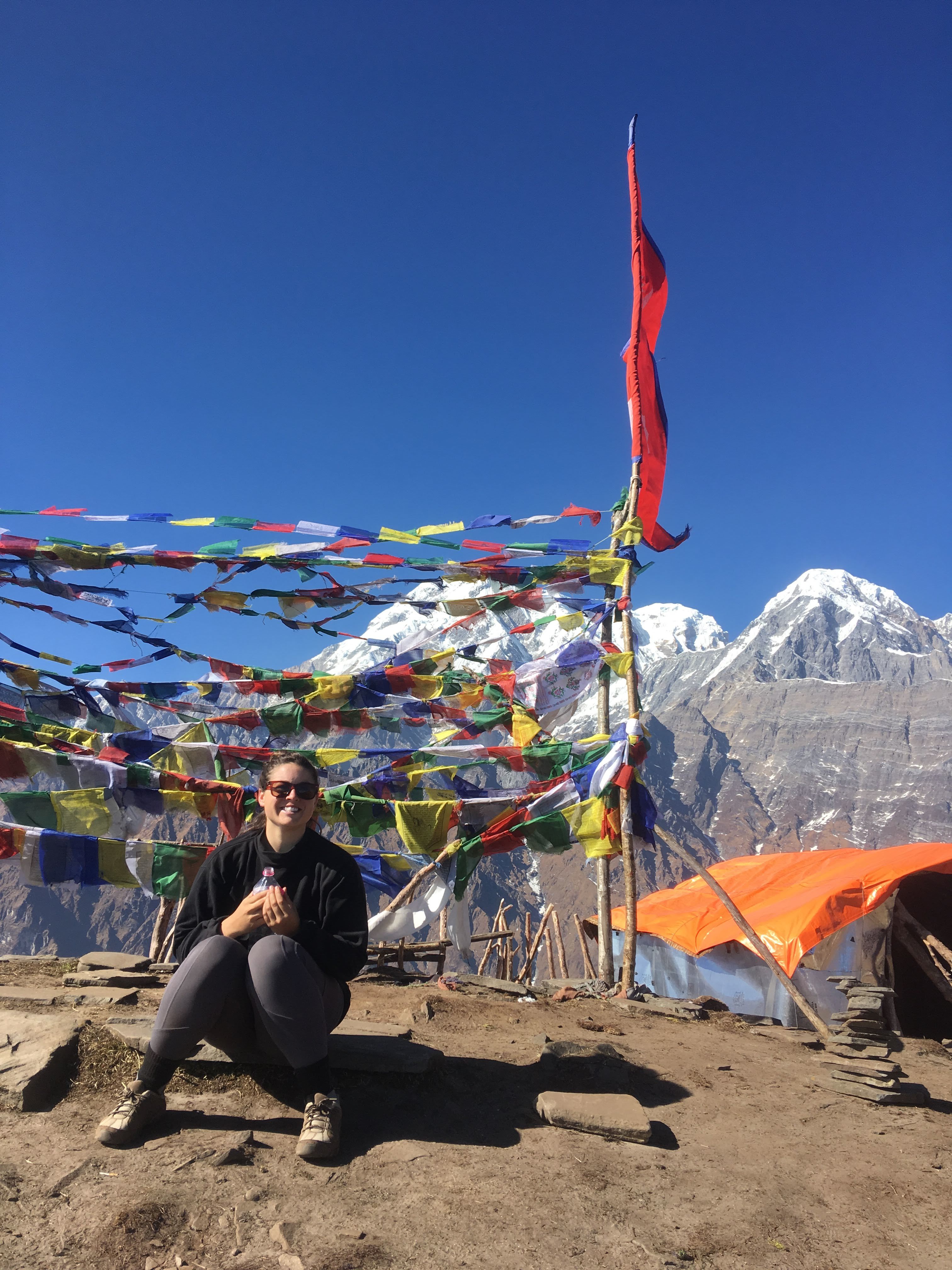 Lauren Dyer rests near the base camp of the Mardi Himal trek.
OUR NEPALI OVERNIGHTER
My favorite part of our trip was a three-day river run on the Class 3-4 Kali Gandaki River, which begins in a small town about three hours northwest of Pokhara then snakes through a jungle corridor. For 100 miles, there is continuous whitewater, its temperature gradually getting warmer thanks to a plethora of hot springs and warm waterfalls.
The water is a light blue and has less trash than many of the other runs in Nepal, likely because there aren’t any villages along the river – which also makes the beaches ideal for camping. Be sure to skip any beaches near villages, though. These are commonly used for cremations and you are likely to see human bones and happy vultures there.
Our first day was the most exciting, as it is the most continuous section of the river with a Class 4 rapid, called Little Brother, and a Class 4+ rapid, called Big Brother. Big Brother was a bit out of my league, so I decided to portage it. As I climbed out of my boat, a few elementary school-aged kids from a nearby village ran over from where they were swimming and playing to help me carry it around the rapid, making it the easiest portage I’ve ever done.
On our second day, during the last 2 miles of the stretch, we saw a massive rock along the bank that the people had turned into a temple. They had built a concrete walkway around the large, circular boulder and hung prayer flags around its edges.
This giant boulder, we later learned, is actually an enormous fossillized shell, making it very pourous. Such shells are known as Salagramas or Shaligrams and are used in South Asia as a symbol of the god Vishnu in the Hindu religion. Shaligrams are found along riverbeds and banks in Nepal, and this massive one along the Kali Gandaki looked out of place with its size and color.
As we approached the boulder, we saw a few kids run down to the beach and wave us over. The people there had clearly seen very few outsiders. There is not yet a road that goes to this village, known as Setibeni. The only way in or out is via ferry.
We got out of our boats and walked through town, where we met what felt like every local child. One of the villagers we met was the English teacher at the school. He told us that the rock wrapped in prayer flags is world-famous and a sacred place that many Nepalese people visit.
That evening was our last night on the river. When we pulled up to our camp spot, I knew it was going to be a long night. Leopard paw prints dotted the beach. I felt lucky we were exhausted, otherwise I would not have slept a wink out of fear.
The next morning, we awoke to the sound of a barking leopard. We later learned that is the sound they make when there is something else in their territory.
We got the hell out of there, but all fear aside, my adventure through Nepal was sublime – from the joy of successfully navigating rapids to being surrounded by jungle, to the growth that occurs from learning about and becoming part of a new culture.
We will go back.