
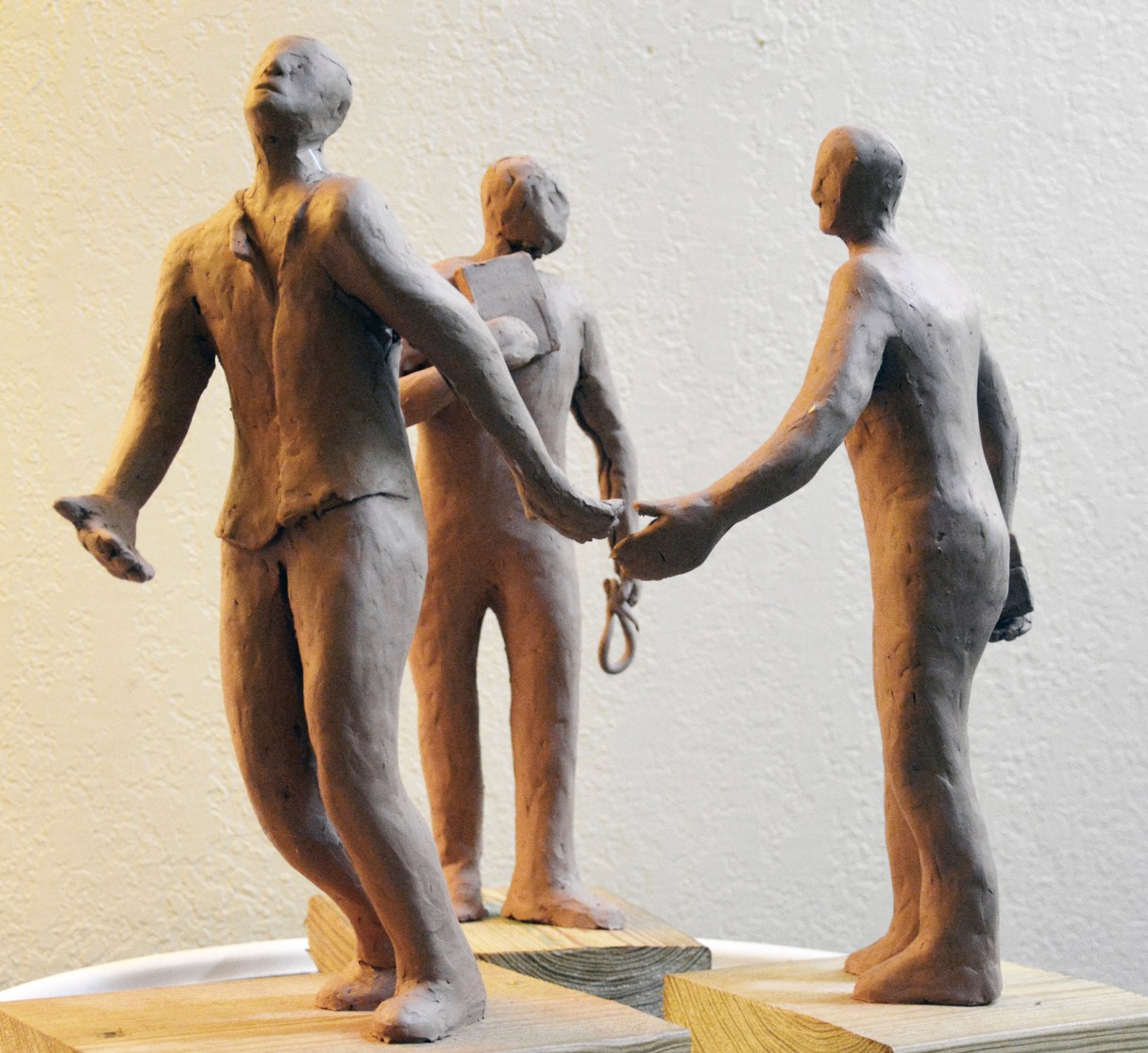

Hamilton County Commissioner Greg Martin wondered aloud Wednesday about a precedent being set if the commission gave $100,000 in bond money to the Community Foundation of Greater Chattanooga to assist with a memorial honoring a black man lynched on the Walnut Street Bridge in 1906.
“I’m really struggling with this thought of using tax dollars to pay for historical monuments,” he said.
However, just a year ago, the commission voted to contribute $250,000 for a memorial to the Fallen Five, the military members who were slain here in 2015 by a radical terrorist.
So the precedent has been set.
Putting aside for a moment the Ed Johnson Project, so named for the man hanged despite being believed innocent of the rape of a white woman, the next questions should be: Is there another fund from which tourism dollars can be drawn, who should determine what memorials and monuments should be funded, and how should it be determined how much to give?
Commissioner Tim Boyd, who was absent from the commission meeting for the Fallen Five vote last year, said the bridge project is worthy, but he has no intention to vote to use commission funds to help build it. Instead, he said, he plans to propose an amendment to Hamilton County Mayor Jim Coppinger’s proposal to spend the money on the memorial that would withhold $25,000 in hotel-motel tax revenue from the Chattanooga Convention and Visitors Bureau (CVB) for the next four months to pay for it.
We won’t rehash the commissioner’s longtime disagreement over the CVB keeping all of the county’s portion of hotel-motel tax revenue. However, we agreed with him then, and do now, that a new funding formula should be created for the revenue that would allow the county to direct some of it to special projects.
And if it is to be a county practice to fund such monuments and memorials, we’d like to see a public committee debate these suggestions and how much money it might propose to the county mayor and the county commission to spend on any project. For when one opens the door to one individual’s good idea, one will be hard-pressed to close it on another’s plans.
In the case of the Fallen Five memorial, one might argue the county was willing to contribute the $250,000 it did because we’re unlikely to see such a slaughter ever again. Given something so unthinkable, we better hope we never see another lynching, either.
As to how much to contribute, one might argue the county in essence funded $50,000 per Fallen Five member, so why should we give twice as much to the memory of one man? But the Johnson Project, though it will honor the memory of Ed Johnson, also will have reminders of other Chattanooga lynchings – at least one other one on the bridge and at least two more in the county.
As of a year ago, according to Times Free Press archives, $300,000 of the $400,000 needed for the memorial had been raised. Some $100,000 more was needed to finish the documentary, and $25,000 was needed for scholarships administered by the Community Foundation.
Were we a county commissioner, though, we would insist our money go to the actual building of the memorial sculpture by Savannah, Georgia, artist Jerome Meadows and not to any documentary film being made about the project, or to any scholarships that will be awarded from money raised dealing with the project.
We have nothing against either a documentary or scholarships honoring Johnson. Indeed, since the “Contempt of Court” book was written about the incident involving Johnson in 1999, a state resolution was passed to honor Johnson, a group of attorneys said they would work to endow a scholarship in his name, a play has been written and produced about the lynching, a painting by local artist Charlie Newton was conceived and completed, a history series around the event was held at the University of Tennessee at Chattanooga, and a remembrance day honoring Johnson was held downtown.
Our concern is that the county commission will have a much easier time justifying spending $100,000 for a memorial that’s – sadly – a part of Chattanooga’s history than for a documentary film or scholarships. Requests for memorials that deal with a part of the area’s history come around rarely. Documentary films and scholarships are made or funded every day, so the requests for such commission funding could become common.
If the commission decides to help fund this memorial, and it doesn’t want to tap the CVB, consider this: Mayor Coppinger is typically but properly stingy with county money, but a precedent was set with the Fallen Five memorial.
We hope the commission will go along with his proposal but will create a group that can suggest what will be funded, and for how much, in the future.