
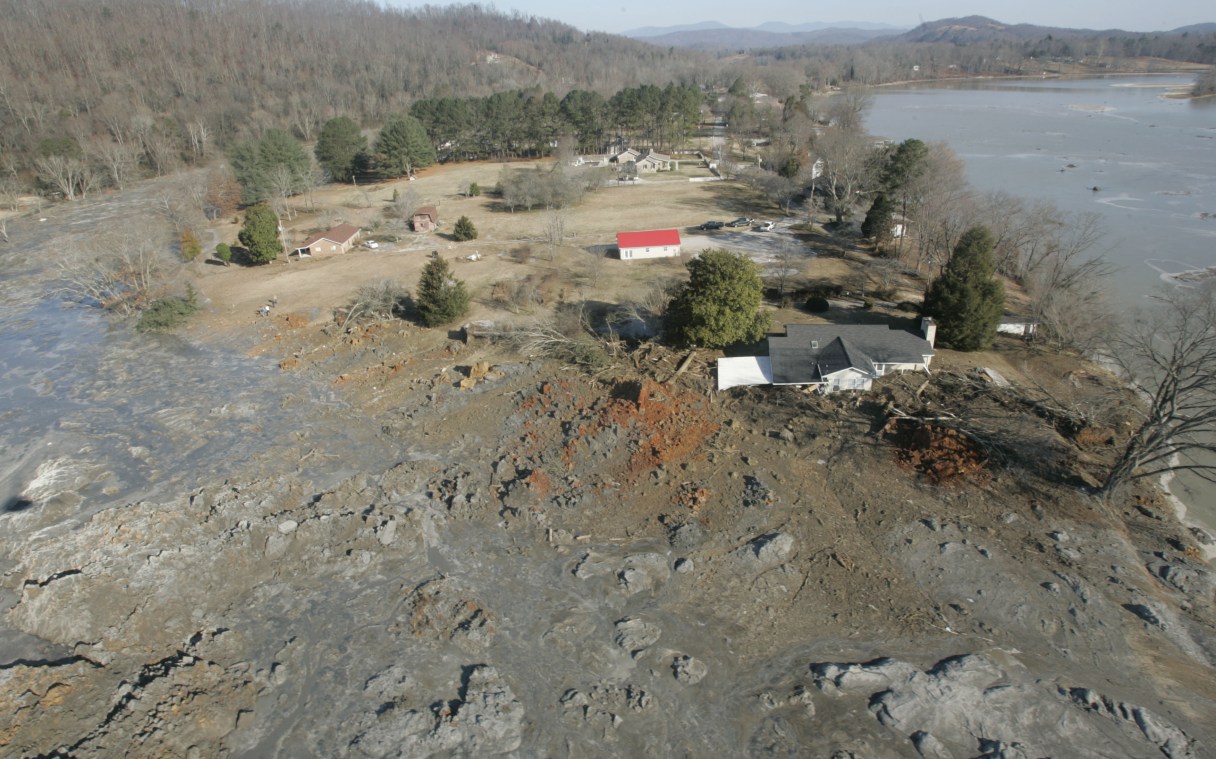
If you thought we were finished paying for TVA’s $1.2 billion Kingston ash spill, think again.
Jacobs Engineering, a global government contractor accused by workers of exposing them to toxic substances that sickened some of them, now is looking both to Tennessee Valley Authority ratepayers and other contractors to pay its legal bills and possible damages, according to a USA Today Network/Knoxville News Sentinel review of court records.
A decade ago, TVA put Jacobs in charge of cleaning up 7.3 million tons of spilled coal ash at the Kingston Fossil Plant in Roane County’s Harriman, Tennessee.
The Jacobs contract cost was $64 million, and the task was immense. An estimated 5.4 million cubic yards of toxic coal ash sludge – more than a billion gallons, and much larger than the oil spill of the Exxon Valdez – burst from a failed retention pond built into a towering landfill between the TVA’s Kingston Fossil Plant and the Emory River on the freezing and dark morning of Dec. 22, 2008.
A tsunami of 60 years of discarded coal ash – carrying toxic compounds including arsenic, mercury, selenium and silica – rolled out and settled over nearly 100 acres of the river and 300 acres of nearby rural and residential land. The ooze strangled an entire finger of the river, tore down docks, pushed several houses off foundations, and made farmland unusable for growing or grazing.
For the next weeks, months and years – five years to be exact – that ash was exposed to sun, rain, air and wind as it was scraped up and pushed or hauled from place to place by earth movers.
Eventually, TVA bought out about 300 residential and farm properties. Over the course of the cleanup, the utility razed what was left of the structures and turned the area into a park. And now, 40 of those cleanup workers are dead and hundreds say they are sick.
Seventy-three plaintiffs, a combination of workers or survivors of deceased workers, have sued in federal court, blaming unsafe working conditions for their illness. The workers say the contractor told them the ash was harmless and they didn’t need to wear protective clothing or masks – even as the ash dried and microscopic pieces of silica blew around with the wind in dust clouds while the workers used earth movers to scrape it up and prepare it for train rides to an Alabama landfill or moved it back into the rebuilt landfill. Those workers or their surviving families want to be made whole.
TVA only revealed that ratepayers may well be on the financial hook for Jacobs’ alleged misdeeds after a jury’s November verdict. What’s more, TVA sheepishly made it public only in a small section of the utility’s quarterly earnings report filed with the Securities Exchange Commission, according to the USA Today-Network Tennessee and the Knoxville News Sentinel.
In December, TVA reported to the EPA that three of five groundwater test wells below the rebuilt landfill show the presence of arsenic and radium, toxic elements of coal ash, above baseline levels. The arsenic measure is below water safety standards, but rose over time, suggesting continued and cumulative contamination.
Roane County and Harriman officials are not happy. In addition to the community’s growing concern over the illnesses of clean-up workers, TVA didn’t tell locals about the growing well contamination. Both Harriman and Roane County officials last year voted to hire legal counsel.
EPA scientists and engineers oversaw the cleanup of the Kingston Ash Spill. And although a TVA environmental officials told local reporters and CBS’s “60 Minutes” that she would swim in the river where the ash backed up, EPA officials insisted TVA put up spray wash stations for trucks and equipment coming off the site. They also required the installation of at least one boot washing stand where CBS anchor Lesley Stahl was made to clean her boots. As the cleanup progressed, TVA watered down and seeded the site with a temporary grass-growing mix to keep the dust down.
But workers have testified the contractor told them they didn’t need masks, and even took masks away from them for a time.
The sprinkler trucks alone should have been a give-away that the ash was not safe, though TVA, too, told reporters over and over that there was no danger to human health. Everything was fine, according to TVA authorities.
Just what was and is fine about $1.2 billion in cleanup costs and counting?
Just what was and is fine about families mourning dead and sickened workers?
Remember this the next time you hear the phrase “clean coal.”