
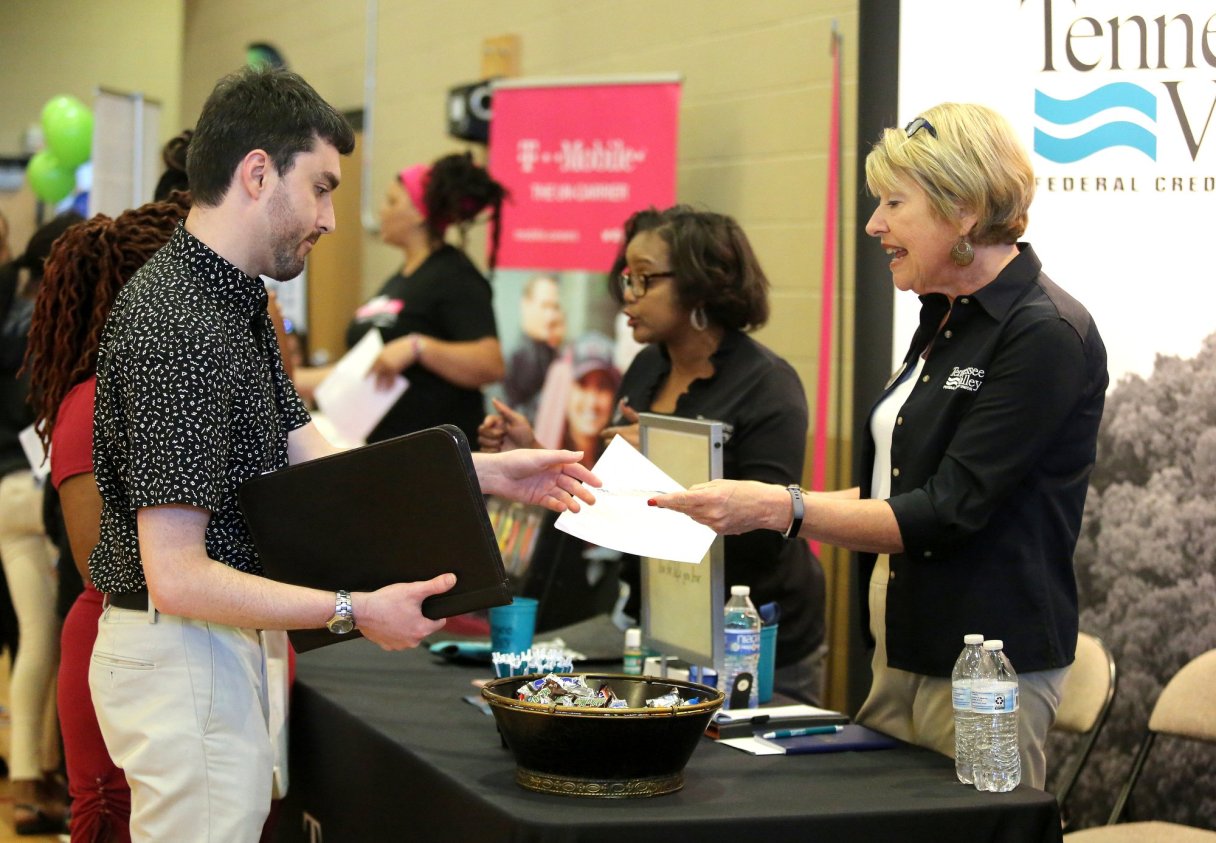
Sean Booth recently mingled among the dozens of tables set up at a spring job fair, hoping to catch the eye of a prospective employer.
At the Chattanooga Area Chamber of Commerce’s spring job fair earlier this month in Brainerd, the 29-year-old was looking for an opportunity that would cater to his bachelor’s degree in history and well-tuned research skills.
The only problem though is that he has worked at a job the past three-and-a-half years that doesn’t use this skill set, and it can be difficult to explain his job history online when he’s just another resume among the dozens, hundreds or even thousands uploaded for one position. Booth explained that being face-to-face with a potential employer is much more appealing than uploading his resume online just so it can be tossed by some hiring manager – or machine – because it doesn’t appear to have what a company is looking for in a candidate.
“I feel like that automatic screening process does not process things correctly sometimes,” he said. “It reads something the wrong way or way too fast.”
Using artificial intelligence in the job hiring process has become more of the norm rather than the exception, and many companies use some form of it whether it’s more basic, like screening resumes for key words, or more sophisticated, like a program that analyzes an applicant’s body language, tone and emotions in a video interview.