
Thursday, October 29, 2026Oct 29

This story is free to read.

BreakPoint: Asteroids and the improbability of our existence

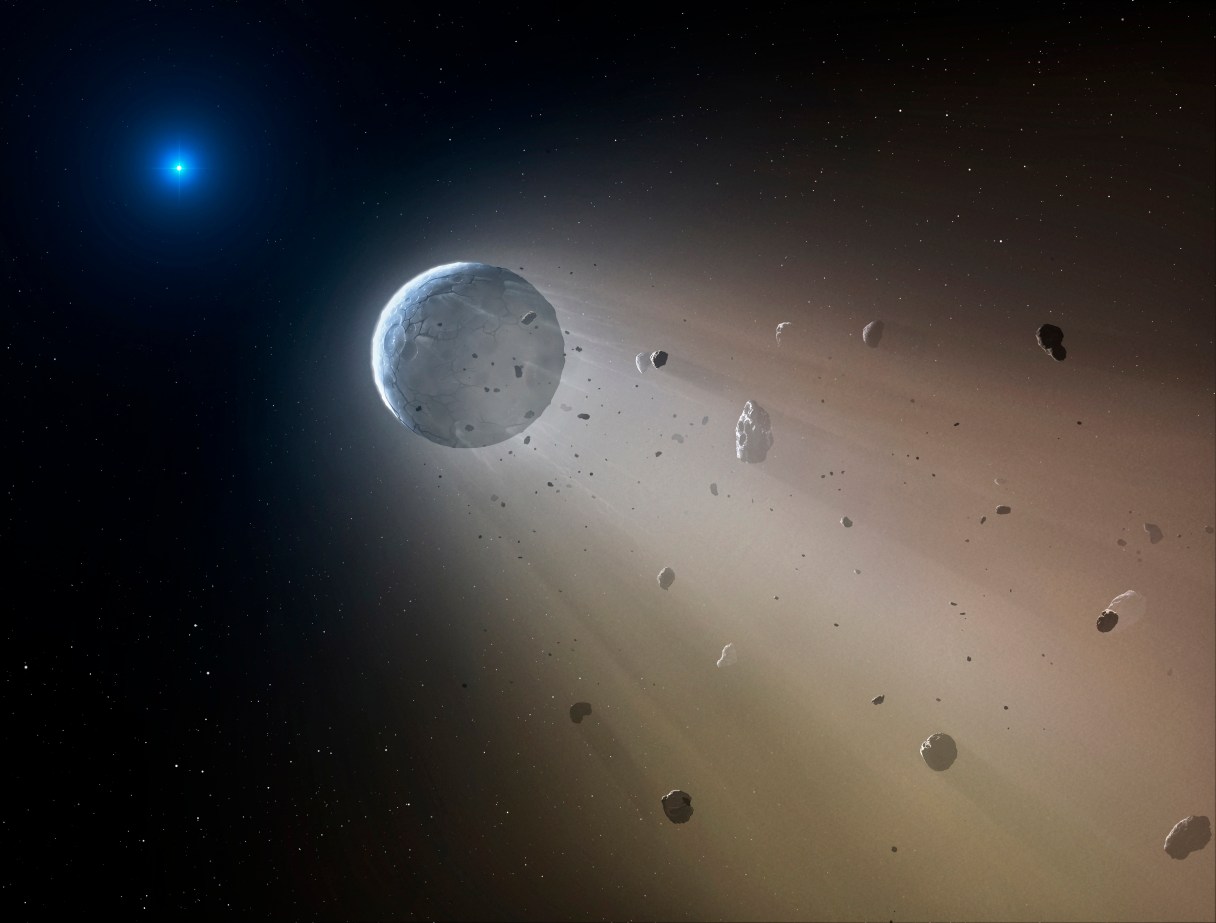
This artist's rendering provided by the Harvard-Smithsonian Center for Astrophysics shows an asteroid slowly disintegrating as it orbits a white dwarf star. On Wednesday, Oct. 21, 2015, researchers at the Harvard-Smithsonian Center for Astrophysics announced they have discovered a rocky object coming apart in a death spiral around a white dwarf star in the Constellation Virgo. They used NASA's Kepler spacecraft to make the discovery, then followed up with ground observations. (Mark A. Garlick/Harvard-Smithsonian Center for Astrophysics via AP)
This artist's rendering provided by the Harvard-Smithsonian Center for Astrophysics shows an asteroid slowly disintegrating as it orbits a white dwarf star. On Wednesday, Oct. 21, 2015, researchers at the Harvard-Smithsonian Center for Astrophysics announced they have discovered a rocky object coming apart in a death spiral around a white dwarf star in the Constellation Virgo. They used NASA's Kepler spacecraft to make the discovery, then followed up with ground observations. (Mark A. Garlick/Harvard-Smithsonian Center for Astrophysics via AP) This artist's rendering provided by the Harvard-Smithsonian Center for Astrophysics shows an asteroid slowly disintegrating as it orbits a white dwarf star. On Wednesday, Oct. 21, 2015, researchers at the Harvard-Smithsonian Center for Astrophysics announced they have discovered a rocky object coming apart in a death spiral around a white dwarf star in the Constellation Virgo. They used NASA's Kepler spacecraft to make the discovery, then followed up with ground observations. (Mark A. Garlick/Harvard-Smithsonian Center for Astrophysics via AP)

On April 13, 2029, a 370-meter wide asteroid formally known as 99942 Apophis will pass by Earth at a distance of about 19,000 miles.

While 19,000 miles sounds like a long way away, in astronomical terms it’s the equivalent of having a bullet whiz by your ear. There are man-made satellites that orbit farther from Earth.

Even scarier, it was initially believed there was a slight chance Apophis could strike the Earth in 2036. That’s why, when the asteroid and its trajectory was discovered in 2004, scientists named it after the Egyptian god of chaos who, by the way, is also the villain in the TV series “Stargate-SG1.”

Thankfully, that possibility has since been ruled out. Still, as the saying goes “There are plenty more where that came from,” in particular, in the asteroid belt between Mars and Jupiter.

The imminent threat of asteroid-caused destruction was the motivation behind a recent Planetary Defense Conference at NASA’s Goddard Space Flight Center. The purpose of the conference was to discuss “the threat to Earth posed by asteroids and comets, and actions that might be taken to deflect a threatening object.”