
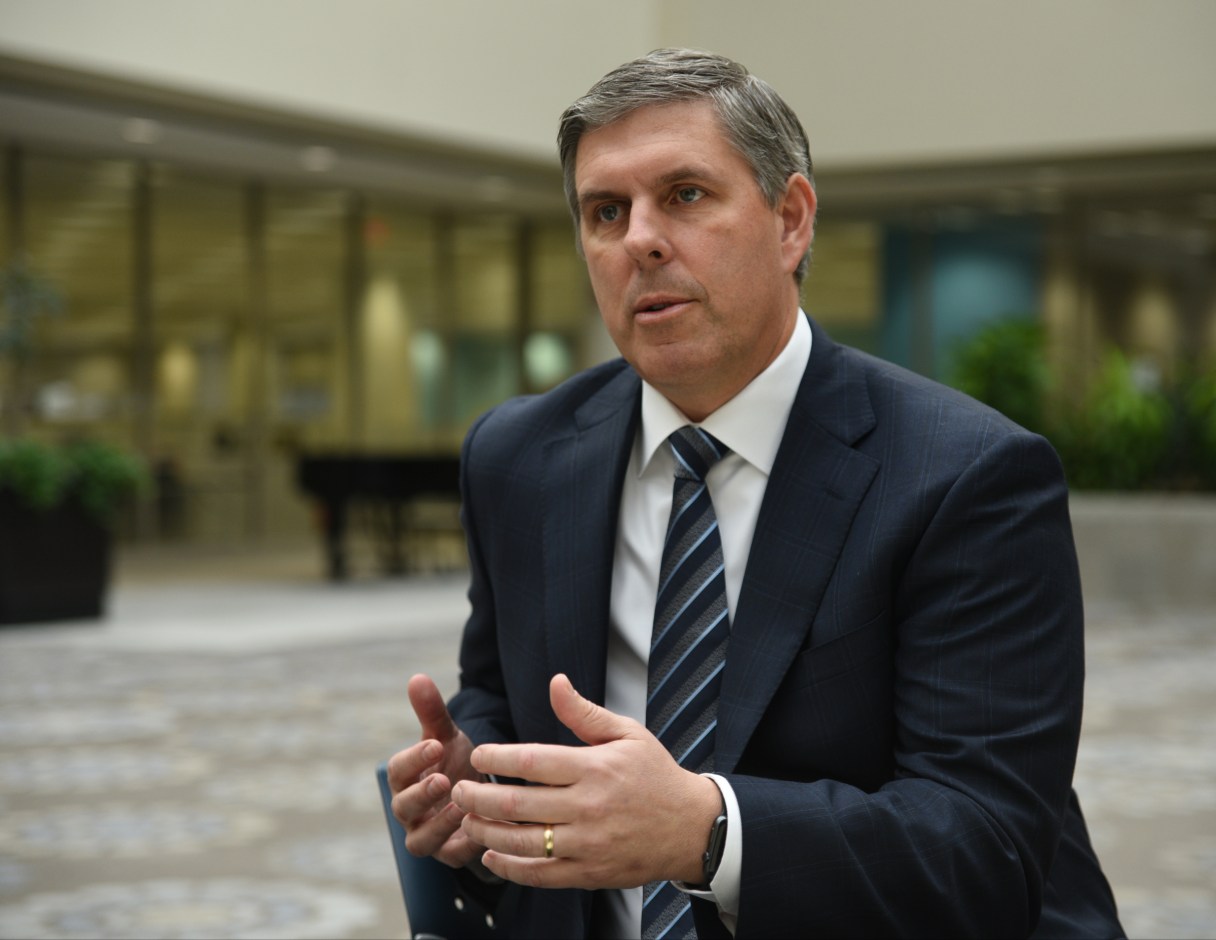
Unum Group has authorized the repurchase of up to $750 million of the company’s outstanding common stock through November, 2020 and boosted its quarterly dividend 9.6 percent.
The Chattanooga-based insurance company announced the moves during the company’s annual meeting Thursday in Portland, Maine, where company CEO Rick McKenney said Unum “stayed the course on our capital plans” to boost after-tax income last year by 21 percent per share despite industry headwinds.
“Our strong capital position allows us to continue to invest in our businesses as well as return value to our shareholders,” McKenney said.
The new stock repurchase authorization replaces the previous authorization of $750 million that was scheduled to expire on Nov. 24, 2019.
Unum’s quarterly dividend will increase to 28.5 cents per common share, or $1.14 per share on an annual basis, effective with the dividend expected to be paid in the third quarter of 2019.
Despite the higher dividend and extension of the stock repurchase, Unum shares fell nearly 3.8 percent, or $1.30 per share, to close after the annual meeting at $33.28 per share – the lowest price since mid January for Unum.
Tesla rebounds as orders rise
Shares of Tesla, suffering one of the worst stretches in company history, rebounded Thursday after CEO Elon Musk told employees that orders are up.
The company’s stock closed up 1.4% to $195.49 on a volatile day that started out with a loss. Tesla stock has shed about 60% of its value in three weeks and is trading at the lowest levels since late 2016.
Musk told employees in a memo late Wednesday that the company had over 50,000 net new orders so far this quarter, and that based on current trends, Tesla Inc. has a chance of exceeding the record 90,700 deliveries set in the fourth quarter of last year. The memo was circulating on the internet and confirmed as authentic by a person with knowledge of its origin.
Musk’s memo said the company needs to sustain production of 1,000 Model 3s each day, something that it has done multiple days. It’s averaging production of 900 vehicles per day, the memo said.
Demand for Tesla vehicles fell by about one third from the fourth quarter of last year to the first quarter of this year. At the first-quarter pace, the company will sell about 250,000 vehicles this year, more than 100,000 below the low end of the company’s forecast of 360,000 to 400,000.
Investment chief jailed over Ponzi scheme
The former head of a Tokyo and Las Vegas investment firm was sentenced Thursday to 50 years in prison for bilking thousands of Japanese victims in what prosecutors called a $1.5 billion international Ponzi scheme that ranks among the largest-ever fraud cases in the U.S.
Defendant Edwin Fujinaga, 72, also was ordered to pay nearly $1.3 billion in restitution to victims, including many vulnerable retirees in Japan who were told they were safely investing in a medical collections business that could earn a 6% to 10% annual return.
Evidence at trial showed that Fujinaga instead spent lavishly on himself, buying a Las Vegas golf course mansion, private jet, luxury cars and real estate in California wine country, Beverly Hills and Hawaii. Chief U.S. District Judge Gloria Navarro said efforts by Fujinaga to apologize were “offensive.”
Fujinaga blamed changes in the dollar-to-yen exchange rate for problems while he headed MRI International Inc. for more than a decade. He said he was trying to clean up a corrupt medical accounts payable industry and is now so “despondent” that he has to take medication.
The judge rejected his explanation and acknowledged that the severity of his crimes approached those of convicted U.S. Ponzi schemers Bernard Madoff in New York, Allen Stanford in Houston, and Scott Rothstein in Miami.
Sales, profits rise at Best Buy stores
Under a cloud of tariffs on Chinese-made goods, Best Buy Co. reported higher-than-expected results for the first quarter, led by sales of appliances, wearables and tablets.
The electronics retailer blew past analysts’ profit expectations and were in line on other measures, pushing its stock up 2% in premarket trading. Executives said they remained confident about the rest of the year, reconfirming the guidance they had previously given to investors about full-year results.
“This outlook balances our better-than-expected Q1 earnings, the fact that it is early in the year and our best estimate of the impact associated with the recent increase in tariffs on goods imported from China,” Hubert Joly, the company’s chief executive, said in a statement.
Tariffs on about $200 billion worth of China imports are scheduled to rise to 25% from 10% on June 1.
Best Buy earned 98 cents per share for the three months ended May 4, 11 cents higher than analysts were expecting. Adjusted for one-time events, Best Buy earned $1.02 per share, 15 cents higher than expected.
Sales across domestic and international operations were flat, at $9.1 billion, while comparable sales among stores open at least a year rose 1.1%.