
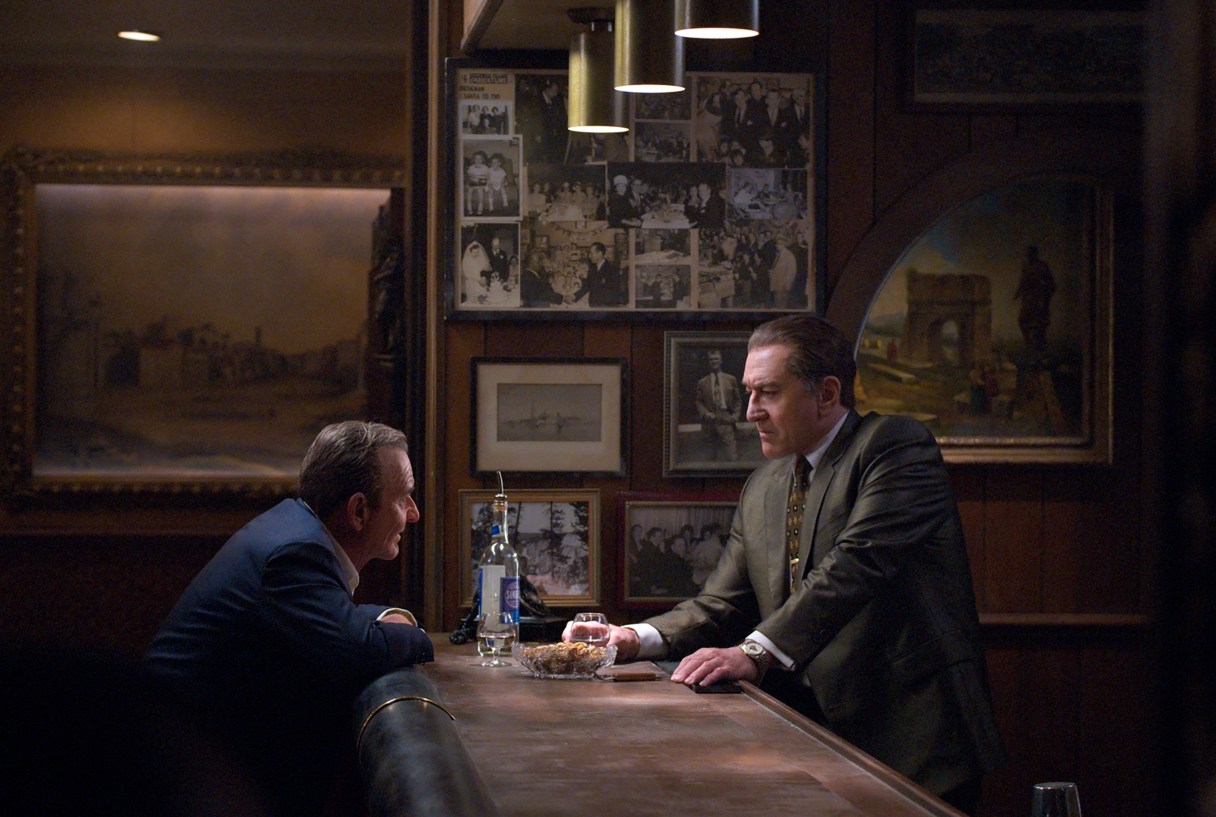
The runtime is the most boring aspect of Martin Scorsese’s “The Irishman” to dwell on.
There is no question that three hours and 28 minutes qualifies as a long movie. And in a landscape where some films can make two hours seem bloated and overindulgent, it’s at least understandable why one might be wary. But Scorsese has earned the benefit of the doubt and “The Irishman” keeps you rapt from the first winding tracking shot through a staid retirement home – a flashy cinematic show in the most un-cinematic of places – through the melancholic end.
The whole film in fact is something of a knowing contradiction: A small epic with a superhero budget, using technology like the oft-discussed de-aging process not for vulgar show or gimmickry but to add real heart and grandeur to a film that is trying to grapple with the scope of a life. The subject at hand here is Frank Sheehan (Robert De Niro), the teamster and mafia figure who claimed right before his death that he was the one who killed Jimmy Hoffa (Al Pacino).
Although hardly accepted as a definitive answer to one of our great unsolved mysteries, Scorsese and screenwriter Steve Zaillian (“Schindler’s List,” ”Gangs of New York”), inspired by Charles Brandt’s “I Heard You Paint Houses,” saw in this deathbed confession the opportunity to make something more poignant and personal: An opus about the enormity of a life lived in and around the mafia.
To pull off this ruminative trick and still make an entertaining film, Scorsese has naturally gone back to his original muse, De Niro, and a few old friends. They include Joe Pesci (who came out of retirement for an all-time performance as crime boss Russell Bufalino, who is both sympathetic and otherworldly sinister) and Harvey Keitel (in a small role), who have along with their director defined and illuminated the concept of the mafia for many who will never come near that world.