
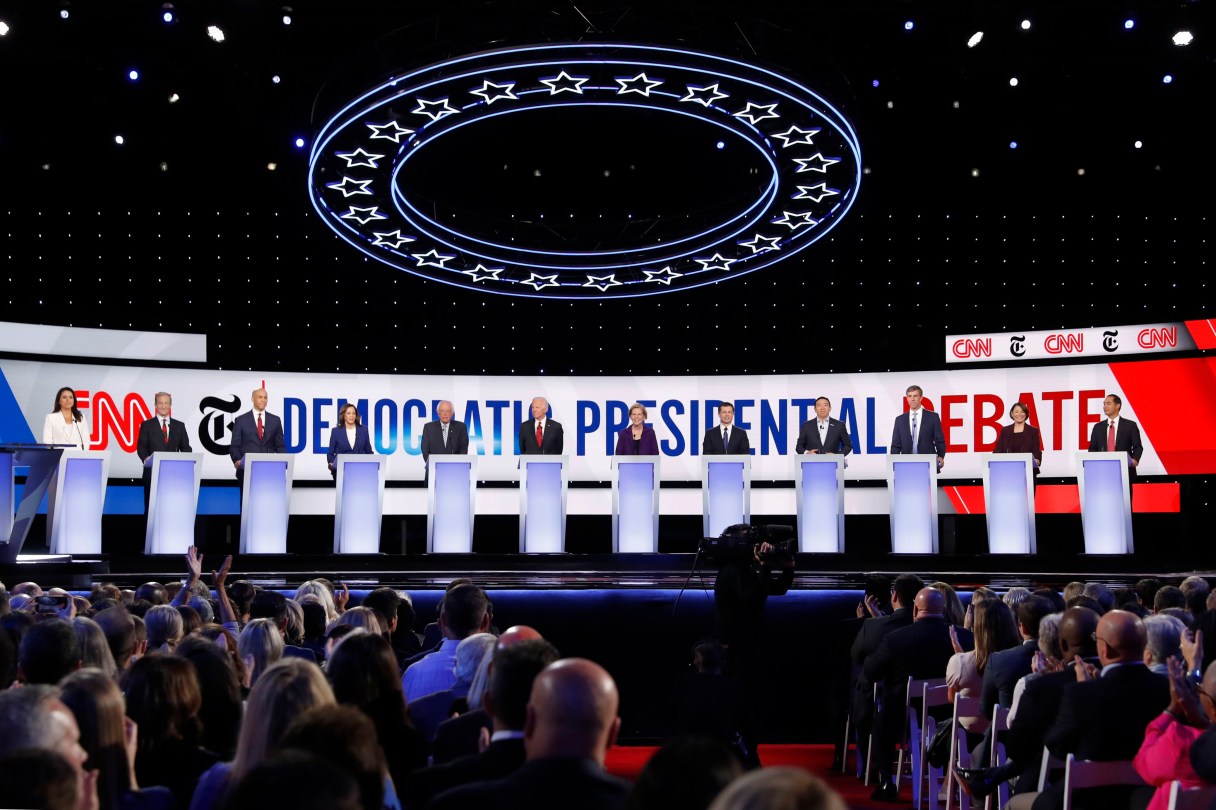
The most recent Democratic debate lasted three hours and, according to one transcript I checked, exceeded 30,000 words.
Almost none of them were about religion.
God came up only in throwaway phrases. “God bless Kamala,” said Cory Booker, praising Kamala Harris for discussing reproductive rights. Joe Biden scattered “for God’s sake” and “God forbid” like croutons on his word salads. Tulsi Gabbard, explaining the meaning of “aloha,” noted that “we’re all God’s children.”
When Booker fleetingly mentioned his participation in a bipartisan Bible study group, I snapped to attention. That was the closest the debate came to acknowledging the importance of faith in many people’s lives.
While the percentage of Americans who don’t identify with any religion has grown significantly over the past decade – to 26% from 17%, according to a sweeping survey by the Pew Research Center – it’s still the case that more than half of Americans say that they pray daily and 45% attend religious services at least once a month.
But you wouldn’t know it to tune into the Democratic primary. If many Republican candidates travel far out of their way to recruit the Almighty into electoral service, many Democrats steer clear of religion. In light of the rightful separation of church and state, they don’t want to be seen as spotlighting or peddling any one creed.
But it’s not necessary, and it’s not smart.
Democrats would make it harder for Trump to vilify them as enemies of so-called traditional values if they talked a bit more about spirituality and religion – including, if applicable, their own.
Mike McCurry, a Democratic consultant who served as a Clinton White House press secretary and now teaches at the Wesley Theological Seminary in Washington, says the church-state divide shouldn’t dissuade the candidates. “That’s such a misreading of what the political DNA of America is,” he said. “We have had religion woven into our political structures and our political debate from the very beginning.”
Besides, he added, a Democrat who speaks persuasively about religion has a potentially huge tactical advantage: “Imagine the contrast if you’re running against Donald Trump, who has absolutely none of that vocabulary.” While the president may have the farthest reaches of the religious right locked down, many Americans of faith are appalled by him.
And he’s vulnerable not just because of his personal history and public demeanor, which amount to a raging bonfire of the pieties. He also has governed in ways that contradict the principles of charity and mercy that are central to many religions.
Pete Buttigieg took gorgeously effective note of this in the Democrats’ first debate, in June, referring to the Trump administration’s treatment of migrants at the border.
“The Republican Party likes to cloak itself in the language of religion,” he observed. “But we should call out hypocrisy when we see it.” And any political party that suggests that “God would smile on the division of families at the hands of federal agents – that God would condone putting children in cages – has lost all claim to ever use religious language again.”
He’s not the only Democratic presidential candidate with religion in his history and on his mind. He’s just unusual in his readiness to mention it.
In the Democratic debates, Elizabeth Warren, a Methodist, has repeatedly reflected on her past as a teacher. But she has never taken the few extra syllables to note that she taught Sunday school.
In terms of connecting with as much of the electorate as possible, that’s a mistake. And in terms of the president’s moral fluency, it’s a blown opportunity.
The New York Times