
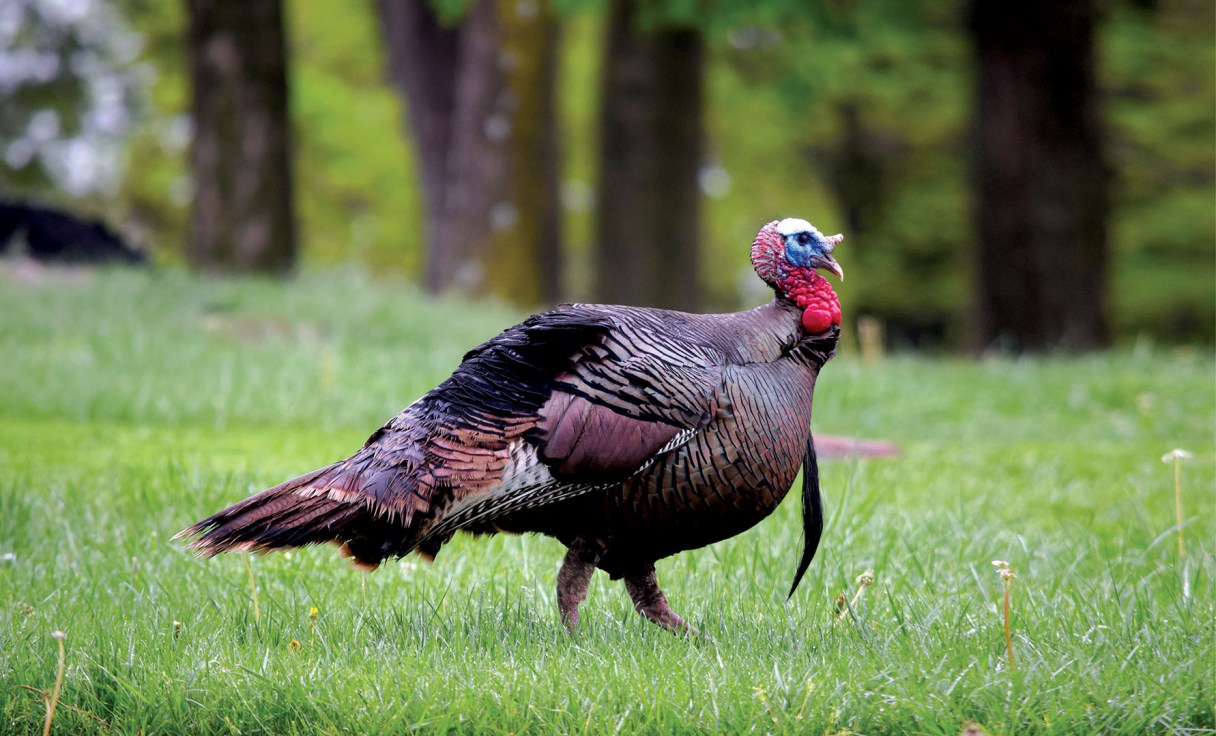
To call a person a “turkey” is to call him or her slow or stupid. But consider this: Young turkeys are able to walk and feed themselves just hours after hatching. Meanwhile, most songbirds remain in their nests for around three weeks. Hawks and eagles may stay up to 10 weeks.
Within 1-2 weeks, a turkey can fly, albeit not far. An adult turkey typically does not cover more than a quarter mile at a time. But where the turkey falls short in flight, it makes up for on land.
The wild turkey can run up to 25 miles per hour, making it one of the fastest running birds on Earth. In fact, it can almost keep pace with Olympian Usain Bolt, who holds the world record for fastest human footspeed at 28 miles per hour.
Founding father Benjamin Franklin recognized the turkey’s potential. If it had been up to him, the wild turkey – not the bald eagle – would be our national symbol. In a 1784 letter to his daughter Sarah “Sally” Bache, Franklin wrote:
“For my own part I wish the bald eagle had not been chosen as the representative of our country. He is a bird of bad moral character. He does not get his living honestly. You may have seen him perched on some dead tree, where, too lazy to fish for himself, he watches the labour of the fishing hawk; and when that diligent bird has at length taken a fish, and is bearing it to his nest for the support of his mate and young ones, the bald eagle pursues him, and takes it from him.
“For in truth, the turkey is in comparison a much more respectable bird, and withal a true original native of America. He is besides, (though a little vain and silly tis true, but not the worse emblem for that) a bird of courage, and would not hesitate to attack a grenadier of the British guards who should presume to invade his farm yard with a red coat on.”
^^^
Turkey Fast Facts
The wild turkey is the largest nesting bird in Tennessee.
Turkey droppings tell a bird’s sex and age: Male droppings are J-shaped; female droppings are spiral-shaped.
Domesticated turkeys cannot fly.
The wild turkey is one of only two bird species domesticated in the New World. The other is the Muscovy duck.
(Source: US Fish & Wildlife)
^^^
Comeback Kid
In the early 1900s, the wild turkey almost went extinct due to unregulated hunting and loss of habitat.
“And not just in Tennessee,” says Roger Shields, wild-turkey program coordinator for the Tennessee Wildlife Resources Agency. “Pretty much all the eastern states were losing turkeys.”
Efforts to restore populations began around the 1950s. First, wildlife officials attempted to captive-rear them by breeding game farm turkeys with wild ones. Poults were raised as wild as possible, then released.
But, Shields says, “Unfortunately, those birds just didn’t have the wherewithal to survive.”
Then, in the 1980s, TWRA implemented a new trap-and-relocate method. The idea was to catch wild turkeys in areas with decent numbers and move them to viable habitats that were missing the native bird.
Soon thereafter, “Turkey numbers went through an explosive phase,” says Shields.
In 1951, wild turkeys inhabited only 18 of Tennessee’s 95 counties. Today, they are found statewide, with an estimated population of 300,000.
“[Wild turkeys] have an aesthetic value for us. People like to see them,” Shields says.
They are also a critical part of the forest food chain, he says. “They are a prey species. Everything in the woods wants to eat them, from the eggs to the poults to the adults.”