
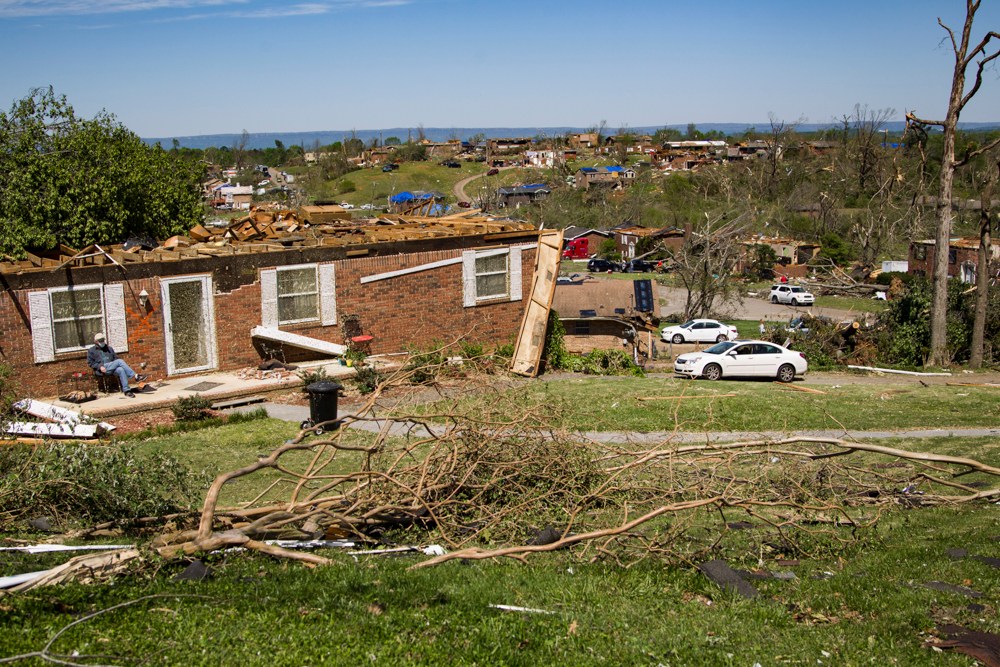

We are a little flummoxed when we see reports that some people in Hamilton County intimate there had been no warning before a tornado leveled neighborhoods in East Brainerd on Easter Sunday night.
If they mean there were no sirens or text or email alerts, then we’ll grant that didn’t happen. But to suggest a tornado was a total surprise is to ignore the severe weather warnings for the area that had been predicted for days.
Indeed, we saw one semi-official social media posting during the middle of the week before Easter that indicated Sunday’s storms could be the worst to hit the area since the April 27, 2011, tornado outbreak. That got our attention.
Anyone who experienced that day nine years ago in Chattanooga – or March 29, 1997 (another Easter weekend) – is aware of the potential for deadly twisters in East Brainerd and could have had plans for what to do in case a warning was issued.
And if one paid even the slightest attention to the weather on Easter, one might have heard about a series of tornadoes that had raked Mississippi and Alabama and were marching from the afternoon into the evening from southwest to northeast. The highest potential for Chattanooga, local television meteorologists told viewers even as some complained about the weather interruptions to their regular programming, would be around 11 p.m. – at night, when they are hardest to spot.
As it drew closer to 11 p.m., though, it looked like the threat of the worst might bypass the area. If we made it to 1 a.m., the storm potential would be gone.
Unfortunately, even with the newest, fanciest and most sensitive equipment to monitor their formation, tornadoes can emerge like a thief in the night.
The April 12 tornado that National Weather Service (NWS) officials tentatively say began just outside the Tennessee border in Georgia – very close to Camp Jordan in East Ridge – about 11:19 p.m. was on East Brainerd like a shot. A tornado warning was issued by the NWS and immediately was broadcast by meteorologists monitoring the volatile weather situation on their 11 p.m. newscasts.
Tornadoes, alas, do not come knocking on doors to announce themselves. They don’t follow traffic patterns in moving across the geography. They are no respecters of state, city and community borders. They may veer past one neighborhood and hit the next. They don’t necessarily go from one house to another like the door-to-door salesmen of yore. They may devastate a house on one street and leave the one next door relatively undamaged.
(MORE: Videos and photos: Drone footage of storm and tornado damage in the Chattanooga area)
Many people who were awake, or who were awakened by the storm, point to 11:25 p.m., or there about, as the moment when their home was hit. A power outage probably preceded the hit by five minutes or less.
So, after the power went out, after televisions displaying the latest warnings were silenced, residents probably had five minutes to take shelter. And those were the ones who were paying attention.
Those who weren’t, those who were asleep, those who had discounted the storm’s potential were caught unaware. Fortunately, the loss of life was minimal – though one is too many – and most of the injuries weren’t life-threatening.
A text or email message alert, depending on how – or if – one sets up one’s smartphone, weather radio or warning device would not have provided much more warning for those asleep or not paying attention than for those who were awake and monitoring the situation.
Some have complained since no alert was sent out – presumably by county emergency management authorities – days before the event, but we don’t believe citizens want to receive warnings every time there is the slightest threat of severe weather. If a tornado occurs once every 1,000 weather alerts, citizens who receive such warnings will ignore them because severe weather so rarely develops into a tornado.
And county emergency management officials have said a tornado siren not only would confuse citizens aware that a siren is sounded for a significant nuclear problem at the Sequoyah Nuclear Plant but also would not be heard by many people due to the county’s rolling topography.
In the end, we feel being personally responsible for knowledge of approaching severe weather is no different from being personally responsible for behavior during other crises in our country today.
We can’t know exactly when and where a tornado will strike – even with the best of technology – but we can remain alert to the possibility. We can’t prevent ourselves from getting the COVID-19 virus if we are exposed to it – and are susceptible – but we can do everything possible to keep ourselves healthy so our chances are better for recovery if we do get it, and we can remain socially distant wherever possible to prevent being exposed. And we can’t prevent a recession that is the fallout from a global virus, but we can be fiscally conservative with our money so that we are in a better position to ride it out if one does occurs.