
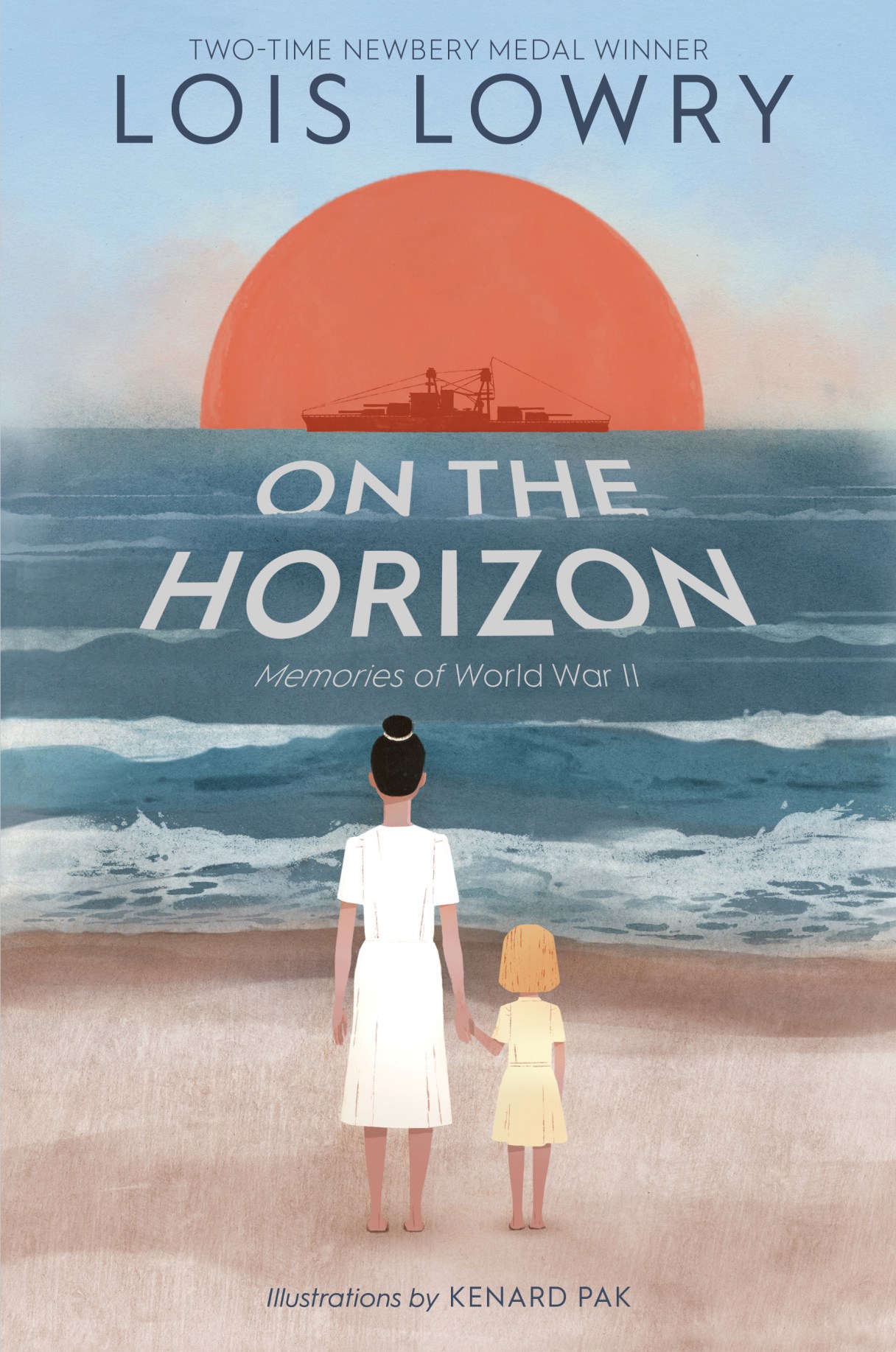
“ON THE HORIZON” by Lois Lowry (Houghton Mifflin Harcourt, 80 pages, $17).
Lois Lowry has been writing for children and young adults for nearly 45 years. She’s published more than 40 books and has twice won the distinguished Newbery Medal, but her achievements haven’t dulled her interest in trying new things. At nearly 83, she has written her first book in verse. “On the Horizon,” illustrated by Kenard Pak, tells stories of Lowry’s childhood, as well as of real people whose lives were lost in the World War II bombings of Pearl Harbor and Hiroshima – all in lovingly wrought poetry.
Lowry was born in Honolulu in 1937, and decades later, in one of her family’s home movies, a friend spotted the U.S.S. Arizona passing by 3-year-old Lowry as she played on the beach in Waikiki. This footage was filmed approximately one year before Japanese planes bombed Pearl Harbor on Dec. 7, 1941. It was partly this discovery – “Now, years later,” Lowry writes in the book, the footage seems “holy” – that prompted the first section (“On the Horizon”) of this three-part book, in which Lowry recalls her childhood and pays tribute to the sailors who died in Honolulu on that infamous day.
The book’s second section, “Another Horizon,” looks to Hiroshima on the morning of Aug. 6, 1945, when an American plane dropped an atomic bomb, killing tens of thousands of people. The final section, “Beyond the Horizons,” features poems about Lowry’s childhood years in Tokyo, where she began living at age 11.
In each part of the book, Lowry’s spare, powerful poems gradually narrow in scope to paint vivid pictures of some of the individuals who died in Pearl Harbor and Hiroshima. It’s the haunting specifics of their stories that will linger in readers’ minds. In “On the Horizon,” she writes of George and Jimmie Bromley, who were brothers from Tacoma, Washington, serving on the U.S.S. Arizona on that horrific day: “They found George Bromley’s body,” Lowry writes. “Not Jimmie’s, though.” The Naval Academy ring of Capt. Isaac Campbell Kidd, commanding officer of the Arizona, “was found melted and fused to the mast.” The 21 young men of the Arizona’s Navy Band Unit 22 all died that day, Lowry writes: “Their job was to pass ammunition / to the gunners. But the black powder exploded. / Twenty-one young men, prepared / for morning colors. Not one was spared.”