
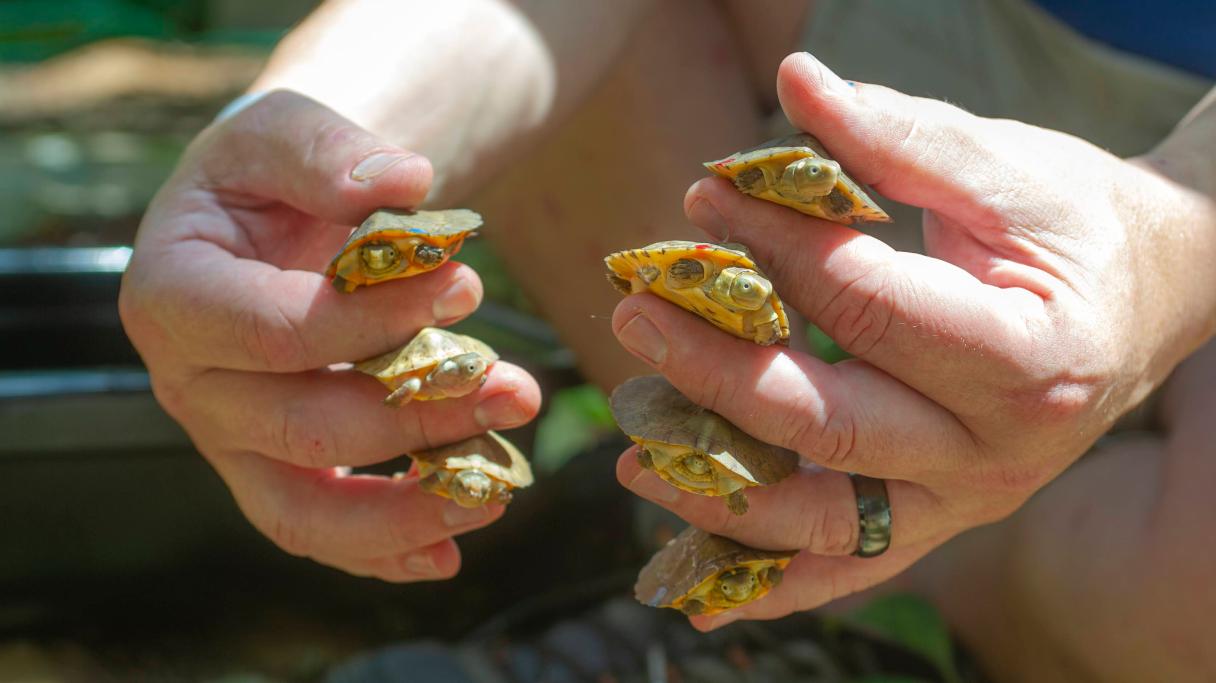
Seven baby turtles from two endangered Southeast Asian species have recently hatched at the Tennessee Aquarium, according to an Aquarium news release.
The five four-eyed turtles and two Beal’s four-eyed turtles emerged from their shells between late June and early July. Four-eyed Turtles (Sacalia quadriocellata) are found only in the streams and ponds of a remote region of extreme southeastern China, while the closely related and critically endangered Beal’s four-eyed turtles (Sacalia bealei) are found in an even smaller area. Both species are named for the distinctive “eyespot” patterns on the top of their heads, the release states.
This year’s batch of four-eyed turtle hatchlings is the Aquarium’s second most-successful year for that species. A record group of seven hatched in 2012, but in some years the Aquarium may only hatch one or two at a time.
In 2007, the Aquarium successfully hatched a Beal’s four-eyed turtle, one of only 18 Beal’s that were being cared for by zoological facilities at the time. Years later, a group of five hatched there in the summer of 2015, and four more arrived in 2019. Including the 2020 pair, the Aquarium has now hatched another 18 of those turtles, doubling the 2007 count for the entire population in human care, according to the release.