
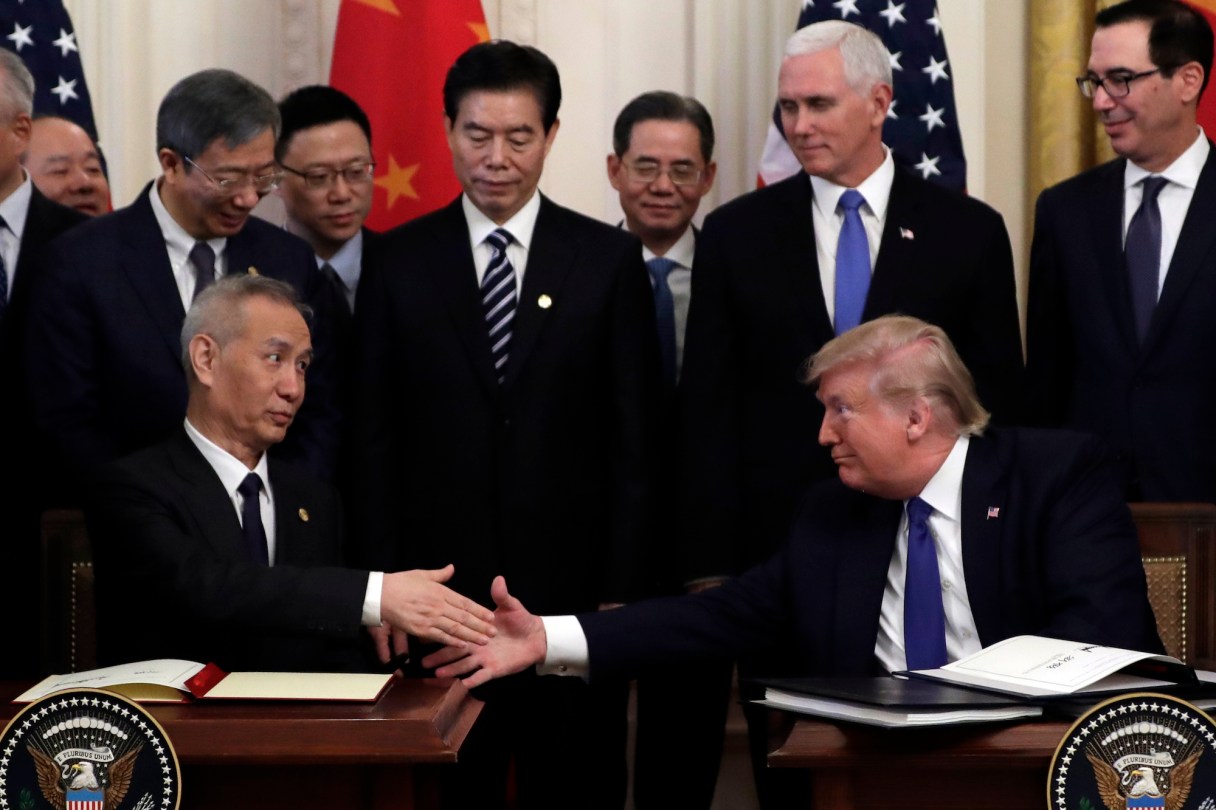
When candidate Donald Trump campaigned on calling China to account for its trade piracy, observers thought he was either crazy or dangerous.
Conventional Washington wisdom had assumed that an ascendant Beijing was almost preordained to world hegemony. Trump’s tariffs and polarization of China were considered about the worst thing an American president could do.
The accepted bipartisan strategy was to accommodate, not oppose, China’s growing power. The hope was that its new-found wealth and global influence would liberalize the ruling communist government.
Four years later, only a naif believes that. Instead, there is an emerging consensus that China’s cutthroat violations of international norms were long ago overdue for an accounting. The world is convinced that China has now become a dangerous international outlier.
Trump courted moderate Arab nations in forming an anti-Iranian coalition opposed to Iran’s terrorist and nuclear agendas. His policies utterly reversed the Obama administration’s estrangement from Israel and outreach to Tehran.
Last week, Trump nonchalantly offered the Palestinians a take-it-or-leave-it independent state on the West Bank, but without believing that a West Bank settlement was the key to peace in the entire Middle East.
Trump’s cancellation of the Iran deal, in particular, was met with international outrage. More global anger followed after the targeted killing of Iranian terrorist leader Gen. Qassem Soleimani.
In short, Trump’s Middle East recalibrations won few supporters among the bipartisan establishment.
But recently, Europeans have privately started to agree that more sanctions are needed on Iran, that the world is better off with Soleimani gone and that the West Bank is not central to regional peace.
In other words, there is now an entirely new Middle East orthodoxy unimaginable just three years ago.
Suddenly the pro-Iranian, anti-Western Palestinians have few supporters. Israel and a number of prominent Arab nations are unspoken allies of convenience against Iran. And Iran itself is seemingly weaker than at any other time in the theocracy’s history.
For the last 20 years, much of the American orthodoxy had agreed with Europe that the increasingly anti-democratic, pan-continental and borderless European Union was the remedy to all of Europe’s past 20th-century catastrophes.
But then Trump again blew up more old assumptions.
NATO will now only survive if its members keep their word and meet their spending promises.
Trump got little credit for these revolutionary changes because he is, after all, Trump – a wheeler-dealer, an ostentatious outsider, unpredictable in action and not shy about rude talk.
But his paradoxical and successful policies – the product of conservative, antiwar and pro-worker agendas – are gradually winning supporters and uniting disparate groups.
After all, the U.S. is beefing up its military but using it only sparingly. It hits back hard at enemies but does not hit first. For Trump, being conventional is dangerous; being unpredictable is far safer.
The result of the new orthodoxy is that the U.S. has become no better friend to an increasing number of allies and neutrals, and no worse an adversary to a shrinking group of enemies. And yet Trump’s paradox is that America’s successful new foreign policy is as praised privately as it is caricatured publicly – at least for now.
Tribune Content Agency