
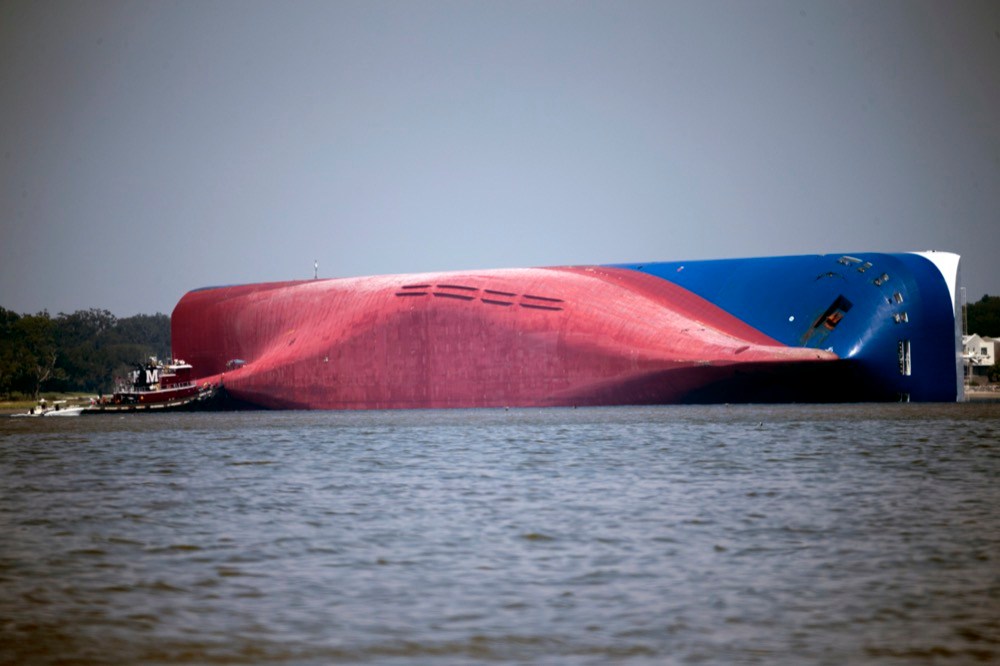
SAVANNAH, Ga. (AP) – A federal judge on Friday ordered attorneys for the U.S. Coast Guard and a maritime salvage company to answer detailed questions about plans to remove an overturned cargo ship on the Georgia coast by sawing it into eight enormous chunks.
The salvage firm Donjon-SMIT filed suit Feb. 13 asking the judge to halt removal of the South Korean freighter Golden Ray, which capsized off St. Simons Island on Sept. 8 shortly after leaving the nearby Port of Brunswick with 4,200 automobiles in its cargo decks.
The multi-agency command overseeing the wreck removal hopes to start cutting the ship into sections in May. But Donjon-SMIT says the Coast Guard violated the federal Oil Pollution Act when it allowed the ship’s owner to drop the company in favor of a rival salvage firm willing to remove the vessel in larger pieces. Donjon-SMIT’s complaint says that plan threatens an “environmental disaster.”
Government attorneys representing the Coast Guard responded Friday that halting salvage efforts already underway “would further delay of the removal of the Golden Ray and increase the risk of harm to the environment.”
U.S. District Court Judge Lisa Godbey Wood has scheduled a hearing Tuesday. Indicating there’s no time to waste, Wood submitted 45 questions Friday for attorneys on both sides to answer in writing prior to arriving in court.