
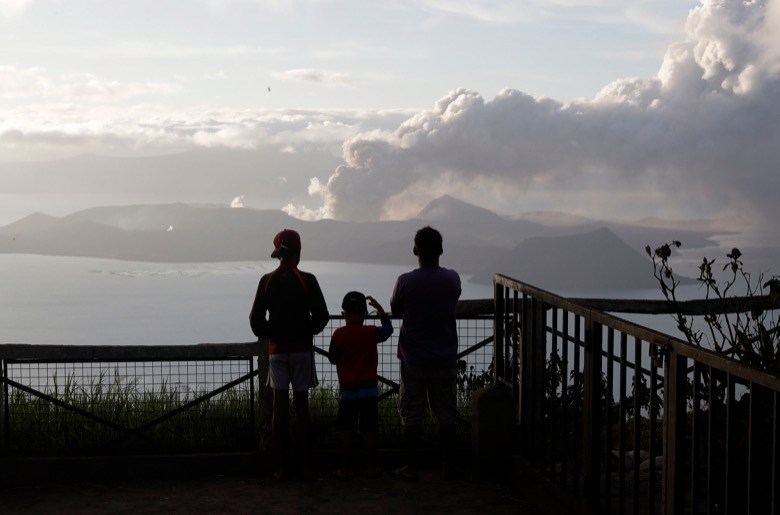
TAGAYTAY, Philippines (AP) – A volcano near the Philippine capital spewed lava into the sky and trembled constantly Tuesday, possibly portending a bigger and more dangerous eruption, as tens of thousands of people fled villages darkened and blanketed by heavy ash.
The continuous restiveness of the Taal volcano and several new fissures cracking the ground nearby likely means magma is rising as well and may lead to further eruptive activity, the Philippine Institute of Volcanology and Seismology said. The volcano was spurting fountains of red-hot lava 800 meters (half a mile) into the sky, and the massive column of ash and volcanic debris at times flashed with streaks of lightning.
The alert level since the eruption began Sunday has been 4, indicating a hazardous eruption is possible in hours to days. Level 5, the highest, means such an eruption is underway.
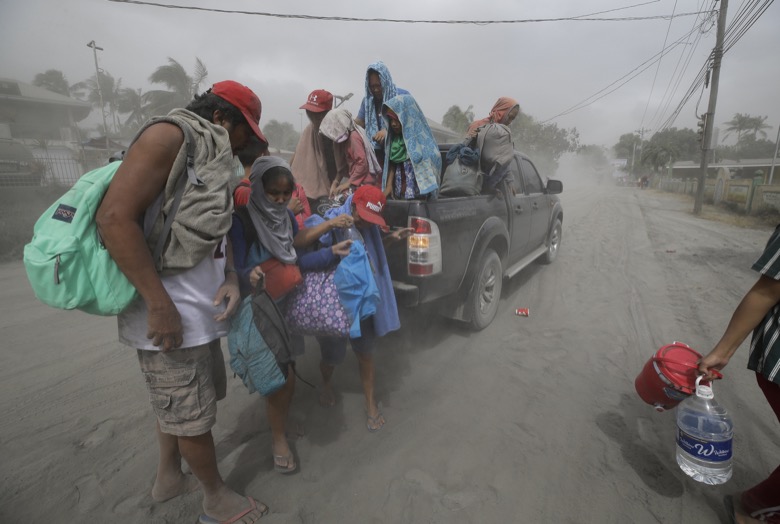 A family evacuates to safer grounds as Taal volcano in Tagaytay, Cavite province, southern Philippines on Monday, Jan. 13, 2020. (AP Photo/Aaron Favila)
About 50 volcanic earthquakes were detected over eight hours Tuesday, indicating rising magma, the institute said. It also warned heavy and prolonged ashfall was possible in nearby villages.
“The speed in the rise of magma is important (in determining) when the volcano will have a strong eruption and if it will slow down and freeze,” said Renato Solidum, who heads the institute. “As of now, we don’t see activities slowing down and the earthquakes still continue.”