
Friday, October 30, 2026Oct 30

This story is free to read.

Some issues reported on Georgia voting machines in election

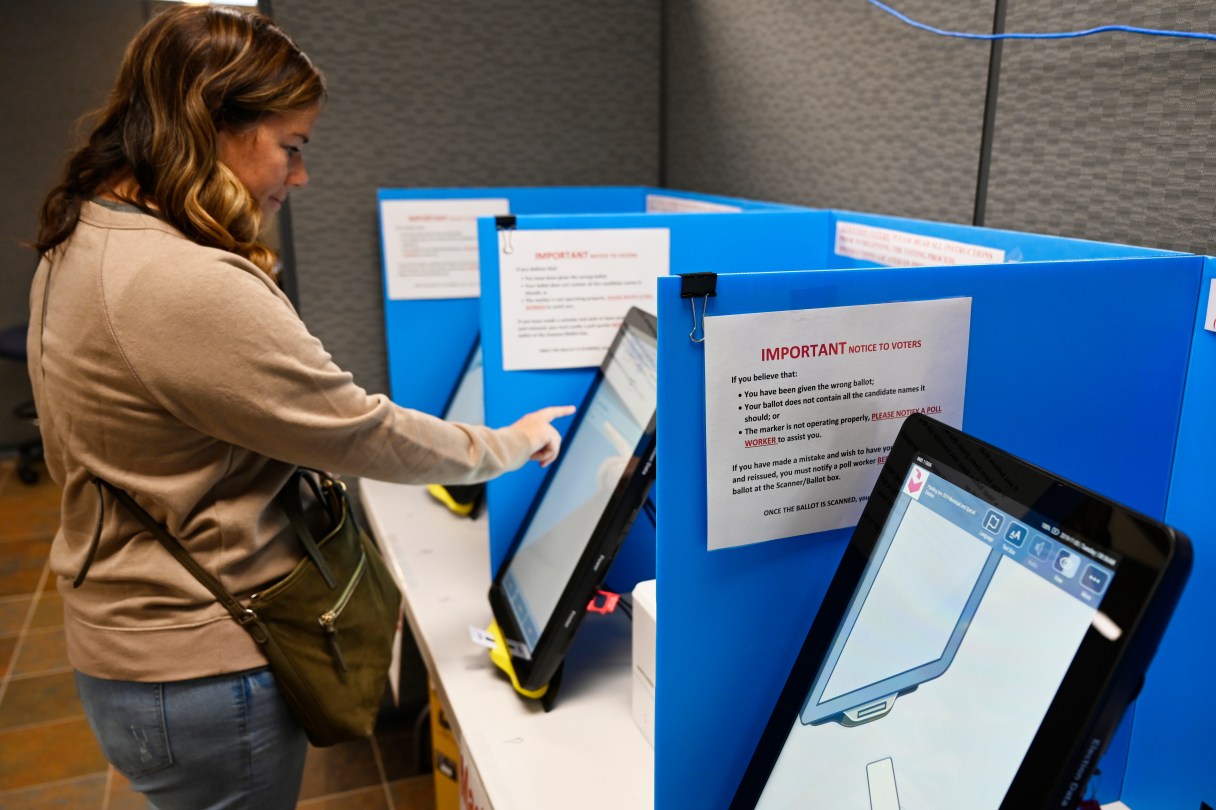
FILE- In this Nov. 5, 2019 file photo, Courtney Parker votes on a new voting machine, in Dallas, Ga. New voting machines that combine touchscreens with paper ballots are getting a limited test run in Georgia, as officials rush to meet a court-ordered deadline to retire the old system before any votes are cast in 2020. This was one of the top stories in Georgia in 2019.  (AP Photo/Mike Stewart, File)
FILE- In this Nov. 5, 2019 file photo, Courtney Parker votes on a new voting machine, in Dallas, Ga. New voting machines that combine touchscreens with paper ballots are getting a limited test run in Georgia, as officials rush to meet a court-ordered deadline to retire the old system before any votes are cast in 2020. This was one of the top stories in Georgia in 2019. (AP Photo/Mike Stewart, File) FILE- In this Nov. 5, 2019 file photo, Courtney Parker votes on a new voting machine, in Dallas, Ga. New voting machines that combine touchscreens with paper ballots are getting a limited test run in Georgia, as officials rush to meet a court-ordered deadline to retire the old system before any votes are cast in 2020. This was one of the top stories in Georgia in 2019. (AP Photo/Mike Stewart, File)

ATLANTA (AP) — Tuesday’s special state House election was another chance to work out kinks with Georgia’s new voting machines.

Secretary of State Brad Raffensperger traveled to the southwest Georgia district, which includes parts of Colquitt, Decatur and Mitchell counties to observe the election. The Republican told news outlets that the state’s new ballot markers and counters performed well, saying voters experienced “just two minor issues.”

But state Democrats and poll watchers said they observed more problems, including failures of ballot markers, ballot printers, scanners and a lack of voter privacy.

The big test looming for the new equipment is the March 24 presidential primary.

The $104 million system includes an electronic poll book to check voters in, a touchscreen computer to make selections, a printer that creates a paper ballot with a text summary of choices and a scanner that reads a code on each printout to tabulate the votes. The printed ballots are then stored inside each machine.