
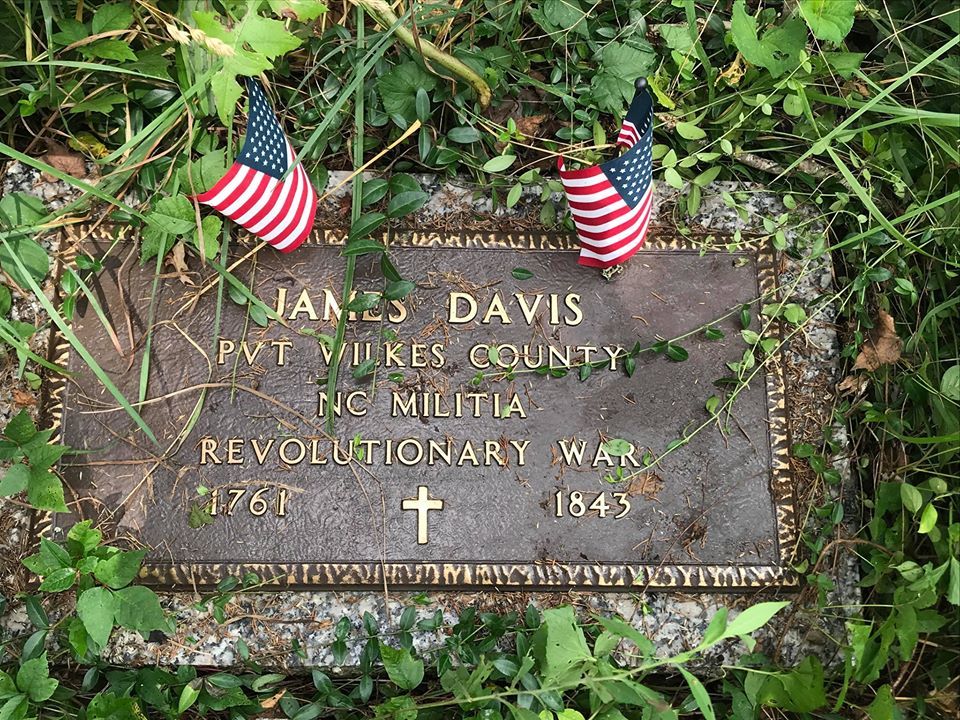
As the new mask mandate reminds us to practice safe health measures, our local cemeteries continue to offer a respite from being quarantined at home. Today’s excursion leads us out of the city to the historic Montgomery Cemetery.
The Montgomery Cemetery, located north of Chattanooga on the north side of Mahan Gap Road, is the final resting place of Revolutionary War patriot Pvt. James Davis. Born in 1761, Davis died at age 82 on Dec. 9, 1843; his wife, Mary Brumley, is buried next to him. His descendants are scattered across the cemetery.
Davis’s Revolutionary War pension application, filed on Aug. 28, 1832, in Hamilton County before the “Worshipful Justices of the Court of Pleas and Quarter Sessions” provides a fascinating overview of Davis’s life and military service.
In his sworn testimony, James Davis stated that he was born in Fauquier County in Virginia but admitted that he had no documents proving his age nor his service other than his recollection. He traced his movement westward following service on the Continental Line in North Carolina, indicating that he moved first to Greene County, Tennessee, for about 15 years and then to Knox County. After 10 to 15 years in Knox County, Davis spent two years in Campbell County, about 12 years in White County, followed by moves to Jackson County, Alabama, and a return to Tennessee, with residences in Marion County and then Hamilton County. At the time of his application, he had been in Hamilton County for nine years. Given his advanced age, it is understandable that the number of years at each residence may be inaccurate.
A more detailed examination of his movements conducted by local historian and cemetery sleuth Jim Holcomb and the Hamilton County Genealogy Society enhances the story. Based on land documents, Davis paid $45 for a land lot in Dallas, then the Hamilton County seat of government, in 1832. The following year, he purchased an additional lot for $200. In a search of land documents, it appears that Davis sold that lot to Aaron Rawlings in 1833 for $300 but eventually, upon default by Rawlings, regained the land. By 1836, Davis and family had relocated to an area known as Long Savannah, now known as Snow Hill. As the removal of the Cherokee opened land for speculation, Davis purchased 160 acres, apparently the land he was already residing on as an “occupant enterer.” Just days before his death, a deed indicates that he sold the land to his son, Wesley, but apparently the sale was never formalized. More than a decade later, the widow of his son, Sullivan, executed a deed for her portion of the land to her brother-in-law, Wesley Davis.