
“If something cannot go on forever, it will stop.” Economist Herbert Stein, 1976
Despite lackluster profit growth among American companies, the S&P 500 index of large cap stocks gained 32% during 2019. Since almost all of that gain resulted from expanded PE multiples (investors willing to pay more and more for the same dollar of profits), a correction was inevitable. What could not have been anticipated was the rapidity of the decline and the unexpected trigger: a novel new virus.
Much is yet unknown about this new coronavirus and its associated disease, COVID-19. But we do know that there will be economic consequences globally and heightened volatility in equity markets until more clarity is attained. We also know that for long-term investors, the correct response is “keep on keepin’ on”.
The impact has been most pronounced in China where the outbreak began (90% of all known cases are still on Mainland China). In an effort to arrest the spread of the virus, entire factories have been shuttered and transportation links severed, disrupting manufacturing supply chains and retarding China’s already slackening growth. A widely-followed measure of manufacturing output in China fell to its lowest level since measurement began in 2004. This is significant within the country, as large scale unemployment could easily lead to unrest, but also ripples through the global economy. Many major US companies including Apple and Microsoft have reduce or eliminated estimates of sales and profits for the near term, and have limited or curtailed business travel to affected regions.
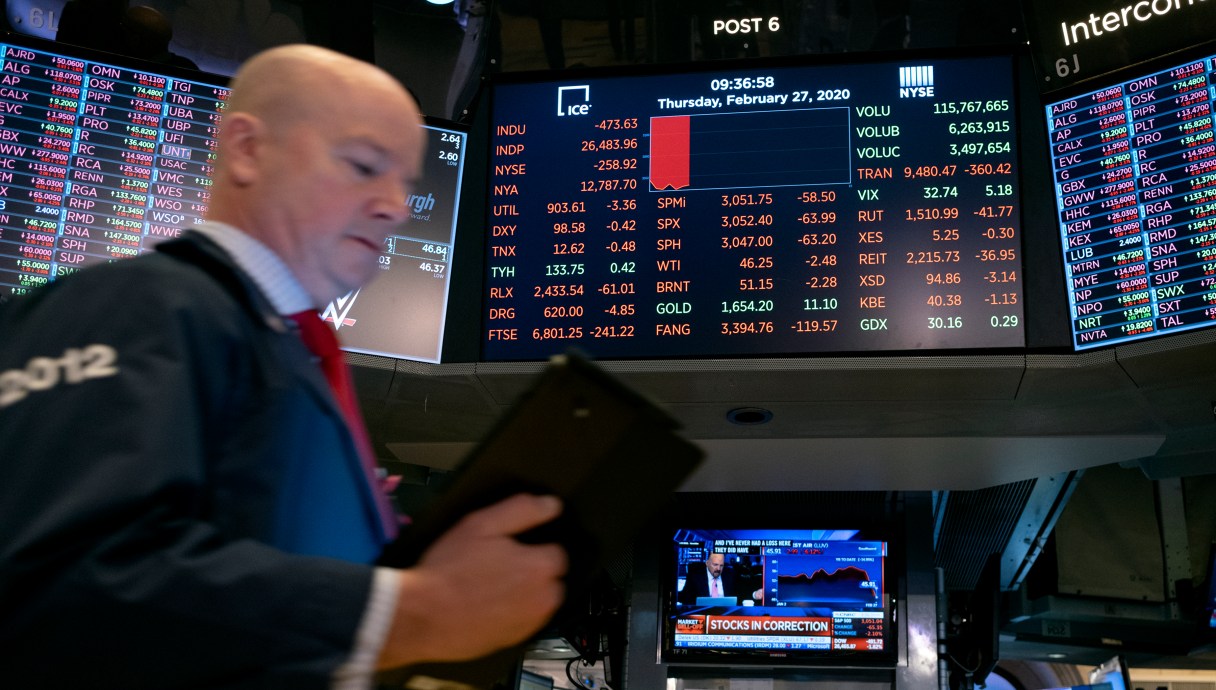
One result of the concerning developments was the steepest decline in the US stock market since the 2008 financial crisis. During such periods of stress, it is helpful to remember that over 75% of all stock transactions are automated computer trades responding to predefined algorithms. Long overdue based on valuations, the correction (defined as a 10% decline) was essentially switched on by the uncertainty of the outbreaks that cannot be modeled or projected. Essentially, HAL 9000 said “I don’t understand, so let’s sell until I do”.
Markets rebounded strongly on Monday in response to expectations that the Federal Reserve and other central banks will act aggressively in response. Lower rates and free money HAL understands: “Buy”. The one-day 5% gain reminds us that individual investors cannot time the market and should follow a steady long-term strategy.
This is especially true given the schizophrenia on display Monday. While the stock market quaffed copious draughts of Fed punch, the bond market pitched a fit, with the U.S. 10-year Treasury yield falling to an all-time, historic low of 1.08% at the close on Monday. The conflict between bond and stock market outlooks reinforces the expectation that more volatility lies ahead. And of course the ultimate containment of the viral outbreak still lies in the future, how distant we do not know.
So given the tremendous uncertainty, what’s a retirement investor to do?
The uninterrupted stock boom could not go on forever. So also the coronavirus scare will eventually end. Since timing is impossible, the next best thing is “untiming:” keep on plowing money into your 401(k). With prices lower, your dollar will but more shares (called “dollar cost averaging”). Looking back five years from now, the odds are you won’t remember the details (quick: when was the Zika virus that shaved 13% off the S&P?).
It’s also a good time to rebalance, if your plan doesn’t do it for you. Take time to reallocate more money from the sectors with gains (like bonds) into the depressed asset classes like stocks.
And then forget it. If something cannot go on forever…
Christopher A. Hopkins, CFA, is a vice president and portfolio manager for Barnett & Co. in Chattanooga