
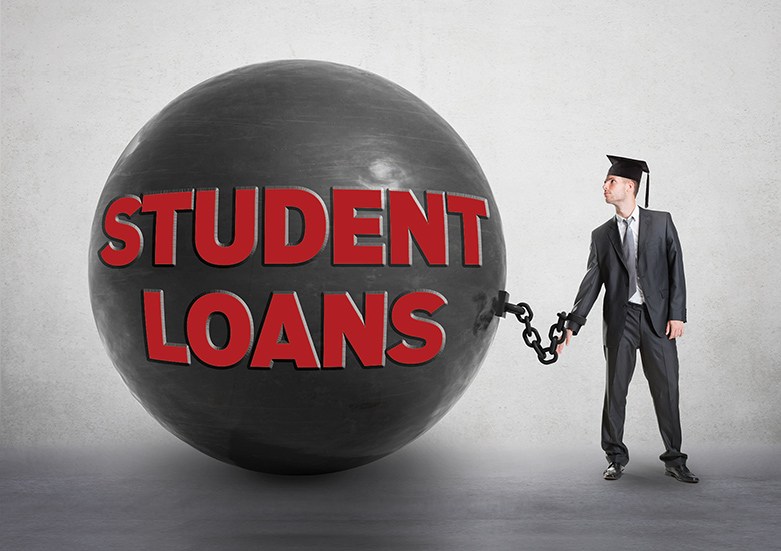
YES: Student debt relief is good politics – and good policy
By Josh Hoxie
Ask any young person, or anyone who knows young people, about student debt and you’re likely to hear some combination of frustration, exasperation and desperation. Every year, the data show the problem getting worse.
Hope for a solution seems fleeting. Or, at least it did.
Sen. Bernie Sanders has taken the idea of forgiving student debt and making college attendance free to the mainstream. Polling from The Hill newspaper shows 58% of Americans now support free public college and canceling student debt.
Young people are caught between the expectation that getting a college education will give them the best chance for prosperity and the fact that the cost of it has been rising rapidly for years.
A 2017 study from the Economic Policy Institute found the earnings gap between college graduates and those who just graduated from high school is at its highest point ever. College graduates, on average, earned 56% more than high school grads in a given year.
No, not everyone needs or wants a degree. There are still jobs that offer good pay and benefits and don’t require one. Yet with the decline of the labor movement, these jobs aren’t as abundant as they used to be. For many, a college degree is increasingly necessary to get ahead.
But that degree comes at an increasingly steep cost. And the wages you make after college may not be enough to keep up.
Millennials are on track to become the first generation in modern American history to make less money than their parents did. Today’s rising generation earns 20% less than their parents did at their age, despite being better educated and more productive. They’re buying houses later and at a lower rate, delaying starting a family longer and saving less for retirement.
Meanwhile, college tuition has risen six times faster than inflation since 1970. Without a significant change to the public policies creating this dynamic, young people – as well as the rest of us – are screwed.
Student debt now tops $1.6 trillion nationally, with the average college graduate leaving school nearly $30,000 in debt. Many leave school with two, three or four times this sum. Many parents and grandparents have taken on comparable burdens co-signing loans in an effort to help their kids.
It’s easy to imagine a young person with a huge student debt who is struggling and often failing to get by turning their frustration inward. Squeezed between low wages, expensive loan payments and high rents, they look in the mirror and see a failure. This could explain why anxiety and depression rates are so high among young people today.
In the wealthiest country in the world, you shouldn’t have to take on tens of thousands of dollars of debt just to start your working life. There’s more than enough wealth in this country to support free or affordable higher education for all – it’s just concentrating into fewer and fewer hands at a dizzying rate.
As a 2018 study I co-authored for the Institute for Policy Studies pointed out, three dynastic wealth families – the Waltons, the Kochs and the Marses – have seen their wealth increase nearly 6,000% since 1982. The median household over the same period saw their wealth go down by 3%.
Investing in debt relief for students would have an enormously beneficial democratizing effect for young people and median earners. It would also be beneficial for the broader society. After all, student debt is different from credit card or auto loan debt.
More education has the added benefits of a better-informed citizenry, a necessity for democracy. And it forms the basis for a more advanced economy able to better address the growing crises of climate change and economic inequality. Debt-financed cars or televisions don’t quite have the same potential for broad social uplift.
And for the families of those going to school, there’s the obvious benefit of a potentially better job.
Resolving the crises of debt and inequality will take a lot more than debt relief for young people. For that reason, younger voters are also gravitating toward “Medicare for All” and job-creating policies like the Green New Deal.
Yet debt relief would make an enormous impact, and much sooner. Let’s unleash the potential of our young people – and of the working people who drive our economy. Forgive student debt.
 Josh Hoxie / Contributed photo
Josh Hoxie is an associate fellow at the Institute for Policy Studies. He wrote this for InsideSources.com.
___
NO: Take a student loan, repay the student loan
By Neal McCluskey
You take a student loan, you repay your student loan. That should be the obvious, baseline understanding of how student lending works. There may be times when that should not apply, but contra presidential candidates Bernie Sanders and Elizabeth Warren, those times should be rare, and dependent on specific circumstances.
Federal loans constituted about 88% of total student loan volume in the 2018-19 school year. Let’s be clear what they do: give taxpayer money to students so the recipients can get a degree and vastly increase their lifetime earnings.
Georgetown University’s Center on Education and the Workforce has estimated that the typical person who ends their formal education with a bachelor’s degree will earn about $1 million more over their lifetime than someone topping out at a high school diploma. That’s a big payoff, and there is no justification for making taxpayers eat associated debt, which for the 69% of 2018 grads with debt was $29,800 on average.
What would wide-scale forgiveness be? Straight up robbing Peter to enrich Paul.
Such forgiveness would not just be morally wrong, it would exacerbate many huge higher education problems, ranging from rampant price inflation – the more money people are able to pay, the more colleges can charge – to the amenities arms race. If students don’t think they would have to repay their debt, why not accept higher student fees for, say, a fancy on-campus water park?
That said, there are two situations in which it may be reasonable to forgive loans, especially if they are private, but possibly even federal: when it is either physically or financially impossible for borrowers to repay.
Physical inability to repay is easy to envision. If someone has an accident and ends up with a disability that makes it impossible to work, or work at the level of remuneration they had reasonably expected, it makes sense to forgive their loans. This applies whether the loans are federal or private – if one is rendered utterly incapable of earning enough to repay, there is nothing reasonably to be done.
What about financial failure? This one is tougher if it does not stem from an act of God. If someone spends on luxuries, or buys too big a house, and renders themselves unable to repay their debts, they can declare bankruptcy, empowering a court to create a repayment plan that can discharge some debt. But they should really remain responsible for what they owe – the situation was of their own making.
In such a situation student loans are harder to discharge than other liabilities such as credit card debt. For student debt, one has to demonstrate that repayment would create an “undue hardship,” which is considered to be a high bar, though it is poorly defined in law.
For federal loans, having a high bar makes sense. Such loans are made with money taken from taxpayers who had no choice in the matter. Making the taxpayers whole should be a top priority.
Private loans are fundamentally different in that the lenders freely choose to do business with students, and stand to reap profits. It is far more reasonable to make those loans dischargeable on terms similar to other debt. Indeed, the more risk a lender bears, the greater their incentive to rigorously assess a potential borrower’s ability to handle college work and get the degree that unlocks big earnings. The benefit will redound to wannabe borrowers, who will get an objective assessment of whether enrolling in college is a good idea. The federal government, in contrast, conducts no such assessment, happily giving out loans to millions of people who do not finish and struggle with debt.
Even with some justification for making private loans more easily discharged in bankruptcy, rules for existing loans should not be changed retroactively. Easier bankruptcy should apply only to loans originated after reforms are passed, so that lenders can adapt their policies and terms.
The norm for student loan repayment should be consistent with basic – and frankly, obvious – fairness: you take out the loan, you repay it. In rare circumstances that may not be possible, and we should consider tweaking such things as bankruptcy laws. But the fact that one should repay one’s debts should not be the least bit controversial.
 Neal McCluskey / Contributed photo
Neal McCluskey is the director of the Cato Institute’s Center for Educational Freedom. He wrote this for InsideSources.com.