
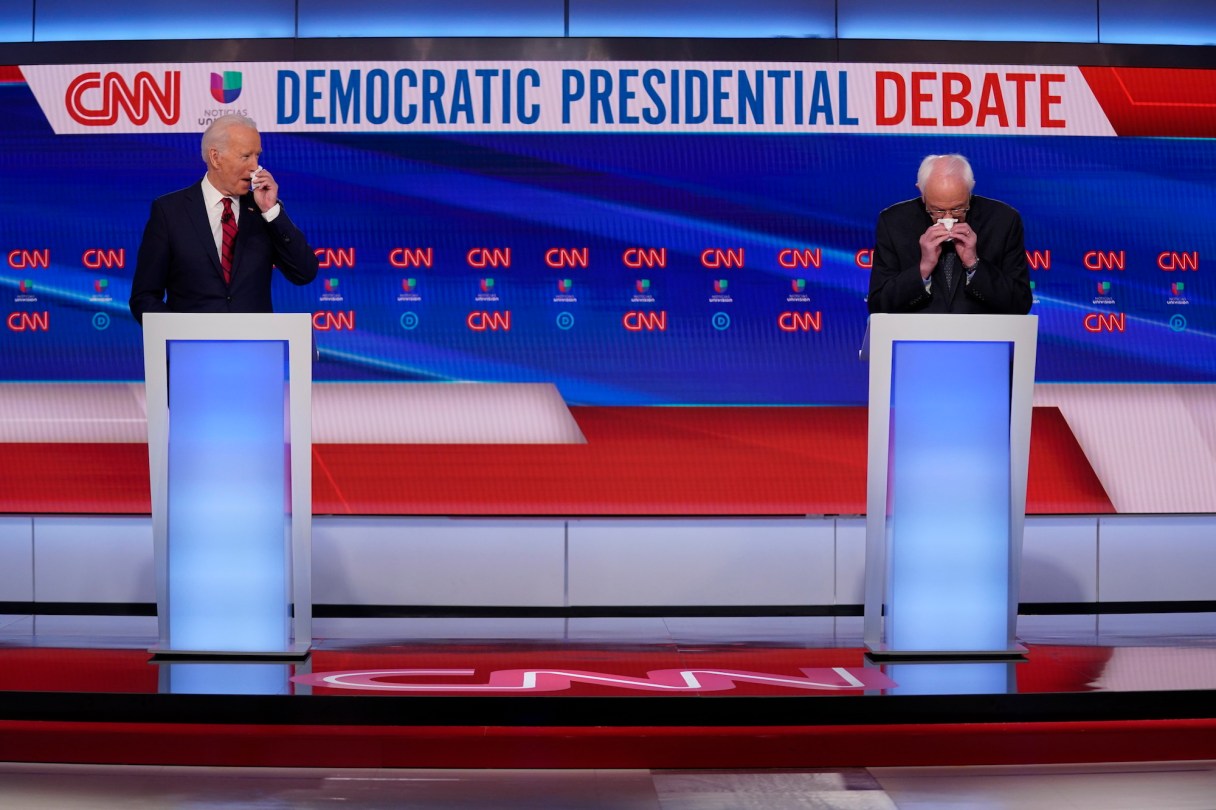
“This is an unprecedented moment in American history,” Bernie Sanders said on Sunday night. It certainly produced an unprecedented debate, the singularity of which was captured in a superficially odd but profound bit of business near the start.
Both Sanders and Joe Biden volunteered proudly that they hadn’t shaken hands. Both sang the praises of soap. And both spoke of hand sanitizer as if it were holy water.
The pandemic caused by the coronavirus changed and governed everything about the evening, in ways overt and oblique. It determined the first question that the two candidates were asked. It informed the last.
Above all, it was the terrifying context in which their inevitable policy disagreements, aspersions on each other’s characters and exhumations of each other’s records took on a wholly different cast. All that stuff was unquestionably important – and yet.
There was a life-threatening, nation-shuttering, wealth-decimating crisis at hand. Did Biden’s decades-old comments about Social Security or onetime support of the Hyde Amendment matter even an eighth as much? Did Sanders’ long-ago votes on gun control or kind words about Fidel Castro?
The two Democrats’ criticisms of each other, which grew heated at times, seemed almost immaterial next to what needed to be said – and sometimes was – about the denier in chief, Donald Trump.
That dynamic favored Biden, for several reasons. He’s now the far-and-away front-runner for the Democratic presidential nomination, with a lead in delegates that Sanders probably can’t overcome, so any sense of urgency for the party to unite in common cause against Trump becomes a summons to send Biden into the general election in the strongest shape imaginable.
Barring some remarkable, unforeseeable development, Sunday night was likely the valediction to Sanders’ bid for the Democratic nomination. That’s not because there was any particular, glaring deficiency in Sanders’ performance.
Sanders projected passion and self-assurance. He defended himself well against Biden’s attacks. And he raised fair, even necessary questions about whether, on issues like climate change, Biden’s proposals were more timid than the stakes demanded.
But there was something strained and strange about Sanders’ repeated pivots from the pandemic to income inequality, from the pandemic to corrupt pharmaceutical executives, from the pandemic to how many millionaires and billionaires have contributed to Biden’s campaign. The world has been transformed; the script remains the same.
To guarantee further that the media wouldn’t fixate on who had got the better of whom, Biden threw in some major news, promising outright that he would pick a woman as his running mate.
There were also bad moments for Biden: selective retellings and lavish sugarcoating of votes and comments he’d made in the past.
He provided a mostly reassuring answer to perhaps the biggest question coming into this debate: With only one opponent sharing two full hours and a whole lot of talking to do, could he communicate his thoughts sharply enough, make his points with sufficient force and keep his sentences from running out of gas on a road to nowhere?
Squaring off against Sanders was a preview of squaring off against Trump.
Sunday night’s debate was a two-person face-off, of the kind bound to occur in a general election. Did the extra time mean added peril? Biden was plenty repetitive and occasionally misspoke, but it was nothing to bolster team Trump’s gross caricature of him as a barely animated corpse.
The two candidates may have stood at a greater distance from each other than they normally would, but somehow they were closer together. Even during the debate’s bitterest exchanges, I never got the sense that either of them was really and truly intent on savaging the other.
You can’t tell Americans to pull together at this frightful juncture if you’re pushing them apart. The Democrats seem to get that. If only the president did, too.
The New York Times