
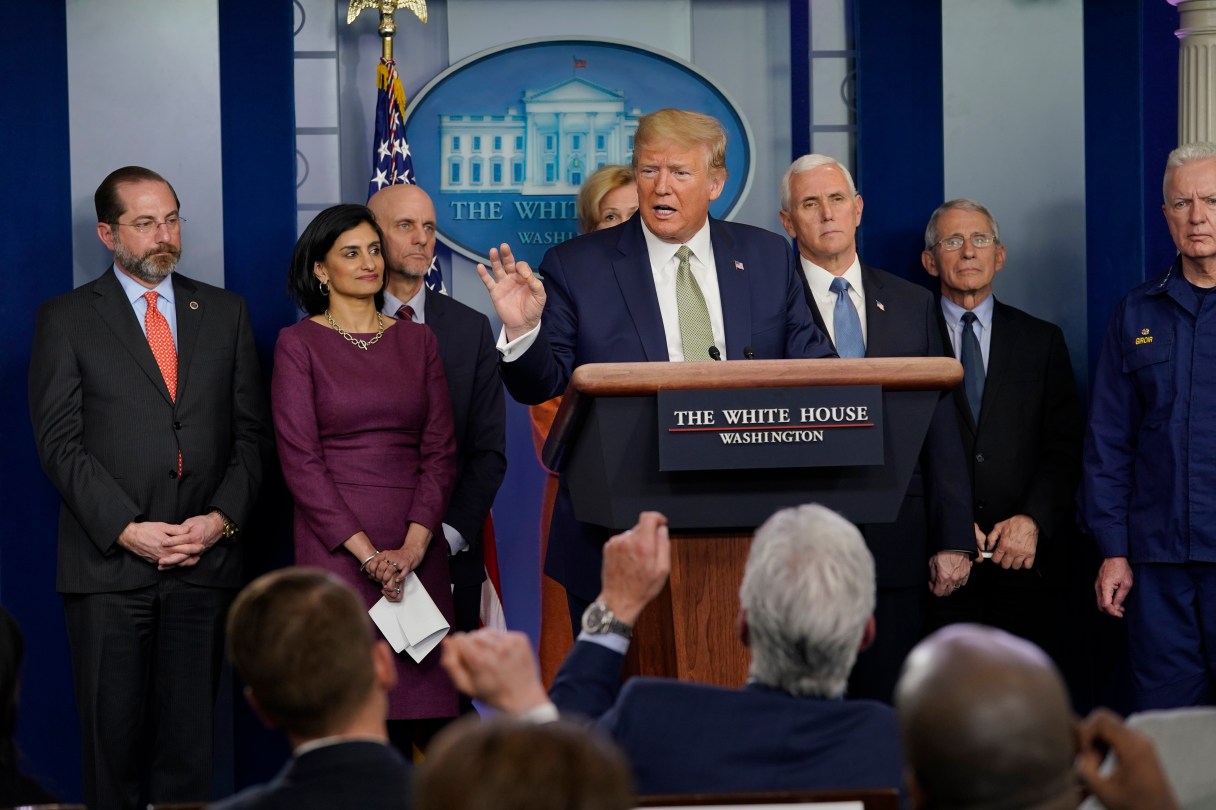
So Donald Trump is now calling COVID-19 the “Chinese virus.” Of course he is: Racism and blaming other people for his own failures are the defining features of his presidency. But if we’re going to give it a nickname, much better to refer to it as the “Trump pandemic.”
True, the virus didn’t originate here. But the U.S. response to the threat has been catastrophically slow and inadequate, and the buck stops with Trump, who minimized the threat and discouraged action until just a few days ago.
Compare, for example, America’s handling of the coronavirus with that of South Korea. Both countries reported their first case on Jan. 20. But Korea moved quickly to implement widespread testing; it has used the data from that testing to guide social distancing and other containment measures; and the disease appears to be on the wane there.
In the U.S., by contrast, testing has barely begun – we’ve tested only 60,000 people compared with South Korea’s 290,000, even though we have six times its population, and the number of cases here appears to be skyrocketing.
The details of our failure are complex, but they all flow ultimately from Trump’s minimization of the threat: He was asserting that COVID-19 was no worse than the flu just last week (although true to form, he’s now claiming to have known all along that a pandemic was coming).
Why did Trump and his team deny and delay? All the evidence suggests that he didn’t want to do or say anything that might drive down stock prices, which he seems to regard as the key measure of his success.
Well, that was a bad bet. Since then, the stock market has more or less given up all its gains under the Trump presidency. More important, the economy is clearly in free-fall. So what should we do now?
I’ll leave health policy to the experts. On economic policy, I’d suggest three principles. First, focus on hardship, not GDP. Second, stop worrying about incentives to work. Third, don’t trust Trump.
On the first point: Many of the job losses we’ll experience over the next few months will be not just unavoidable but actually desirable. We want workers who are or might be sick to stay home, to “flatten the curve” of the virus’ spread. We want to partly or wholly close large business establishments, like auto plants, that could act as human petri dishes. We want to close restaurants, bars and nonessential retail establishments.
Now, there will surely be additional, unnecessary job losses caused by a plunge in consumer and business spending, which is why we should be engaged in substantial overall stimulus.
What policy can do is reduce the hardship facing those who are temporarily out of work. That means that we need to spend much more on programs like paid sick leave, unemployment benefits, food stamps and Medicaid that aid Americans in distress, who need far more help than they’ll get from an across-the-board cash drop.
Which brings me to my second point. The usual suspects are already objecting that helping Americans in need reduces their incentive to work. That’s a lousy argument even in good times, but it’s absurd in the face of a pandemic.
Finally, about Trump: Over the past few days, state TV, I mean Fox News, and right-wing pundits have abruptly pivoted from dismissing COVID-19 as a liberal hoax to demanding an end to all criticism of the president in a time of national emergency.
This is where the history of the Trump pandemic – all those wasted weeks when we did nothing because Donald Trump didn’t want to hear anything that might hurt him politically – becomes relevant. It shows that even when American lives are at risk, this administration’s policy is all about Trump, about what he thinks will make him look good, never mind the national interest.
Dealing with the coronavirus would be hard in the best of circumstances. It will be especially hard when we know that we can’t trust either the judgment or the motives of the man who should be leading the response. But you go into a pandemic with the president you have, not the president you wish you had.
The New York Times