
Monday, November 16, 2026Nov 16

Migrants trying to reach Europe pushed to deadly Atlantic

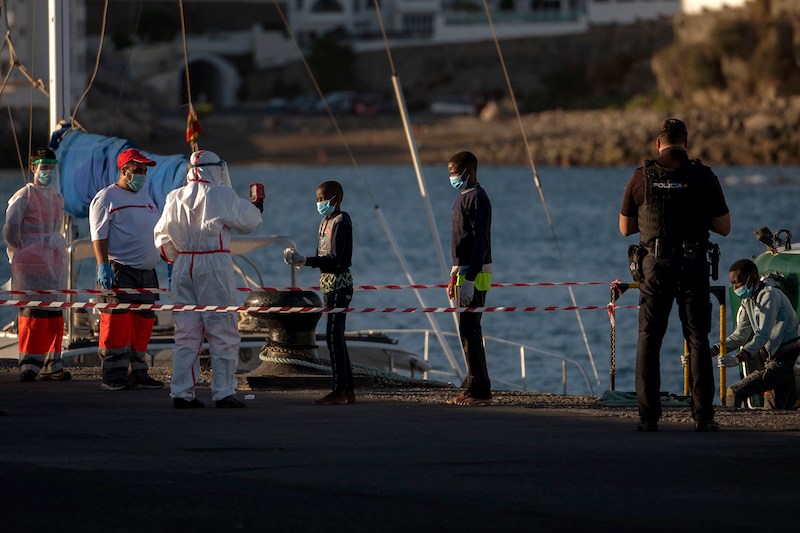
A boy has his temperature taken as he arrives with others migrants at the Arguineguin port in Gran Canaria island, Spain, after being rescued in the Atlantic Ocean by emergency workers on Thursday, Aug. 20, 2020. Migrants and asylum seekers are increasingly crossing a treacherous part of the Atlantic Ocean to reach the Canary Islands, a Spanish archipelago near West Africa, in what has become one of the most dangerous migration routes to European territory. (AP Photo/Emilio Morenatti)

FUERTEVENTURA, Spain (AP) – The only person who wasn’t crying on the boat was 2-year-old Noura.

Noura’s mother, Hawa Diabaté, was fleeing her native Ivory Coast to what she believed was continental Europe. Unlike the 60 adults on board, only Noura was oblivious to the risks of crossing the open waters of the Atlantic Ocean in an overcrowded rubber dinghy.

As the waves quickly got bigger and people more nervous, Noura told her mother, “Be quiet, mama! Boza, mama! Boza!”, Diabaté recalled. The expression is used by sub-Saharan migrants to celebrate a successful crossing.

After several hours in the ocean, it was finally “Boza.” Spain’s Maritime Rescue Service brought them to safety on one of the Canary Islands.

Migrants and asylum-seekers are increasingly crossing a treacherous part of the Atlantic Ocean to reach the Canary Islands, a Spanish archipelago near West Africa, in what has become one of the most dangerous routes to European territory. Noura and her mother are among about 4,000 people to have survived the perilous journey this year.