
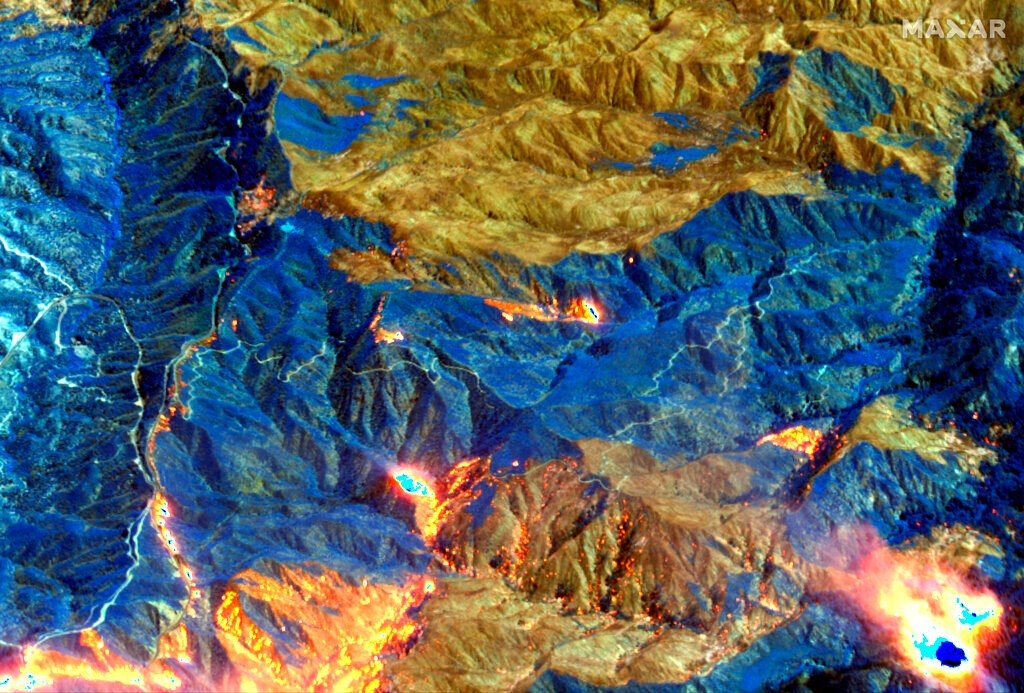
LOS ANGELES (AP) – Federal investigators are looking into whether a huge wildfire near Los Angeles was sparked by Southern California Edison utility equipment, the company said.
Edison has turned over a section of an overhead conductor from the utility’s facility near a dam in the area where the Bobcat Fire started Sept. 6, company spokesman David Song said Wednesday.
In an incident report filed with the state Public Utilities Commission last week, Edison said its equipment experienced an issue near the area where the fire was first reported.
The initial report of fire was near Cogswell Dam at 12:21 p.m. Sept. 6, the utility wrote in its filing.
Five minutes earlier, at 12:16 p.m., a circuit at the substation in the San Gabriel Mountains experienced a “relay operation,” Song said, indicating its equipment detected some kind of disturbance or event on the circuit.
Cameras captured smoke developing in the area around 12:10 p.m., prior to the activity on Edison’s circuit, Song said.
Edison will assist the U.S. Forest Service in its investigation of the fire that has burned more than two dozen homes and other buildings on its way to becoming one of the largest blazes in Los Angeles County history.
THIS IS A BREAKING NEWS UPDATE. AP’s earlier story follows below.
LOS ANGELES (AP) – Firefighters are finally starting to tame an enormous wildfire burning in the mountains northeast of Los Angeles.
Officials are confident that crews will make more progress on the Bobcat Fire after containment on Wednesday hit 38% – a 21% jump from a day earlier – before hot, dry winds return to Southern California in a few days.
Meanwhile, a major fire in the northern part of the state, the CZU Lightning Complex in San Mateo and Santa Cruz counties, was 100% contained, the California Department of Forestry and Fire Protection, or Cal Fire, said Tuesday evening. The fire was ignited during a barrage of lightning on Aug. 16 and the cluster of blazes went on to destroy 925 homes and kill one person.
Firefighters have also controlled several other lightning-sparked wildfires burning for more than a month in Northern California.
Crews battling the Bobcat Fire took advantage of two days of calmer weather after erratic winds last weekend pushed flames out of the Angeles National Forest and into communities in the desert foothills, fire spokesman Larry Smith said Wednesday.
“Because the fire transferred out of the timber and into the light fuels near the desert, we were able to make some real progress,” Smith said. Crews will shore up containment lines ahead of hotter, gusty weather predicted for the weekend, he said.
Thousands of residents remain under evacuation orders and warnings near the fire that’s now one of the largest on record in Los Angeles County. It’s burned for more than two weeks in the San Gabriel Mountains and has destroyed at least 27 homes and other buildings.
It’s one of dozens of other major wildfires raging across the West, including five in California that are among the largest in state history.
Numerous studies in recent years have linked bigger U.S. wildfires to global warming from the burning of coal, oil and gas, especially because climate change has made California much drier. A drier California means plants are more flammable.