
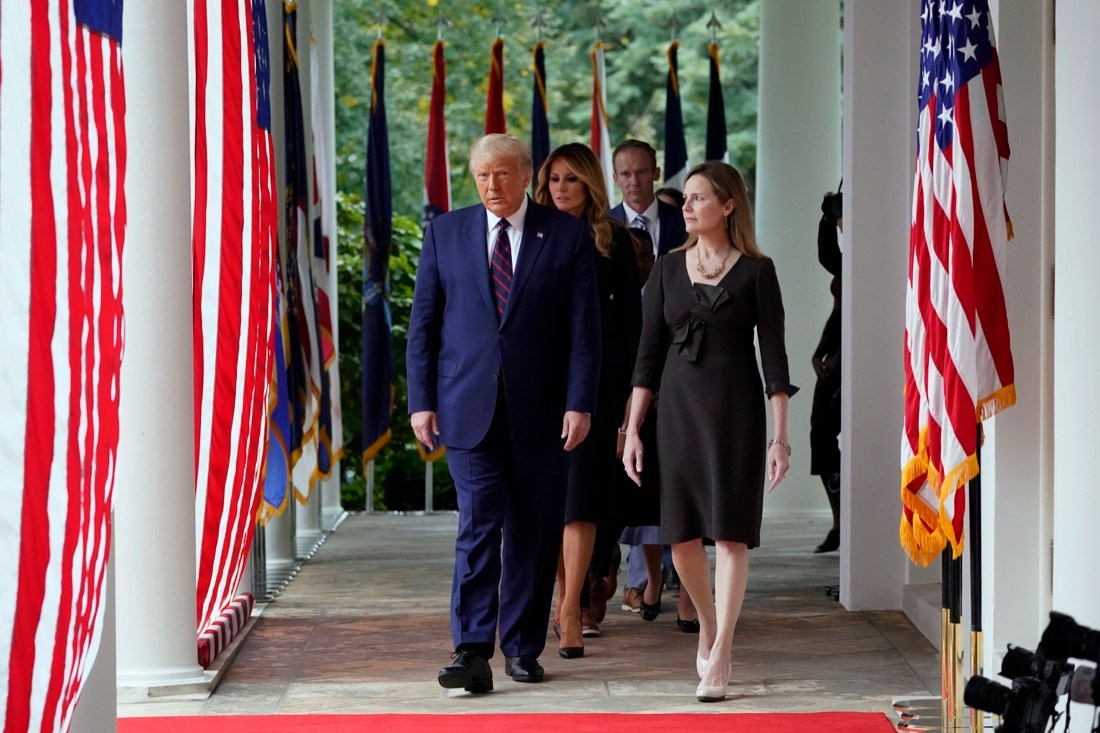
WASHINGTON (AP) – Four years ago, Amy Coney Barrett was a little-known law professor in Indiana. Within weeks, she is likely to be the newest associate justice on the U.S. Supreme Court.
Barrett’s fast-track rise, set to drive the nation’s highest court to the right for a generation or longer, is the fulfillment of a decadeslong effort by conservatives to remake the federal bench that kicked into high gear after President Donald Trump was elected. For Trump, whose 2016 victory was bolstered by white evangelicals’ reluctant support of his candidacy tied to his promise to fill the seat vacated by the death of Supreme Court Justice Antonin Scalia with a conservative, the latest nomination brings his first term full circle.
Even before Ruth Bader Ginsburg’s death, Trump was campaigning for reelection in 2020 on his record of confirming more than 200 federal judges during his first term, fulfilling a generational aim of conservative legal activists.
“Today’s nomination is the capstone of a more than four-year process where the president seized upon the issue, stayed focused, and called attention to a small bench of very talented people who he could put on the Supreme Court,” said Leonard Leo, of the conservative Federalist Society.
The following account is based on information from five people familiar with the process and the president’s thinking who were not authorized to speak publicly about the details.