
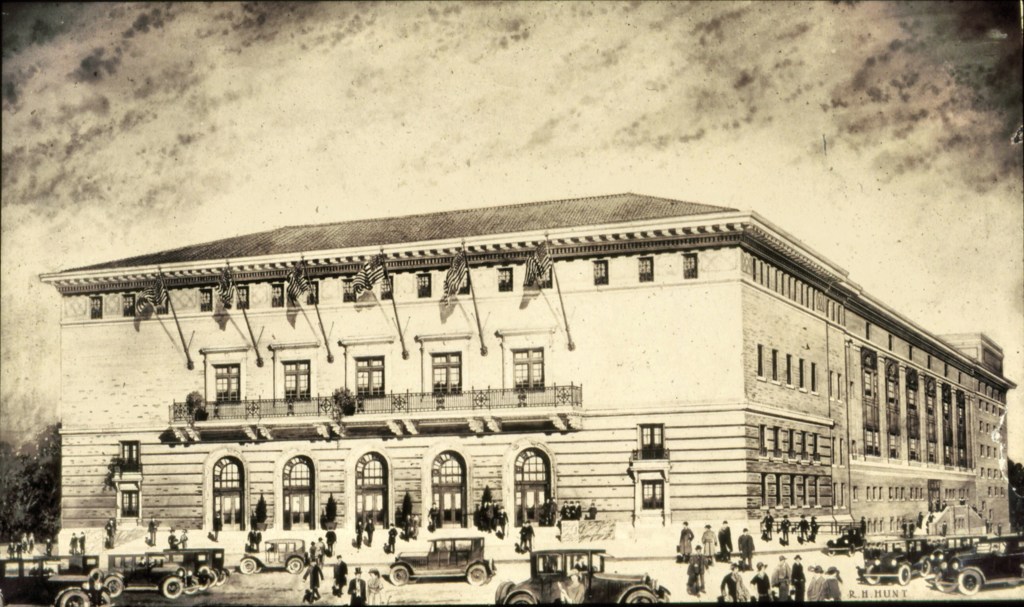
Thousands drive by the building each week, often without realizing that the official name of the building is The Soldiers and Sailors Memorial auditorium, now referred to as Memorial Auditorium.
Dedicated in a two-day ceremony in February 1924, the massive structure was built to commemorate the region’s “sons who offered their lives to the Nation’s service in the great World War.” In the dedication program, a more than 50-page bound volume, the committee explained its decision to build an auditorium. “We erect for posterity, in commemoration of their patriotism, a hall in which mementos of their achievement may rest; an auditorium in which great bodies of our people may assemble for civic service; for the cultivation of the arts; for the promotion of a higher and a broader citizenship. It is fitting that our tribute should take this form.”
The Great War had touched every community in the nation. Family members, searching the newspapers for information about the Allied troops, followed their sons from the Argonne Forest to Chateau Thierry; they read about Germany’s last push, the Great Spring Offensive, and the Allied forces entrenched along the Western front. The horrors of the war were all too present; stories of gas attacks, tanks and needle guns filled the nightmares of those watching from a distance. When an armistice was declared on Nov. 11, 1918, communities struggled to deal with the cost of this first world war and how they might honor the dead who had lost their lives so far from home.
In Chattanooga, the thoughts of constructing some type of a memorial began before the armistice. At a Kiwanis Club meeting at the Patten Hotel on Oct. 9, 1918, Dr. Harold Major, pastor of First Baptist Church and a Kiwanis member, addressed the group and suggested that there should be “a movement toward a memorial of some kind.” Applause rang out in agreement, and a committee was formed to “consider the matter and report its conclusions.” Committee members were D.H. Griswold, chairman, Dr. Harold Majors, and O.P. Darwin, president of the Kiwanis Club.
The Kiwanis committee then chose to invite representatives from every civic body in Chattanooga to attend an organizational meeting at the Chamber of Commerce on Nov. 15, 1918. However, before the city-wide meeting, the Kiwanis Club held its annual luncheon on Nov. 5, and the previously planned program gave way to a vigorous discussion of a “proposed memorial.” Frank E. Mahoney proposed that there should be a “memorial hall,” and the idea was presented at the community meeting 10 days later.