
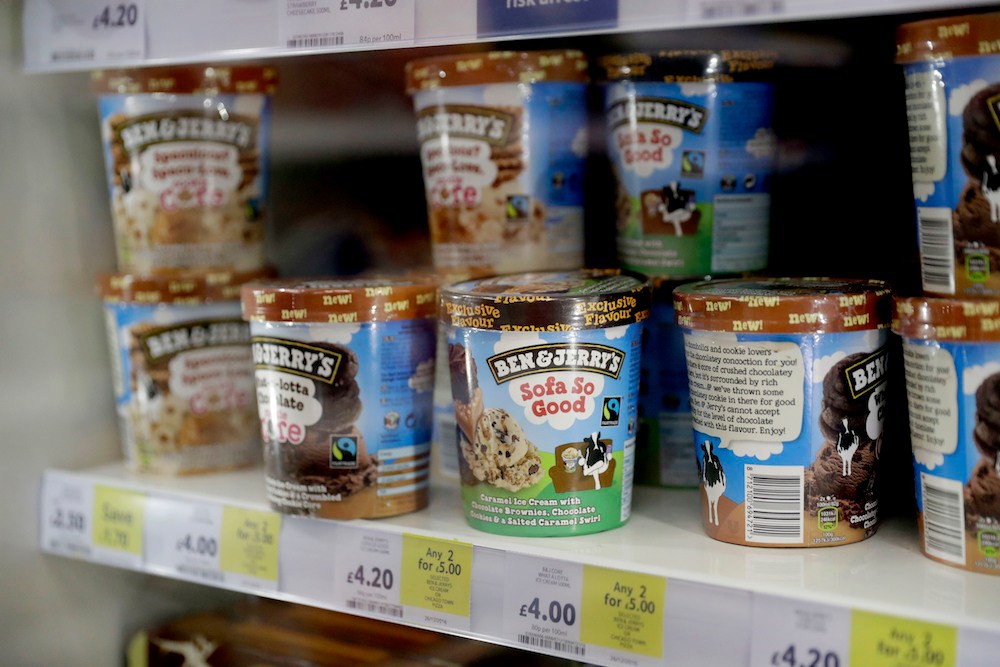
Ben & Jerry’s last month announced to controversy and fanfare that it would no longer sell its ice cream in East Jerusalem and the West Bank, though it says it will continue selling it elsewhere in Israel. “Ending the sales of ice cream in the occupied territories is one of the most important decisions the company has made in its 43-year history,” Bennett Cohen and Jerry Greenfield, the company’s founders and former owners, explained in a guest essay in this newspaper. “It was especially brave.”
To which my reaction, based on 21 years of reporting on the Israeli-Palestinian conflict, was: Who the hell eats Peace Pops in Hebron? And just how big a hit to the global bottom line of Unilever, the consumer-goods giant that is Ben & Jerry’s corporate parent, will be the loss of sales in Jerusalem’s Old City?
We live in the era of “Woke, Inc.,” to borrow the title of Vivek Ramaswamy’s delightful new book on what he calls “corporate America’s social justice scam” – an era in which corporations adopt trendy causes to help shield them from criticism while pumping up their stock prices. There’s Gillette, trying to peddle razors by decrying toxic masculinity. There’s Nike, minting money off Colin Kaepernick’s protests. There’s BP, rebranding itself as “Beyond Petroleum” – and then spilling 200 million gallons of crude into the Gulf of Mexico.
But Cohen and Greenfield are the godfathers of Woke Inc., pioneers of a unique marketing magic that seeks to get people to believe that buying a high-fat, high-sugar product that contributes to diabetes and obesity also makes us more virtuous. I don’t want to overstate things here, since I’m as guilty as the next guy of scarfing down a half pint of New York Super Fudge Chunk. But at least I don’t pretend that I’m making the world a better place in the bargain.
It’s admirable that people who own companies should put their money where their mouths are – donating to causes they admire and doing business in keeping with their ethics, at the risk of public blowback.
As for consumers: If you don’t like it, don’t buy it.
Cohen and Greenfield sold their company to Unilever in 2000 for $326 million in cash, while negotiating an agreement that protected and funded the company’s social activism. Good for them. Now they are trumpeting their values while other people’s money and reputations are on the line. It’s a remarkably cheap sort of virtue.
The effect of the boycott on Ben & Jerry’s profits is likely to be trivial, since the Israeli market, with or without the West Bank, is minuscule. But Unilever finds itself facing the prospect of legal action, not to mention much closer scrutiny of the unsavory places and ways it has done business, like on a Kenyan tea plantation.
The decision also called attention to the fact, unmentioned by Cohen and Greenfield, that the supposedly independent Ben & Jerry’s board that exists to handle its social mission was in no hurry to bless Unilever’s pledge to keep doing business in Israel.
On the contrary: The Ben & Jerry’s board chair, Anuradha Mittal, is publicly furious with Unilever. NBC News reported that her board tried to put out a different statement “that made no reference to continued sales in Israel,” but that “Unilever released the statement against the wishes of the board.”
As for Unilever, it will be hard-pressed to honor its promise to stay in Israel while keeping out of the West Bank, since Israeli law forbids companies from operating that way.
So much for Cohen and Greenfield bravely honoring the principle to distinguish between the West Bank and Israel. What we really have is a feckless political gesture, a corporate fiasco, a de facto boycott of the Jewish state, an enraged Israeli government, and a handful of customers who won’t get their Chunky Monkey cravings satisfied. Just how any of this translates into peace or justice, much less ending “the occupation,” is anyone’s guess.
To have to write a whole column about the Ben & Jerry’s founders’ personal political views shouldn’t be necessary. Too bad their sanctimonious, inept, and dishonest attempt at foreign policy makes it so.
The New York Times