
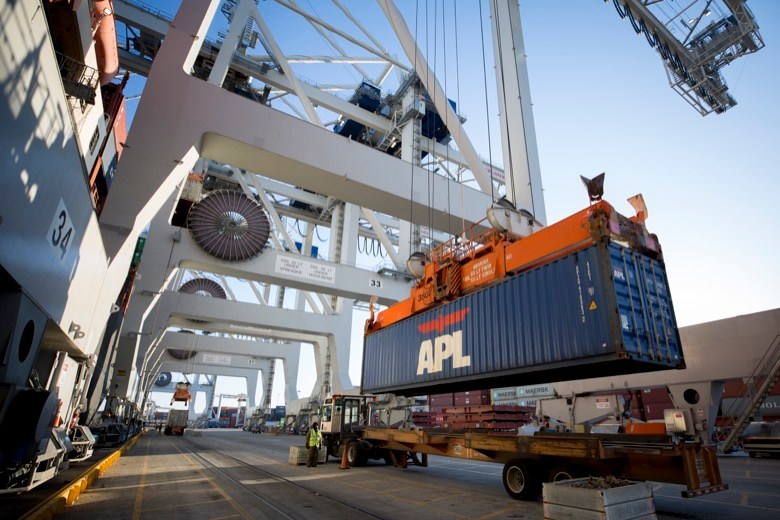
Christmas is coming, and while the geese may be getting fat, retailers are increasingly worried that shelves will look a bit thin due to the unprecedented containership backup at American ports. Images of vessels queueing up outside U.S. ports are just the most visible sign of a vast and complex infrastructure that is jammed up from stem to stern. And unfortunately for Santa, the clogs are not likely to clear much before his midnight run.
The initial response to the COVID-19 outbreak was a sharp curtailment of global shipping. But the startling recovery in consumer demand and the dramatic shift to online shopping have strained the global shipping industry’s capacity to ramp back up to full capacity. The congestion at marine terminals is partly a function of a sharp spike in imports but is also the consequence of logistical bottlenecks farther down an interconnected supply chain that is stressed at every level.
As of Friday, 40 loaded containerships were anchored in San Pedro Bay awaiting a berth at the ports of Los Angeles and Long Beach, tying a record set in February. In a more typical year, there might be one or two. Transit and unloading times between China and the US West Coast have doubled, and freight rates have quadrupled just since the first of the year.
The backup at the ports is not due to a lack of labor. The big problem is that there are so many containers trapped inside the terminal that there is no room to unload another ship. The amount of time a cargo box sits around until it leaves the port, known as “terminal dwell time,” is currently at a record five days, more than twice the typical dwell time.
But the port backups are symptomatic of greater stresses elsewhere in the supply chain. Economist John Martin, Ph.D. of Martin Associates says that the proximate cause is a breakdown of logistical facilities and equipment “outside the gates” of the terminal. In a study conducted for the Pacific Maritime Association, Martin found that much of the terminal congestion stems from inland sources including jammed warehouses, overburdened railroads, shortages of drivers, and misallocation of containers and truck chassis. These downstream choke points are backing up the pipes to the terminal and must be cleared before the ports can regain normal efficiency.