
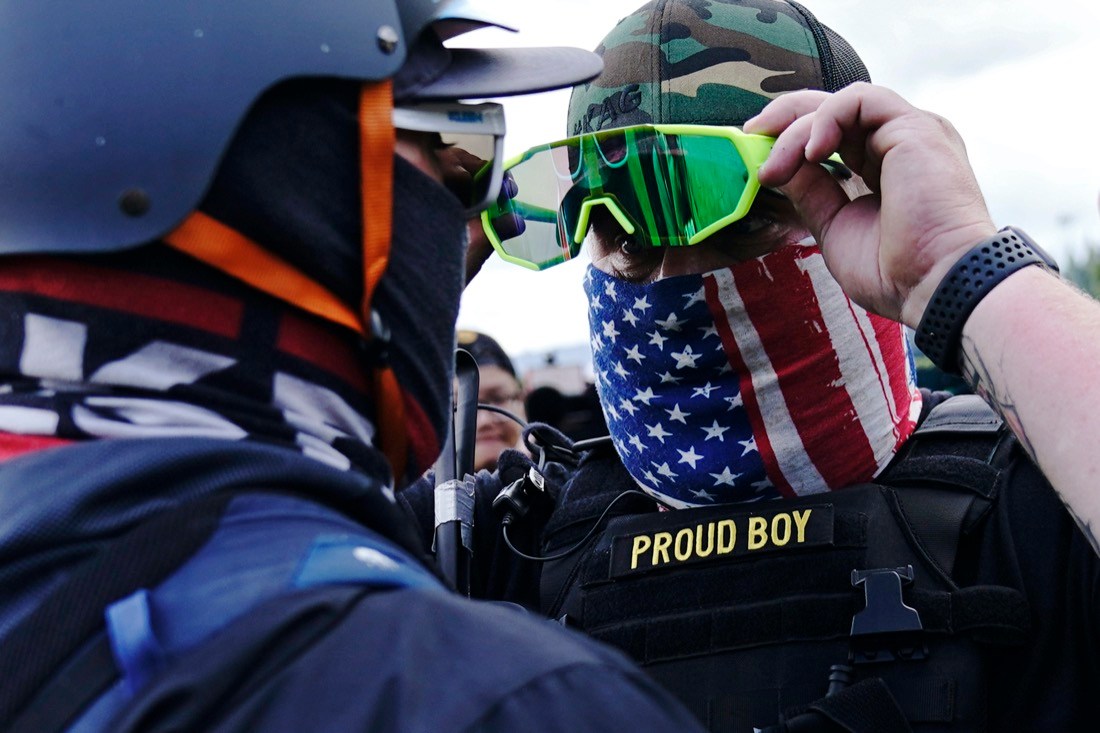
During one of the most politically divisive years in recent memory, the number of active hate groups in the U.S. actually declined as far-right extremists migrated further to online networks, reflecting a splintering of white nationalist and neo-Nazi groups that are more difficult to track.
In its annual report, to be released Monday, the Southern Poverty Law Center said it identified 838 active hate groups operating across the U.S. in 2020. That’s a decrease from the 940 documented in 2019 and the record-high of 1,020 in 2018, said the law center, which tracks racism, xenophobia and anti-government militias.
“It is important to understand that the number of hate groups is merely one metric for measuring the level of hate and racism in America, and that the decline in groups should not be interpreted as a reduction in bigoted beliefs and actions motivated by hate,” said the report, first shared exclusively with The Associated Press.
The Montgomery, Alabama-based law center said many hate groups have moved to social media platforms and use of encrypted apps, while others have been banned altogether from mainstream social media networks.
Still, the law center said, online platforms allow individuals to interact with hate and anti-government groups without becoming members, maintain connections with likeminded people, and take part in real-world actions, such as last month’s siege on the U.S. Capitol.