
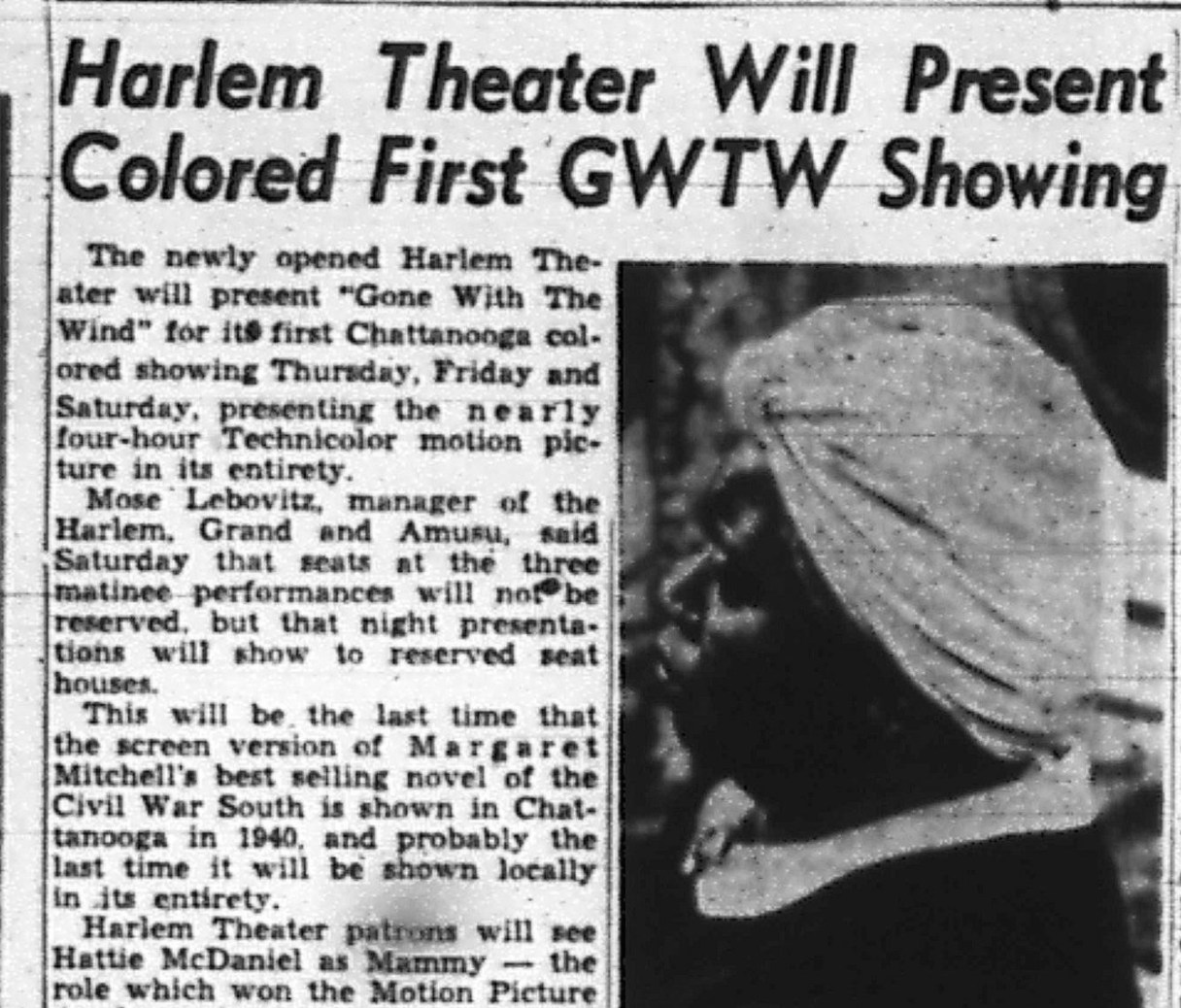
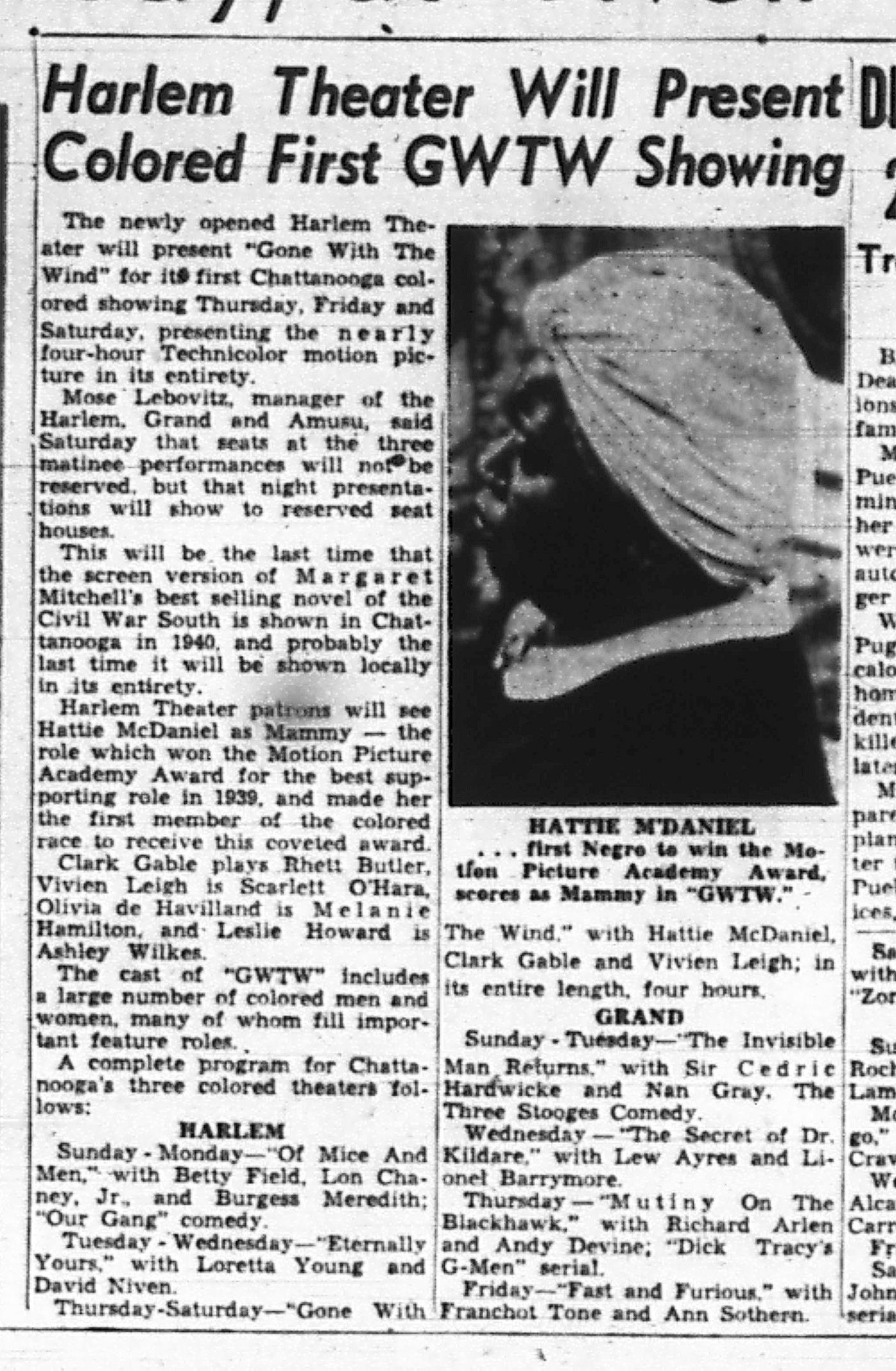
 Photo courtesy of The Chattanooga Public Library / In 1940, the Chattanooga News-Free Press ran an article about “Gone with the Wind” showing at the Harlem theater at 220 W. 9th St.
Since the Theato opened at 702 Market St. in 1906, Chattanoogans have had many theaters in which to watch movies. Depending on the year, 9 cents, 25 cents or slightly more could get you into a movie, perhaps two movies and a cartoon, newsreel and serial. You might even have a little extra for popcorn or candy.
By 1920, Chattanooga had 18 movie theaters, many on Market Street and Main Street. Chattanooga also had segregation, and Black movie fans did not have the freedom to enjoy the cinema as did their white counterparts. When able to attend, Blacks had to sit in the back of the theater or in the balcony. Should they want to sit anywhere in the theater, they had to visit one of those designated as “colored.”
The 1940s had four thriving segregated theaters: the Amusu at 106 W. Main, the Liberty Theater at 312 E. 9th St., the Grand at 201 E. 9th St., and the Harlem or New Harlem at 220 W. 9th St. The Harlem opened in 1940, promising to be the leading “colored” theater in the entire South. Its policy, according to the News-Free Press on July 10, 1940, was “if it’s a big production, the Harlem will bring it to you at popular prices.”
The theater had the latest in air conditioning, comfort and “eye-soothing” projection equipment. The Liberty opened in July 1942, also promising to be the “South’s finest theatre for colored people.” The Amusu and the Grand had been around since the 1920s, the Grand being one of “Chattanooga’s oldest motion picture houses.” The Grand Amusement Company managed all four theaters, with Mose Lebovitz as president and Abe Solomon as vice-president. In 1958, the Grand suffered a terrible fire which killed the janitor, Joe Shelton, and led to the demise of the building. The Amusu building was vacant; the Harlem Theater building had been torn down. By 1960, the only segregated theater in the city directory was the Liberty, and by 1970, it, too, was gone.
The segregated movie houses showed the same films as the others but with a few differences. Blockbuster movies often came to the “colored” theaters after their first showing. Movie advertisements in the newspaper were different. The local newspapers carried no theater ads for the Harlem, Liberty, Amusu or Grand. The News-Free Press printed the movie schedule for “colored” theaters but not any ads like those for the Tivoli or Rialto. When “Gone with the Wind” came to the Harlem in July 1940, the News-Free Press printed an article on the movie’s first run at a “colored” theater. Instead of featuring Clark Gable or Vivian Leigh, the newspaper story highlighted Hattie McDaniel and the large number of “colored” men and women in the cast who filled many important roles.