
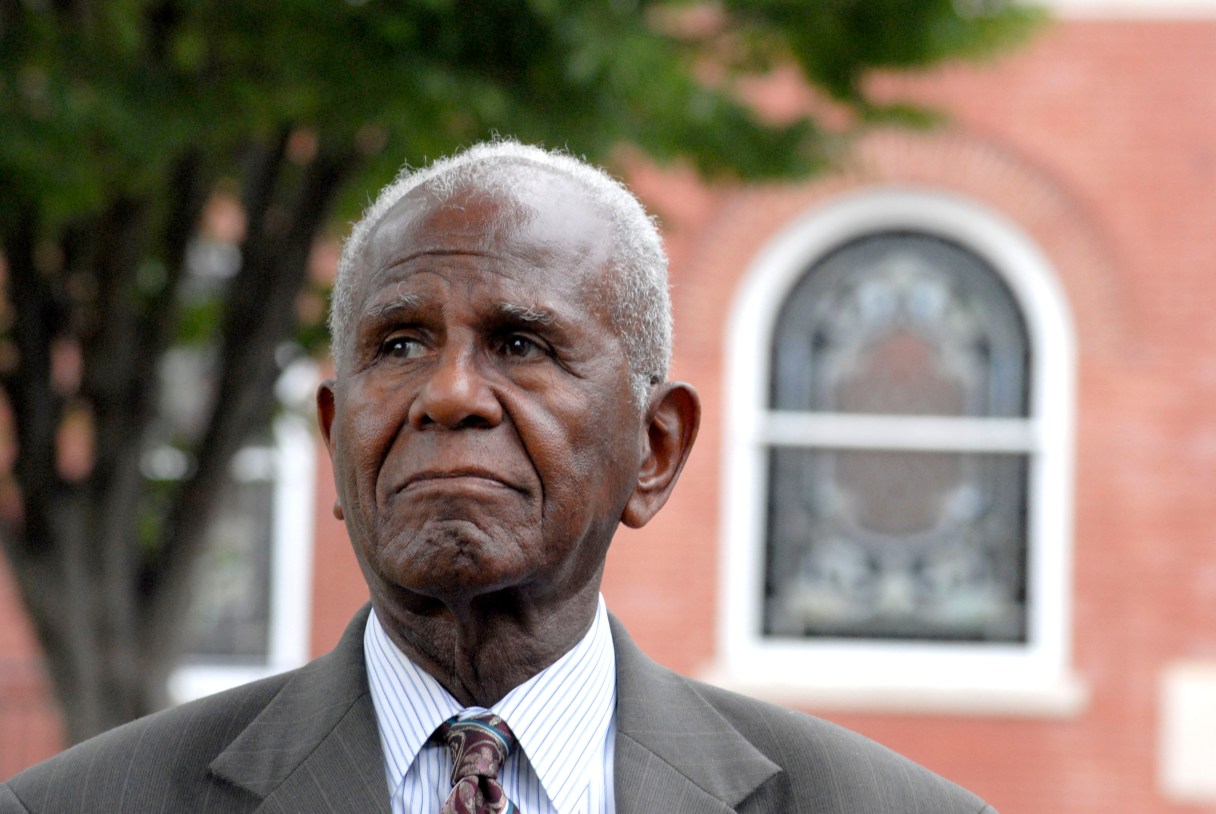

Fifty years ago this week, educator and funeral director John Franklin earned a spot in the runoff election for the position of commissioner of education and health in Chattanooga’s then mayor-commission form of government.
A month later, he would win the runoff against the incumbent, S. Dean Peterson, who also had been the city’s acting mayor.
The election was significant because Franklin became the first Black candidate to win a spot in city government in post-Jim Crow Chattanooga.
It also proved a Black candidate could win a majority of votes in the city, where only 35.8% of the population was Black, according to the 1970 census.
But not just any candidate might have had the same fate. He was the right man at the right time.
Franklin said of himself he was in no sense an “agitator,” an “activist” or a “militant.”
At issue in the race – though it was actually out of local hands with a decision pending in federal courts – was how integrated local schools would be.
Franklin, principal at Alton Park Junior High, had allowed as to how he’d like to see more white students attend almost all-Black Howard and Riverside high schools and more Blacks attend almost all-white Brainerd and City high schools.
However, he said he did not favor busing to achieve a racial balance, which was at the crux of the suit in federal court.
Peterson, his opponent, preferred to leave things the way they were.
The commissioner of education at the time also was chairman of the city school board, which was in effect run by the superintendent, and ostensibly was the head of the city health department, which was in effect run by its administrator.
The officeholder, wrote J.B. Collins, urban affairs editor for the Chattanooga Free Press, was “virtually an administrator without a department,” though with other commissioners he also was “co-responsible for all operations of city government.”
But Franklin had thoughts about the position and about city government that were amazingly prescient.
* He, for instance, favored election of the then-appointed school board from districts to assure better representation. Ironically, some of the same people who supported his election would sue him and other commissioners more than 15 years later to force a form of government that had better representation.
That form of government, adopted in 1989, called for a mayor elected citywide and nine council positions elected by district. The districts were drawn to assure Black representation in three of the districts; a fourth would be a “swing” district.
The then-city school board would be elected in the same districts, but that changed when the city and county schools merged in 1997.
* Franklin also saw the need, which has become critical in the last 10 years, for students to have post-secondary training of some type in order to take family-wage jobs in an ever more technological job market.
“Today’s accelerating and changing technology coupled with the explosion of knowledge [make] it imperative that most people at all levels of employment seek some form of continued training or retraining in order to maintain the competencies required in our rapidly changing labor market,” he said during the runoff campaign. “New and progressive occupations give rise to the need for workers with greater diversity and complexity of skills.”
* Franklin also favored public kindergarten, which was not compulsory at the time. Peterson said he believed generally in kindergarten programs but not that children be forced to go. The state adopted such a program within two years of Franklin’s election.
* Franklin, though speaking in an era of “white flight” from rapidly integrating schools, also foresaw the need to “somehow sponsor a return of whites to the core city.” It wouldn’t begin to happen here for two decades or more, but he noted at the time it was being encouraged by mayors around the country, “lest their cities die.”
Chattanooga, he noted, had lost 10,000 people from 1960 to 1970, according to the 1970 census.
Franklin went on to be re-elected in 1975, 1979, 1983 and 1987 but chose to retire and not vie for a seat on the new government in the 1990 election.
The educator/businessman/commissioner died in 2018, but in this era of ideological purity and tribalism his voice might not be as welcome as it was then.
We leave you with part of his campaign introduction, the tenor of which is needed today but the words of which now seem like part of a bygone era: “If elected,” he said, “I intend for my voice to be heard in a positive, objective, Christian-like way . I can’t even qualify as a novice politician, but I assure you that what I lack in this regard, I shall try to compensate for through my sincere commitment to the highest ideals of the human race toward the establishment of pride in our city based on fairness in a concerted, communitywide involvement.”