

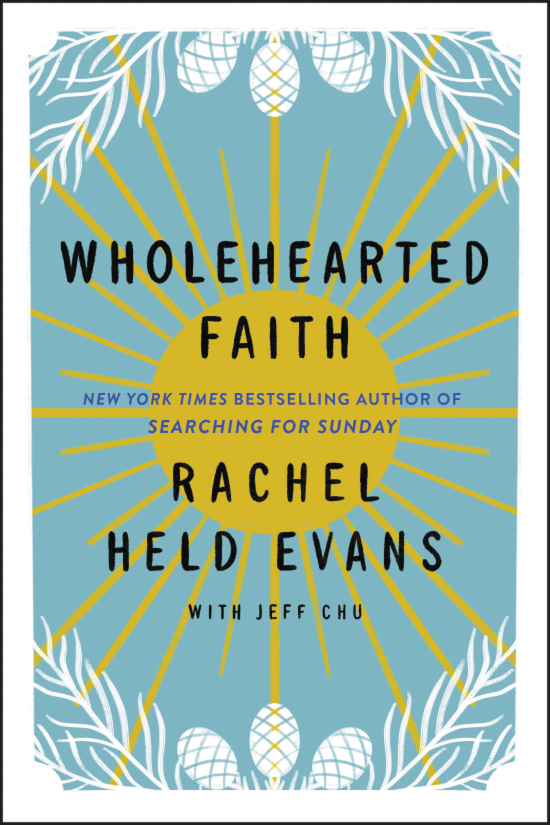
“WHOLEHEARTED FAITH” by Rachel Held Evans with Jeff Chu (HarperOne, 224 pages, $27).
In a posthumous collection of essays, best-selling author and self-described “religious overachiever” Rachel Held Evans describes a way of pursuing God that embraces uncertainty, vulnerability and compassion. Evans’ friend, author Jeff Chu, has revised her unfinished manuscript and compiled other unpublished essays to create “Wholehearted Faith,” the final book from this beloved writer and activist who died of influenza-related complications at age 37 in 2019.
Evans – who grew up in Dayton, Tennessee, site of the infamous 1925 Scopes Trial – championed other Christians wrestling with the line between orthodoxy and heresy and spoke her truth within a movement of post-evangelicalism. She was able to capture the attention of evangelicals and progressives because of her ability to bridge the rhetorical divide between them. In her previous books, including “Evolving in Monkey Town,” “A Year of Biblical Womanhood” and “Inspired,” she traced her evolution from fundamentalist to feminist. In “Wholehearted Faith,” she explores a theology that is unafraid to reach across differences of race, religion and science.




Evans called herself a “memoirist,” although it’s hard not to mourn the loss of the preacher she could have been if raised in a tradition that ordained women. In these essays, she delivers biographical details with discernment, choosing instead to discuss theological ideas over personal events. She recounts familiar anecdotes with her signature humor: her childhood wish to be rewarded with “The Best Christian Attitude,” her adolescence as a “Jesus freak,” her obsession with strong women in the Bible and her addiction to winning Twitter arguments against conservative men. The Christian beliefs she addresses are framed by evangelical paradigms about the centrality of the Bible and the necessity for believers’ testimony of their personal relationship with Jesus. The re-engagement of these apologetics can at times limit the expansive spiritual view she pushes toward. However, the voices she pulls in to reframe her faith are revolutionary in the context of these Christian conservative doctrines and practices.
To broaden her understanding of God’s grace, she consults Black Liberation and Womanist theologies, Jewish midrash and the social-science research of Brené Brown and Jonathan Haidt. It is from Brown’s concept of wholehearted living that Evans coins her concept of wholehearted faith, which she describes as follows: