
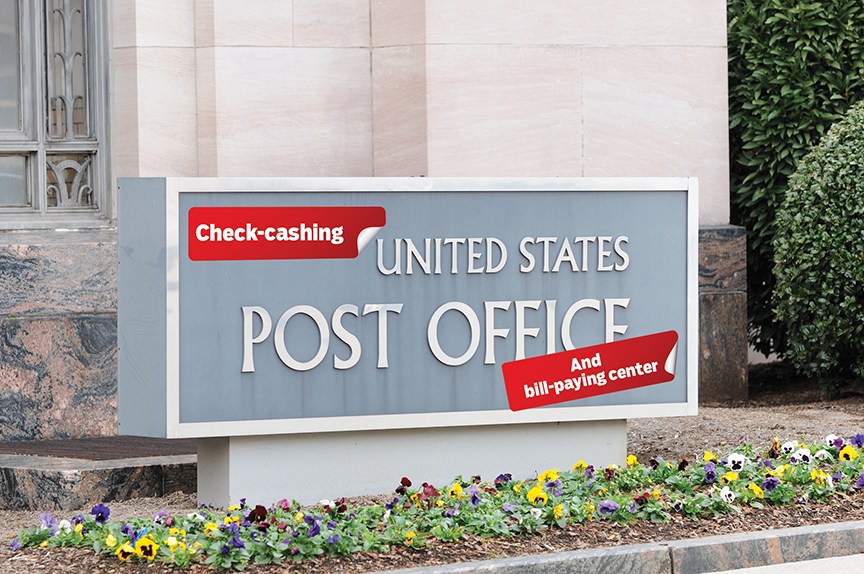
YES: Affordable financial services would be accessible in every community at local post offices
By Nicole Ndumele
The U.S. Postal Service recently launched a postal banking pilot program that allows customers to cash payroll and business checks up to $500 in four cities: Washington, Baltimore, the Bronx and Falls Church, Virginia. This modest pilot is the foundation for more expansive contemplated postal banking services that could include bill-paying services, ATM access, and money order and wire transfer capabilities, all of which would provide critical financial services for millions of people shut out of the banking services that foster economic security and wellbeing for many Americans.
Local bank branches are shuttering in communities all across our country, and mainstream banks are failing to offer financial services that meet the needs of many communities, particularly low-income, rural, and Black and Latino communities. As a result, too many people are forced to turn to exploitative payday lending services that charge exorbitant fees and interest rates for the most basic financial services, including cashing a paycheck.
Robust postal banking, which should ultimately include checking and savings accounts as well as loan options, could step into the breach and provide equitable, accessible and affordable financial services to people who lack access to traditional bank services and would otherwise have to turn to high-cost and low-value fringe financial institutions.
An alarmingly high number of Americans – more than 60 million people – are either “unbanked” (meaning lacking a checking or savings account) or “underbanked” (meaning using products and services outside of mainstream banks like check cashing stores and payday lenders). The one in five Americans who are underbanked are least able to afford fees for financial services, yet pay the highest costs to access their money.
People of color are disproportionately underbanked. The reasons are complex, ranging from inaccessible bank branches, and onerous bank account requirements, to credit issues, and discrimination by and mistrust of mainstream banks.
A recent trend has made banking even less accessible: For at least a decade, banks have been systematically closing bank branches, including a record 3,324 branches nationwide in 2020 alone. These bank closures create “banking deserts” in many low-income, Black and rural communities. More than 90 percent of the bank branches closed since 2008 were located in communities with household incomes below the national median. Rural communities are particularly vulnerable to banking deserts, and majority-Black communities have lost more bank branches than all other communities, including lower-income non-majority Black communities.
Postal banking provides an economic lifeline to countless Americans living in banking deserts. The Postal Service’s 34,000 facilities service every ZIP code in the country. More than two-thirds of the census tracts that have a post office do not have a bank branch.
Postal banking also provides transparent and equitable services and costs. Traditional bank fees and requirements – such as minimum balance requirements, activity fees and overdraft charges – exclude low-income and small-balance customers. These hefty fees and requirements are compounded by racialized checking account costs and fees that are $190.09 higher for Blacks, $262.09 higher for Latinos, and $25.53 higher for Asian-Americans than for whites for entry-level checking accounts. Worse still is exploitation by payday lenders charging steep fees for check cashing services and interest rates as high as 589% for payday loans. In contrast, the postal banking pilot allows customers to cash checks up to $500 at a set price of $5.95.
The Postal Service is uniquely situated to provide accessible and affordable financial services to every family and community in America. Postal banking provides a viable and equitable path forward for American families who have been left out or left behind by our banking institutions and forced to rely on often unscrupulous payday lenders that frequently trap those who can least afford it into a cycle of debt. Postal banking is a key pathway from poverty to economic mobility for millions of Americans and also produces significant revenue and opportunities for the Postal Service to flourish and expand its business model.
 Nicole Ndumele / InsideSources.com (TNS)
Nicole Ndumele is the senior vice president for Rights and Justice at the Center for American Progress. She wrote this for InsideSources.com.
Tribune Content Agency
NO: USPS should continue to focus on its core mission – timely mail delivery
By Paul Steidler
On Oct. 4, three days after the Postal Service implemented degraded standards for first-class mail, ensuring delivery will be slower than in the 1970s, it announced it was getting into a new business: check cashing. The experimental service is taking place in four cities: Washington, Baltimore, the Bronx and Falls Church, Virginia.
The Postal Service has $188 billion in unpaid debts and long-term liabilities, chronic annual losses of $9 billion, and has defaulted on more than $45 billion in retiree health care and pension contributions since 2011. Yet, it is flirting with diving into – yes, wait for it – banking.
America’s leading progressives – Sens. Bernie Sanders and Kirsten Gillibrand, along with Rep. Alexandria Ocasio-Cortez – are pushing quite hard for postal banking. Through the country’s more than 34,000 post offices, they want to provide sprawling new government programs.
The central argument for postal banking is that millions of Americans are unbanked and exploited by payday loan companies and related enterprises that charge onerous fees for check cashing and other services. Unbanked means not having a checking or savings account at a bank or credit union.
While any exploitation of the poor is despicable, the numbers simply do not show that being unbanked is a widespread crisis, or that having USPS enter this business is the best way to solve the underlying problem.
A 2020 report by the Federal Deposit Insurance Corporation found that 5.4% of U.S. households (about 7.1 million households) were unbanked. This is the lowest level since these studies began, with the rate down significantly from 8.2% in 2011.
The FDIC study found that 56.2% of the unbanked were not at all interested in having a banking account, while only 24.8% were very or somewhat interested in having a bank account.
And the unbanked do have cost-attractive options. For example, Walmart charges a maximum fee of $4 for checks up to $1,000, with funds put on a card, and up to three checks a day cashed. Under USPS’s pilot program, it charges $5.95 to cash checks up to only $500 and puts the funds on a card.
The mission and purpose of USPS for the last 245 years has been to deliver mail. It is the only entity that can do this essential public service. Even in the internet age, mail remains important, with 50 billion pieces of first-class mail sent annually. Yet the delivery standard for 39% of first-class mail was lengthened by at least a day, starting Oct. 1.
A critical lesson from USPS over the last 15 years is that when it gets away from its unique public and historical duty, mail delivery suffers. This is borne out by USPS’s intense focus on increasing package delivery over the last 15 years, a competitive product for which customers have many alternatives.
Today packages account for just 6% of total volume, yet the focus on growing this enterprise has caused mail standards to be reduced twice since 2014 and contributed to USPS’s financial difficulties.
Postal banking is much farther afield from USPS’s core mission of logistics management and mail delivery.
There will soon be aggressive pushes to have USPS open savings accounts. Not far behind will be demands for low-interest credit cards, mortgages and auto loans. The aim of progressives is to make USPS a mammoth government lender and to change banking as we know it.
This raises many questions. Is USPS going to offer Venmo-type payment options? Accept Bitcoin for payment? How much depositor and customer data could be stolen by hackers?
Banking technology is changing rapidly and critical to bank service today. USPS does not have the funds to scale up into a widespread banking enterprise. And taxpayers should not foot the bill for this experiment or be the backstop for USPS’s financial services losses.
A 2018 Treasury Department task force report on USPS got it right when it said, “Given the USPS’s narrow expertise and capital limitation, expanding into sectors where the USPS does not have a comparative advantage or where balance sheet risk might arise, such as postal banking, should not be pursued.”
USPS is faltering at its critical mission: timely mail delivery. Postal banking distracts from that mission and will create even more staggering financial losses at USPS, while doing little if any good.
 Paul Steidler
 is a senior fellow with the Lexington Institute, a public policy think tank in Arlington, Virginia. He wrote this for InsideSources.com.
Tribune Content Agency