
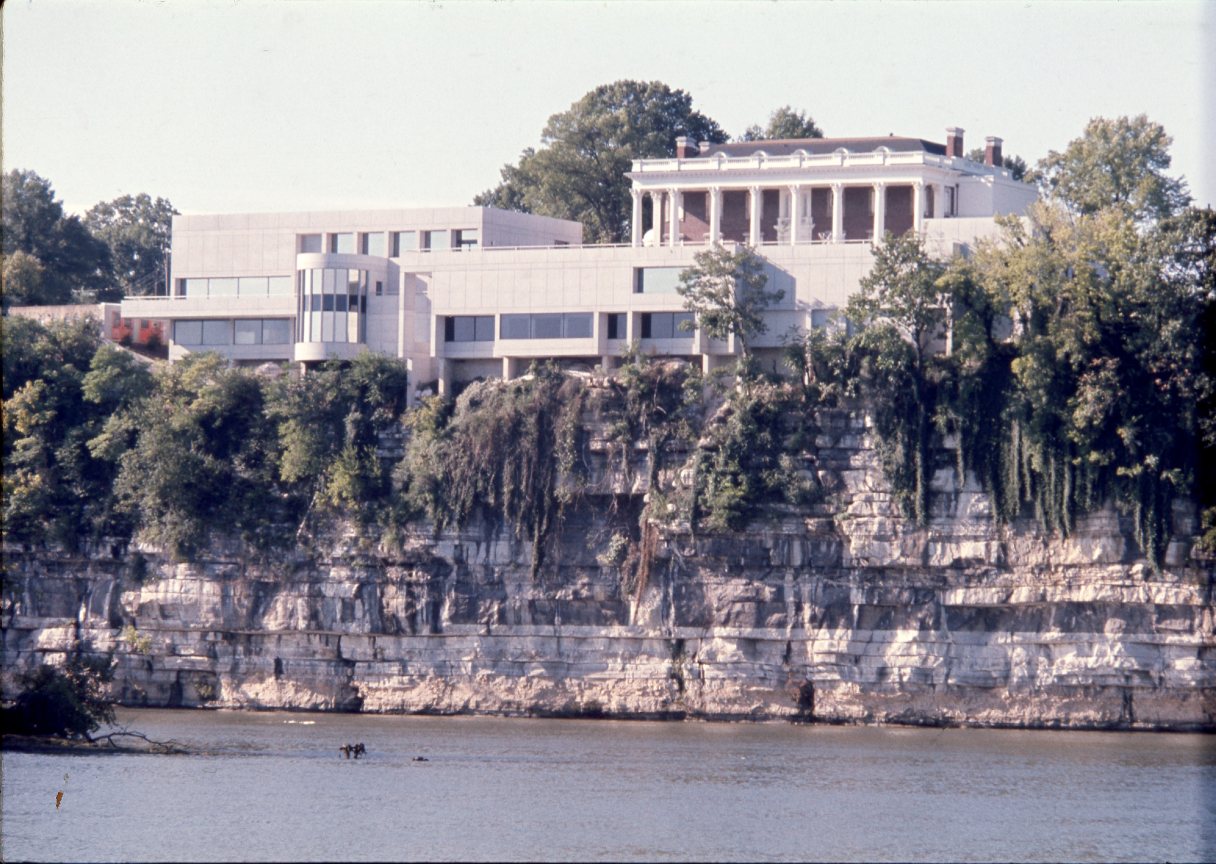
 In this 1975 Chattanooga News-Free Press photo, the Hunter Museum of Art was set to re-open after a two-year renovation and addition project. The East Wing, shown here on the left, was the new structure and joined a 1905 mansion to form the museum. News-Free Press photo via ChattanoogaHistory.com.
The year 1975 marked a turning point for the arts in Chattanooga.
In September 1975, a renovated and expanded Hunter Museum of Art was formally re-opened to the public after two years of work.
Now generally acknowledged as one of America’s best mid-sized art museums, the modern Hunter Museum of American Art was expanded when a concrete structure, known as the East Wing, was unveiled to the public on the last day of summer 1975.
Built in a style known as brutalism, which was popular from the 1950s to the 1970s, the East Wing was designed by the Chattanooga architectural team of Derthick, Henley and Wilkerson. It added space to an existing 1905 neo-classical brick mansion that had served as the main building before the expansion.
As shown in this 1975 photo, the mid-1970s Hunter Museum of Art, perched on a bluff overlooking the Tennessee River, featured contrasting architectural styles. The East Wing is on the left and the mansion is on the right in the photo, which was found in a box of slides recently discovered at the offices of the Chattanooga Times Free Press on East 11th Street.