
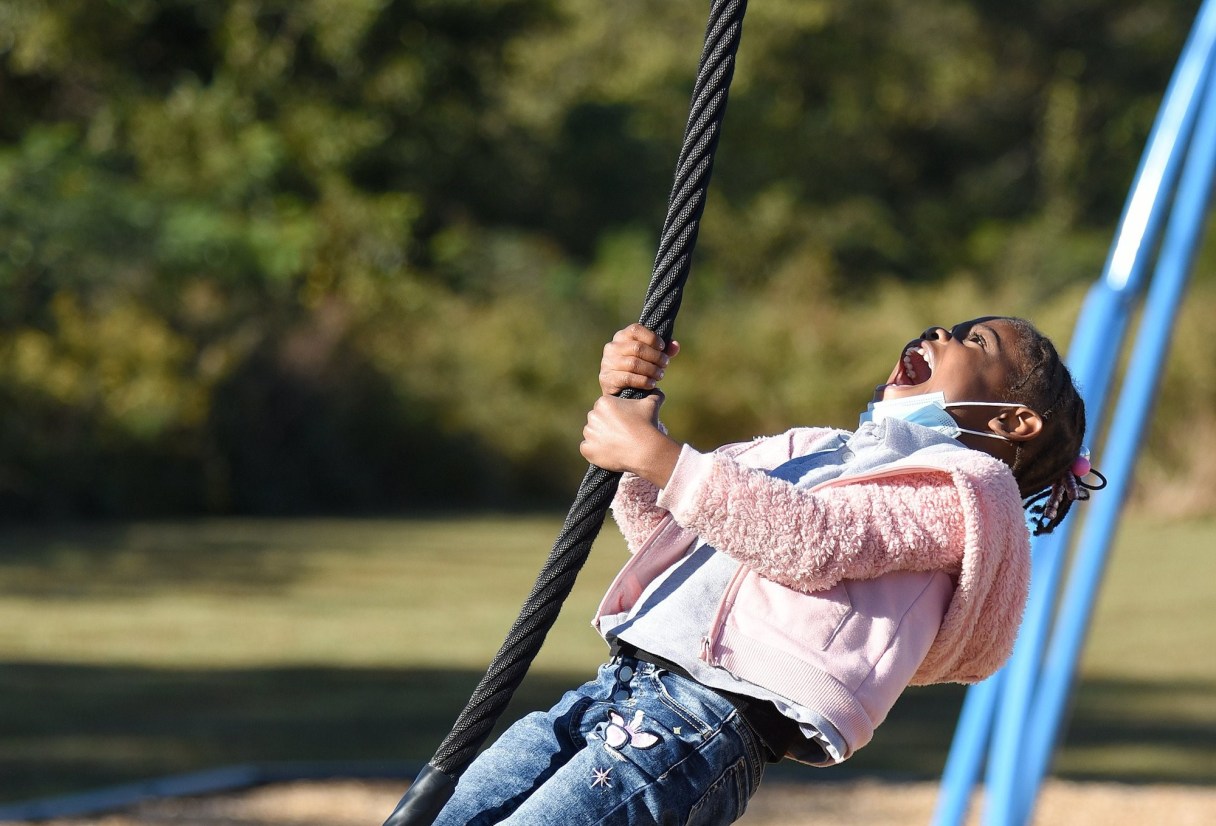
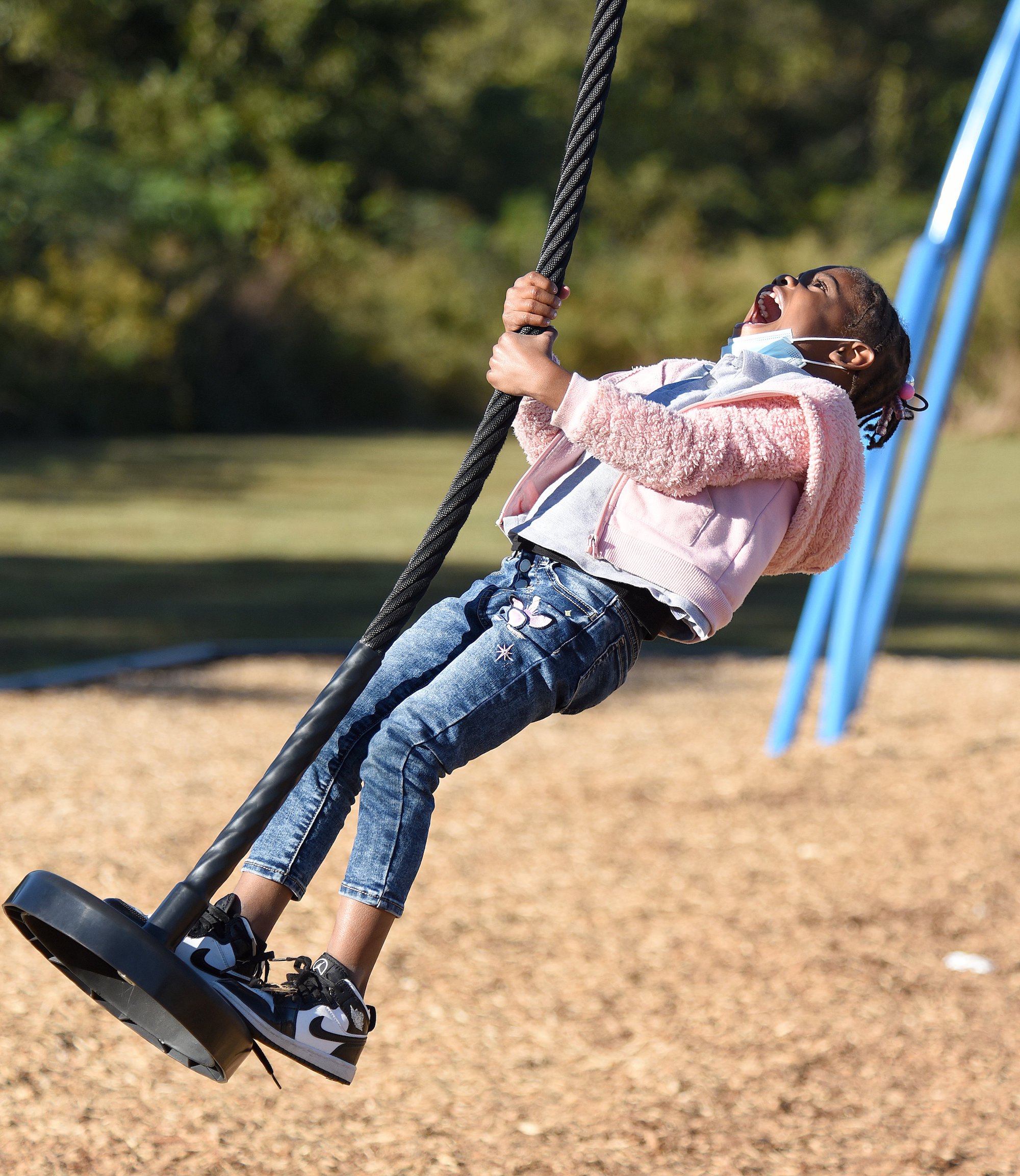
 Staff file photo by Matt Hamilton / Amina Hitchcock, 6, enjoys a zip line on Oct. 27, 2021, at the Southside Community Park.
In his 2000 book “Bowling Alone,” sociologist and researcher Robert Putnam diagnosed a disturbing and growing sense of estrangement within and between communities. In Putnam’s view, several decades of suburban sprawl and the rise of the internet had triggered the decline of many traditional community institutions. As churches, neighborhood schools and parent-teacher associations, fraternal organizations, and even bowling leagues were simply vanishing from American life, civil society was vanishing with them.
Putnam’s words were astonishingly prescient, and the COVID-19 pandemic accelerated many of the trends that he warned us about. For instance, the need for social distancing caused many cities, including Chattanooga, to temporarily suspend access to trails, parks and other public spaces in an attempt to slow the spread of the virus.
Fortunately, the outdoors were reopened when public health officials found them to be safe places for people to gather. This past year has proved that parks are not just a nicety – they are a necessity. The outdoors became a lifeline.
Parks encourage exercise, which reduces the risks associated with heart disease and other ailments. They create proximity to nature, which correlates with a reduction in stress. They stimulate social interaction, which makes them an antidote to social media’s dangerous and manipulative algorithms.
Perhaps most importantly, they are public in their very design, which means they belong to us all – or at least they should be. Equity is about nothing so much as correcting for the inequities of the past, and making sure resources – time, money, focus – are directed in ways that help those who have unjustly been deprived.
Sometimes, barriers to access are physical, as when proper disability accommodations are not made or where signage is unreadable to those who lack fluency in a specific language. Other times, these barriers are cultural and political, visible in how parks are programmed (or not), how well they are maintained (or not), and where they are located (or not.) A pristine park that is inaccessible except by vehicle is hardly an asset to a community where transportation costs already consume up to 30% of a household’s annual income.
Fortunately, these are issues we know how to address. Recently, I had the great honor of spending some time in Chattanooga at the invitation of the Tennessee office of the Trust For Public Land (TPL) and the Chattanooga Design Studio, and I was encouraged and inspired by what I saw. As City Hall and the community move forward with a new parks master plan, I respectfully hope that they’ll think about the following.
> Equity is a value, not a department. Mayor Tim Kelly’s proposed Department of Equity and Community Engagement expands this concept in big ways. With the right resources, this department could place Chattanooga on the cutting edge of cities serious about centering inclusion in all of their policies.
> Engagement is a process, not a box to be checked. Put another way, engagement begins with listening – and it never really stops. Chattanooga should be proud that the city has such a rich tradition of doing community engagement well. This is one tradition that should continue. New public space opportunities at the Tubman site in East Chattanooga and throughout the Westside invite city leaders to find ways to bring more community voices into these plans.
> Representation matters. When people can picture themselves in a space, they’ll follow, and so we owe it to ourselves to be intentional about finding ways to make sure people of varying colors, shapes, sizes, abilities, and cultures can see themselves in the places we’re working with them to create.
The America that Robert Putnam believes we have lost is not likely to return any time soon. I believe that some of the shifts in behavior caused by the pandemic will end up being permanent, or at least very slow to reverse.
At the same time, I believe that we can use our public spaces to build a new sense of community – open, social, civil, and equitable. It won’t happen by accident; now is the time to make the choices to ensure that it will.
Ronda Lee Chapman is director of equity for the Trust For Public Land.