
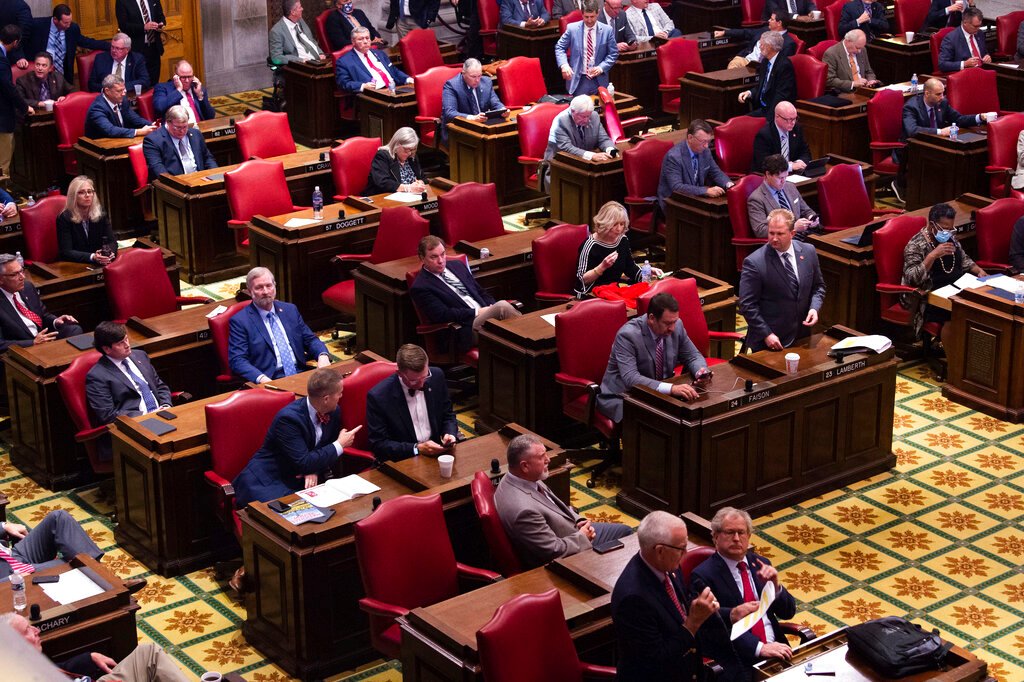
A legislative panel has approved temporary rules that guide how Tennessee school districts investigate complaints about classroom discussions of race and gender – and the hefty financial penalties that fall on districts that fail to abide by the rules.
Emergency rules have been in effect since July 31. They were tweaked again in November, following the passage of legislation barring K-12 educators from teaching certain concepts related to race in the classroom.
And while Monday’s review of the rules by the legislature’s Joint Government Operations Committee was routine, some lawmakers took the opportunity to levy sharp criticisms at the underlying law and the rules crafted by the state’s Department of Education.
Critical race theory is an academic framework for studying the persistence of race and racism in shaping the nation’s social fabric and institutions, and it is not typically taught in K-12 schools. Lawmakers nevertheless passed a ban on the teaching of certain ideas related to the theory.
The law lays out 14 “prohibited concepts” in the classroom and gives the state Department of Education the authority to withhold education funding for school districts that fail to prevent, investigate or discipline the teaching of them.
The banned concepts include that the United States is “fundamentally or irredeemably racist or sexist” and “an individual should feel discomfort, guilt, anguish, or another form of psychological distress solely because of the individual’s race or sex.”
“Teachers teach facts. We do not teach feelings. How do you hold someone accountable with legislation or rules because of how a student feels when they are learning facts,” said. Rep. Gloria Johnson, a Knoxville Democrat who is also a retired teacher. “Say it’s the Trail of Tears and their grandmother is an Indian. How do you legislate or punish based on feelings when a teacher is teaching facts?”
Attorneys for the Department of Education noted the rules they crafted are based on the wording of the legislation, but should a complaint arise over an educator’s teaching of a subject, the school district would make the determination of whether one of the 14 prohibited concepts was “tripped.”
The rules lay out a process available only to current students, their parents and district employees who believe a prohibited concept was taught in schools. They must first take their concerns to the local school board, which must conduct an investigation. Appeals of local school board decisions may be made to the Department of Education.
Violations could result in teachers being suspended, losing their teaching license or getting fired. Financial penalties can also be levied on entire public school districts or charter schools. Those penalties amount to 2% of state funding for the first offense and up to 10% by the fifth.
Complaints may also be lodged by individuals who are not parents of school-age children or employees, but these complaints must go through school boards’ existing grievance procedures, department attorneys told lawmakers. Those complaints may also result in districts losing their funding.
“If a district has a knowing violation, we will withhold their funding,” said Charlie Bufalino, the department’s assistant commissioner of policy and legislative affairs. Bufalino noted districts will have the opportunity to rectify a violation before it is subject to financial penalties.
Rep. Mike Stewart, D- Nashville,raised the specter that more books could be banned under the rules, citing the recent example of the Pulitzer Prize-winning graphic novel about the Holocaust, “Maus,” by Art Spiegelman that was removed from the eighth-grade curriculum in McMinn County Schools.
“The easiest thing to do for the LEA [local education authority] if its presented, say, with this book ‘Maus,’ which talks about the Holocaust – which was apparently just banned in McMinn County – the easiest thing for the LEA to do is just ban the book because then they’re guaranteedto not face second-guessing by the department and not have their funding cut, right,” Stewart said.
“If I’m an LEA, the best thing I can do is just ban every book someone complains about, and that way there’s no way under your statutory framework I can ever be subjected to fines, right?” Stewart said. “That’s how it works.”
Republican lawmakers indicated they may revisit the rules when they come before them again next fall. Some are concerned that the rules should include the ability for any citizen to complain through the same process as students, parents and employees.
But some Republicans also had a sharp message for their Democratic colleagues: “If you don’t like the law, you can file another bill to change it,” said Rep. John Ragan, an Oak Ridge Republican who serves as a chairman of the Joint Government Operations Committee.
Read more at TennesseeLookout.com.