
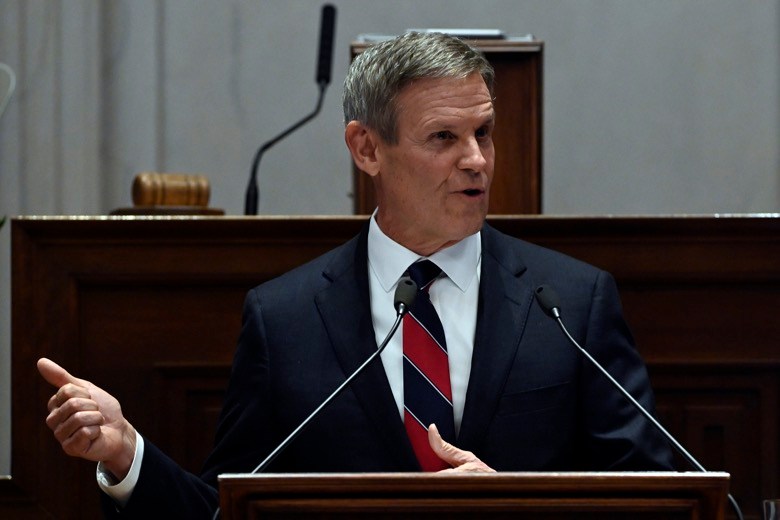
NASHVILLE, Tenn. (AP) — Tennessee’s Gov. Bill Lee on Monday unveiled his $52.5 billion budget proposal for the upcoming fiscal year, an increase from the $41.8 billion budget that the Republican proposed for the current year. The 2022-23 spending plan includes increases for law enforcement, education, state workers, roads and more, buoyed by better-than-expected revenues during the COVID-19 pandemic and federal coronavirus recovery funding. The wide-ranging plan also includes money to make Juneteenth a state holiday. The budget proposal needs ultimate approval from the Republican-dominant General Assembly. Here’s a look at the highlights:
EDUCATION
— $550 million for career and technical education grants to award $1 million each for every high school and $500,000 to each middle school and for additional vocational and rural grant programs
— $200 million to relocate 14 schools currently in flood plains
— $750 million for the following 2023-24 budget year, to fund a change to the education funding formula for K-12 schools that Lee will propose in the ongoing legislative session
— $250 million for infrastructure improvements at Tennessee State University, a historically Black university that the state has underfunded for years
— $200 million for equipment and facility upgrades at community and technical schools
— $124.6 million total increase to the fund that allows for pay raises for teachers and other school worker positions; the fund was increased by $120.1 million for the current budget
— $88.6 million to expand the HOPE scholarship to $5,100 at four-year institutions and $3,200 at two-year institutions
— $66.3 million to the fund for higher education employee salaries, equivalent to a 4% increase to the fund
— $32 million, half of it one-time money, for charter school facilities
LAW ENFORCEMENT
— $355 million for a multiagency law enforcement training academy
— $178.9 million to improve the Tennessee Advanced Communications Network
— $150 million in grants to help reduce crime in communities
— $66.2 million to help local law enforcement agencies with hiring
— $43.2 million to increase salaries for correctional officers at state and privately operated prisons, including a raise to the starting rate up to $44,520 at state prisons
— $15.9 million for the hiring of 100 more Tennessee Highway Patrol troopers
— $9.7 million to hire 20 new Tennessee Bureau of Investigation investigators and 30 forensic scientists and other staff
HEALTH
— $50.4 million to expand a voucher program to more foster children and adoptive children
— $25.5 million to expand Tennessee’s Medicaid program, TennCare, to provide dental benefits to all adult enrollees; $11.9 million to increase dental services and increase the number of dentists in the state
— $18 million to attract 150 new primary care residents to rural areas
— $6.6 million to extend a pilot program that increased postpartum coverage from 60 days to 12 months for all pregnant women on TennCare who currently don’t qualify
ECONOMIC DEVELOPMENT AND INFRASTRUCTURE
— $519 million for new road projects, plus $100 million for existing projects
— $25 million for a grant program to attract major entertainment and sports events and conventions
— $13.4 million for additional infrastructure and environmental work at the Memphis Regional Megasite, where Ford has announced a massive electric vehicle and battery production project
— $9.5 million to continue developing the Wilson County state fair site
— $4 million for enhanced litter removal along roads
GENERAL GOVERNMENT
— $650 million to pay into the pension and other postemployment benefit trust funds
— $128 million for retirement, health insurance and 401k matching payments for state workers
— $120 million for market adjustments to pay for state workers
— $64.4 million for state workers in executive branch agencies to receive a 4% increase to the fund for the state’s performance-based pay program
— $50 million increase to the state’s Rainy Day Fund
— $7.7 million to make Juneteenth a state holiday