
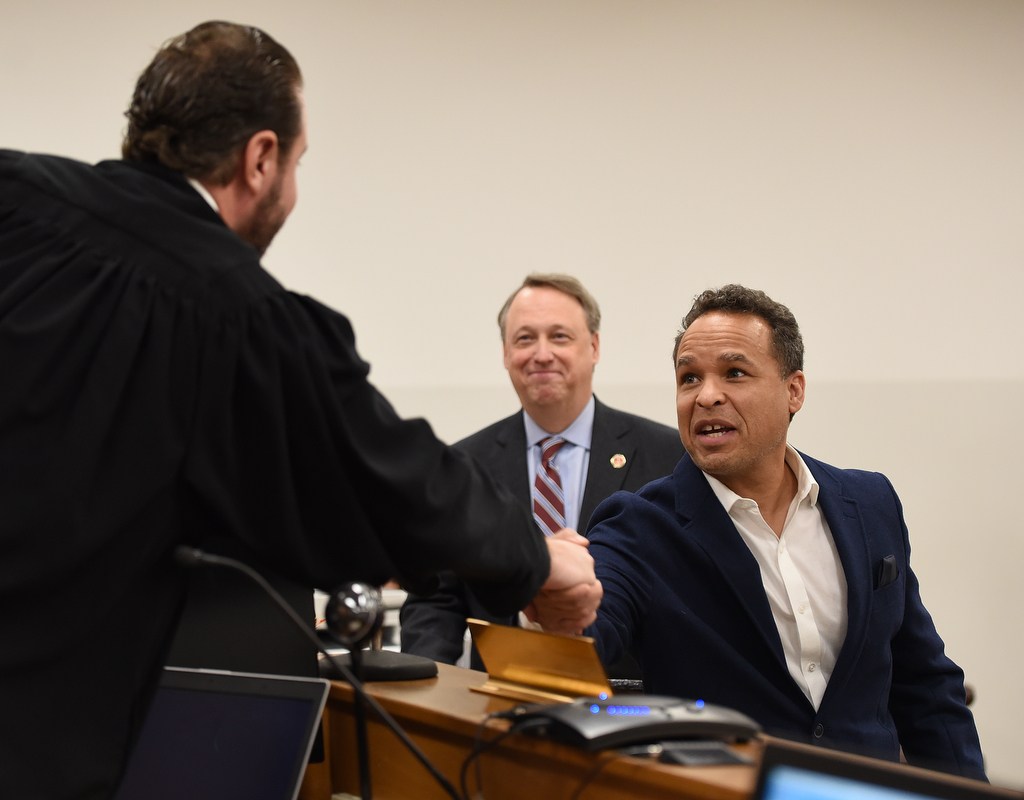
Nathaniel Calloway walked out of the Bradley County Criminal Court on Monday carrying a manila folder, the contents of which meant more than the two-page ruling.
Just an hour earlier, the court affirmed what it had refused more than 160 years ago: Nathaniel Grant was a free man and a rightful citizen of the United States.
Calloway had stood beside 10th Judicial District Attorney General Steve Crump in the courtroom as the district attorney described the case as one of the most important in his career.
“Today is about recognizing the wrong that was committed,” Crump told the court.
Before 10th Judicial District Judge Andrew Mark Freiberg, Crump told the story of Nathaniel Grant who was born into slavery in 1812 and was owned by Capt. William Grant of Cleveland.
Nathaniel Grant and William Grant developed a contract in which Nathaniel would be freed after four years. Nathaniel Grant bought his freedom for $155 on June 30, 1855.
But in 1854, the Tennessee legislature had passed a law “to regulate the emancipation of slaves, and to provide for the transportation of free persons of color to the western coast of Africa.” By 1856, William I. Campbell, a justice of the peace for the county and state, petitioned the Bradley County sheriff to bring Nathaniel Grant, still referred to as a slave and “boy” despite being a free man, before the court.
His former owner opposed the court action, but Grant was forcibly separated from his wife and eight children, then deported to Liberia, a place he had never been. He died months later of tsetse fever.
The journey to clear Nathaniel Grant’s name began around seven years ago when Bryan Reed, associate professor of history at Cleveland State Community College, was walking through the Fort Hill Cemetery, looking for people to feature in a local history tour. Reed began researching the life of Nathaniel Grant’s daughter, Sarah Louise Grant. That research led to her mother and, eventually, to the wrong committed in Bradley County in 1856.
Reed got in contact with Calloway, the great-great-great grandson of Nathaniel Grant. The history professor’s research offered a more complete picture of the family’s history. Calloway and other members of his family previously believed Nathaniel Grant traveled to Liberia of his own will to stake his claim.
In November, Calloway sent a letter to Crump requesting the district attorney overturn the court decision that sent Nathaniel Grant to the west coast of Africa.
Calloway, visiting Cleveland from Los Angeles on Monday, thanked the judge and Crump for standing up to right an injustice. It is never too late to do the right thing, he said.
“This is a symbolic victory, but symbolic victories can go a long way to healing open wounds,” he said.
(READ MORE: Ed Johnson memorial unveiled beside Walnut Street Bridge 115 years after lynching)
Clearing Nathaniel Grant’s name cannot undo the historical wrong, Crump said, but it offers perhaps “the most justice that can be accomplished here on Earth.”
Calloway told the Times Free Press he hopes the attention to Nathaniel Grant’s story will bring more attention to how the pain of historical injustice lingers in the present.
“Hopefully, it will raise awareness about how history affects us today,” he said.
Contact Wyatt Massey at wmassey@timesfreepress.com or 423-757-6249. Follow him on Twitter @news4mass.