
VILNIUS, Lithuania – Three cheers to the White House and NATO for calling out Kremlin lies this week about withdrawing troops from Ukraine’s borders – along with falsehoods meant to justify a possible new attack on eastern Ukraine.
Yet even as the world focuses on Vladimir Putin’s aggression against Ukraine, the Russian leader has managed to surreptitiously swallow neighboring Belarus, while the West wasn’t paying sufficient attention. Indeed, Belarus has become the role model for what Putin would like to do with Ukraine and other sovereign states that were once under Soviet rule.
“Belarus is a laboratory for Putin,” I’m told by Vytis Jurkonis, an expert on Belarus at Vilnius University, over breakfast at my hotel in the Lithuanian capital. In Vilnius, officials are watching closely what new experiments Putin conducts.
They tell me the Russian leader is testing whether the West will let him forcefully take over “neutral” countries – those supposedly linked neither to Western Europe nor to Russia – as Belarus once was and as Putin is demanding that Ukraine become.
One reason I visited the Lithuanian capital is that it lies only 20 miles from the Belarus border.
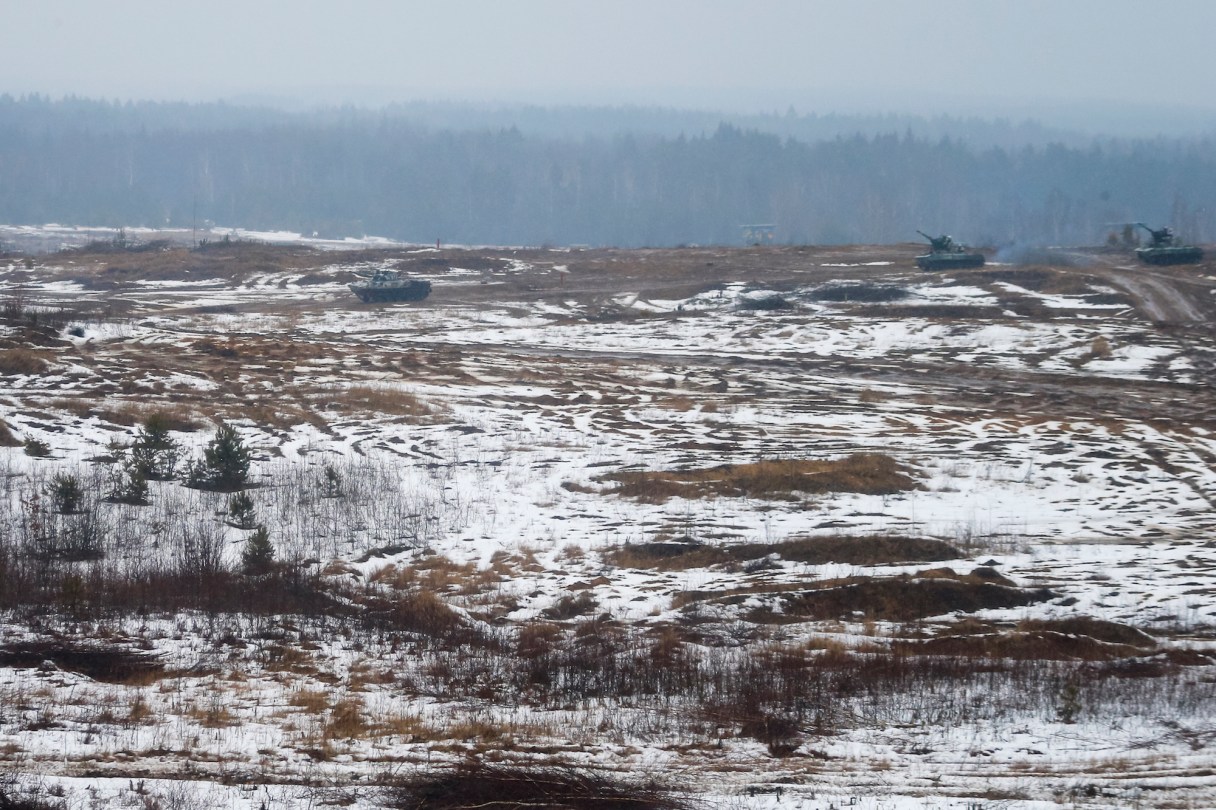
Moscow moved 30,000 troops into Belarus this month, supposedly for military “exercises” – but in reality to threaten Kyiv, only 90 miles from the Belarus border. But these troops also present a dangerous new threat to NATO countries like Lithuania.
With Putin’s troop movements, Russia’s border has effectively moved east, flush up against the 420-mile border Lithuania shares with Belarus. “We don’t believe [Putin’s claims] that those troops will leave,” I was told by Laurynas Kasciunas, chairman of the Lithuanian parliament’s National Security Committee. “If Russian troops stay in Belarus, it is a big game changer for us.”
That’s because Putin can now set up new military bases in Belarus that would threaten the Baltic states and Poland. And Russian troops would be in perfect position to cut off all three Baltic states – Lithuania, Latvia and Estonia – from the rest of NATO.
Thus Putin has managed to successfully integrate a formerly independent buffer state into military (and economic) dependence on Russia, in full view of Western nations.
“We have to recognize we no longer have an independent Belarus, something which is very difficult to accept,” I was told over lunch with Lithuanian Vice Minister Albinas Zananavicius. And Putin clearly hopes to emulate his Belarus achievement with Ukraine.
The Belarus model is a test of whether the United States and Western Europe will permit Putin to destroy nascent or developing democracies in East European countries that don’t belong to NATO or the European Union.
“Russia needs to crush it [Belarus democracy],” says the academic Jurkonis, explaining that a Belarusian success story might have inspired Russia’s democrat opposition at a time when Putin is mounting a severe crackdown against them. “It goes in line with what is happening in Ukraine. Putin wants Ukraine to fail. He wants to show that liberal democracy is a failure, not just in Eastern Europe but in Western Europe and the USA.”
The message from Belarus, where the fight for democracy isn’t over, is that the West cannot afford to let Putin use a variation of the Belarus model against Ukraine by seizing more territory, destroying its economy, or trying violently to install a pro-Russia leader.
As Lithuanian officials told me, Putin has already changed the rules of post-World War II Europe by seizing Ukraine’s Crimea and chunks of its Donbas region by force. His move on Belarus proves that his ambitions don’t stop there.
The Philadelphia Inquirer