
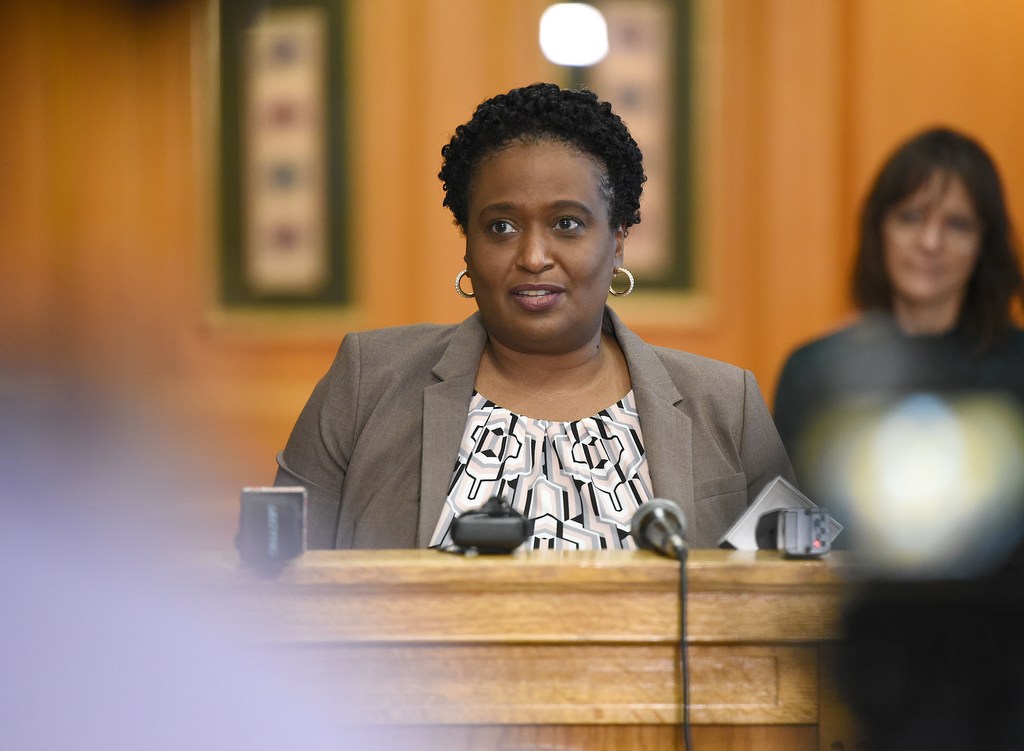
“We’re going to expose the humanity in each other by embracing what we have in common.”
That was how Chattanooga’s newly nominated police chief Celeste Murphy described one of the ways she will accomplish her priorities here, which include reducing violent crime and expanding community policing and youth engagement.
On Wednesday, the editors of these adjoining pages asked the 20-plus-year Atlanta officer for specifics.
“It’s just immersing the department in the community, and the community into the department. That means maybe you go out into the community and you come up with – it could be a kickball game – between one particular street and the precinct officers in that area … That’s when you start seeing people,” she said.
“Now all of a sudden you playing kickball and [the officers] are in their uniform, but you don’t see the uniform at that point. [They’re] like, ‘oh wow, I didn’t know you play kickball.’ It makes you human now. So it’s really just trying to immerse both sides into each other’s culture and lane – and experience things together. It just boils down to people seeing each other outside of the role that’s front-facing.”
It’s impossible not to like hearing this. Especially in this community where policing has too often been a brute sport with tasers and metal batons, and too many previous efforts at community policing have lost focus while too many vows to reduce violent crime fell short.
Our city’s first woman – and first black woman – to be nominated as chief said she will ensure the Chattanooga Police Department partners with schools, the county, faith leaders and others to build connections.
But, no, it’s not all touchy-feely:
“I’m going to make sure we leverage technology and interagency coordination to disrupt that small percentage of people who make the biggest dent in our crimes,” she told a crowd gathered at city hall for the announcement and an impromptu interview with the members of the media.
Mayor Tim Kelly picked Murphy as Chattanooga’s new chief – subject now to an almost certain council confirmation – because he wants, as he has said many times, to diversify the 500-officer local force and to bring community policing back to Chattanooga.
In introducing Murphy, now a deputy chief in Atlanta, Kelly on Tuesday cited a double-digit drop in crime in Atlanta in 2020 when she led Atlanta’s Community Services Division and Special Operations.
“Chief Murphy knows her stuff, and I’ve selected her because she knows how to get stuff done. And she knows how to keep people safe … She’s led community police work her entire career, and she’s never backed down. She is, by her own definition, a winner.”
Later on Tuesday, the winner toured the Chattanooga Police Department and began to meet officers, and on Wednesday she told newspaper opinion editors she saw a department where “there’s a lot that’s going on right” and “a lot of good people.”
No department is perfect, she added. “Do I feel like there could be some more training opportunities, more professional development opportunities? Yes. Expansion of some more technology equipment? Yes. Are they getting the job done with what they what they have now? Yes. Could there be a little bit more diversity in the department? Yes.”
She also hopes to build on the city’s new social worker/police partnership with something akin to what Atlanta does with the nonprofit Policing Alternatives and Diversion initiative, which gives officers the discretion to divert offenders committing low-level offenses to social services and involves a holistic approach for individuals who may suffer from mental illness or homelessness. It began as a training pilot in Atlanta and grew to be department-wide.
It is clear that Murphy has been listening to Kelly, to city leaders and to the questions of the six-member committee that interviewed four candidates to unanimously narrow the choice down to one – her.
“Diversity is how you’re able to solve problems, because you have different perspectives, and that’s one of the things I said I wanted to bring to Chattanooga – a different perspective, Murphy said. “It’s not always about something being totally wrong, or not working, or is disastrous. It’s just about sometimes a fresh start. A new perspective. A new direction.”
We’re very much looking forward to this new perspective and new direction.