
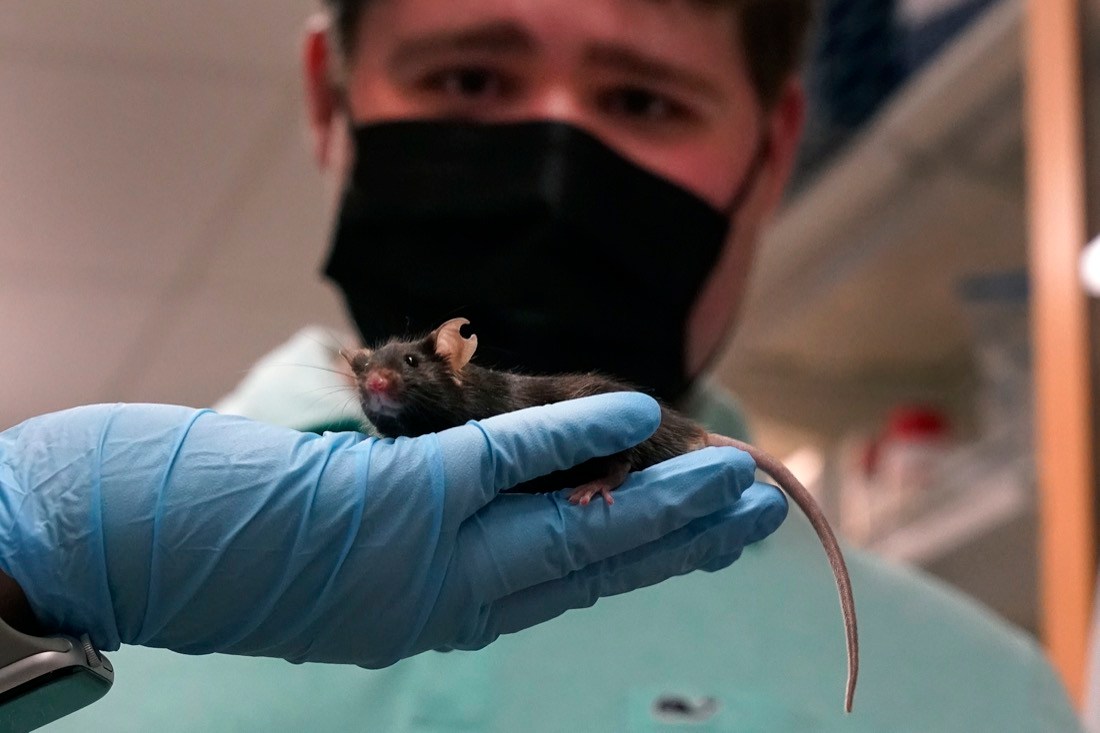
ST. LOUIS (AP) – Jake Litvag leaned in for a closer look as a lab mouse scurried around an enclosure, stopping to sniff a large block.
“Hi, Jakob 1. I’m Jake,” the 16-year-old said, naming the little furry creature engineered to have the same genetic abnormality he has.
That mouse and its lab-grown relatives are the first in the world to mirror the missing gene that causes Jake’s autism. Scientists at Washington University in St. Louis bred the mice, and grew stem cells derived from Jake’s blood, to study and find ways to treat his rare disorder – and look for answers to the larger puzzle of autism.
Jake’s family raised money for the early research, which scientists then parlayed into a $4 million grant from the National Institutes of Health to delve more deeply into Jake’s gene, one of more than 100 implicated in autism. They hope to find “points of convergence” that could someday help people with all forms of the neurodevelopmental condition affecting one in 44 U.S. children.
Jake knows he inspired their work. And that’s helped him see autism as something to be proud of rather than something that makes him different from other kids. His parents, Joe and Lisa Litvag, figured meeting the scientists – and the mice – would show him firsthand what he had brought into being.