
Hey, Braves Country. When it comes to this Major League Baseball lockout, it’s time to look on the bright side. Let’s just say for argument’s sake that the whole season, the entire 162-game schedule goes right down the drain because a selfish bunch of billionaire owners and millionaire players can’t put a weary fanbase first for the first time ever.
In other words, zero games for the entire 2022 season. Not a single crack of the bat, fireworks show, or the sweet sound of a baseball hitting a glove to disrupt a silent summer’s night beyond a Little League field. Nothing but crickets.
Memo to baseball: Soccer clubs nationwide would thank you.
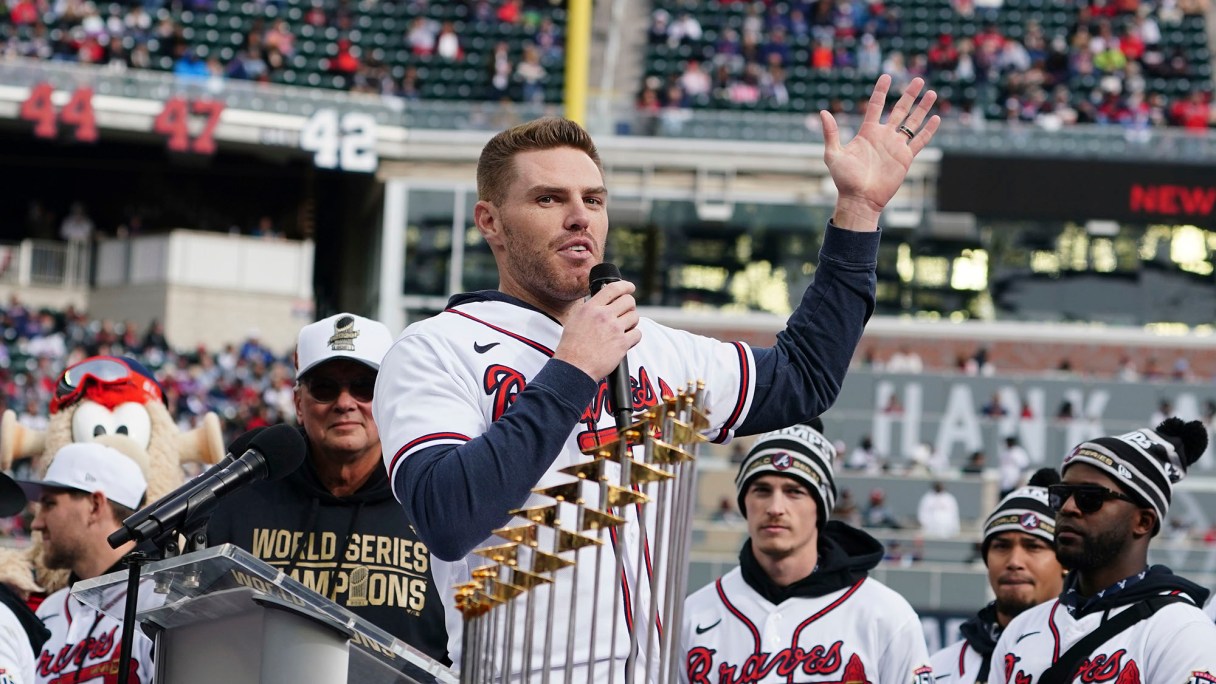
The bright side in all that? Just this: This time next year, your Atlanta Braves would still be the defending world champs, with or without Employee No. 5 – first baseman Freddie Freeman.
It’s never going to come to that, of course. At some point – if not soon after these words are typed – there will be a labor agreement. Always is, even if the 1994 playoffs were called off during the last scorched earth MLB mess.
Talk about an artificial stimulus package and the juice being loose. It was as if the owners and players agreed to hear no evil and see no evil from their lab experiment until they were both back in the black.
And the owners did just that. They used McGwire and Sosa to line their pockets, then tossed them aside. If they need a similar marketing tool long on economics and short on ethics to bounce back from this latest labor unpleasantness, they’ll do the same.
That’s the business of baseball, and pretty much every other professional sport. Or do you think the NFL really worries about concussions or all those aging and crippled NFL veterans out there whose families have to fight the league and players union for every dime they need to care for those who helped make the league what it is today?
Let’s be clear that neither side is exactly traveling the high road here. The owners want a harder salary cap to protect them from themselves. The players want a soft cap or no cap, as well as more freedom of movement from team to team.
But if you were to embrace one side or the other, the players seem to have a more reasonable argument. Or as players rep and superstar pitcher Max Scherzer noted a few weeks ago: “We want a system where threshold and penalties don’t function as caps, allows younger players to realize more of their market value, makes service time manipulation a thing of the past, and eliminate tanking as a winning strategy.”
The players are on the right side of allowing earlier market value and time manipulation. It’s complicated, but it only helps the owners.
 AP photo by Gregory Bull / Atlanta Braves general manager Alex Anthopoulos talks with reporters during Major League Baseball’s GM meetings Wednesday in Carlsbad, Calif.
The tanking argument is a bit different. A smart man with a grand plan, Braves general manager Alex Anthopoulos was accused of taking advantage of this tanking strategy by others to build Atlanta’s title team. A pedestrian 51-53 at the trade deadline, Anthopoulos skillfully obtained outfielders Eddie Rosario (Cleveland), Adam Duvall (Miami) and Jorge Soler (Kansas City), as well as reliever Richard Rodriguez (Pittsburgh) after picking up Joc Pederson from the struggling Chicago Cubs a couple of weeks earlier. With Rosario eventually becoming NLCS MVP and Soler earning the same honor in the World Series against Houston, the Braves won it all for the first time since 1995.
Said a bitter super agent Scott Boras of the Braves’ acquisitions: “The rules allow them to be a less-than-.500 team at Aug. 1 and add four players, five players from teams that no longer wanted to compete, and for very little cost change the entirety of their team and season. And we saw this unfold to the detriment of teams that create at vast expense, planning and intellect and won over 100 games. In doing all this, we have now created an understanding that a fan would not know who the true team is until, frankly, the trading deadline.”
Then again, what else would you expect from someone representing the kind of players who almost always come, in Boras’s words, at a “vast expense”?
The harsher reality in all this is that a prolonged lockout, strike, whatever term you choose, could come at a vast expense for baseball. The games are already too long. The playoff games, especially the World Series games, start too late. The tickets aren’t getting any cheaper, nor the concessions, nor the parking. With inflation going through the roof and gas seemingly doubling over the past two years, a couple of unexpected months off from baseball could make the fans’ return in large numbers problematic.
As tensions have risen the past few days, MLB commissioner Rob Manfred said the postponment of Opening Day would be a “disastrous outcome” for his sport.
In truth, a disastrous outcome is what we’re witnessing in the Ukraine. This baseball mess is merely business as usual between two sides with more money than sense. Same as always.
Contact Mark Wiedmer at mwiedmer@timesfreepress.com.