
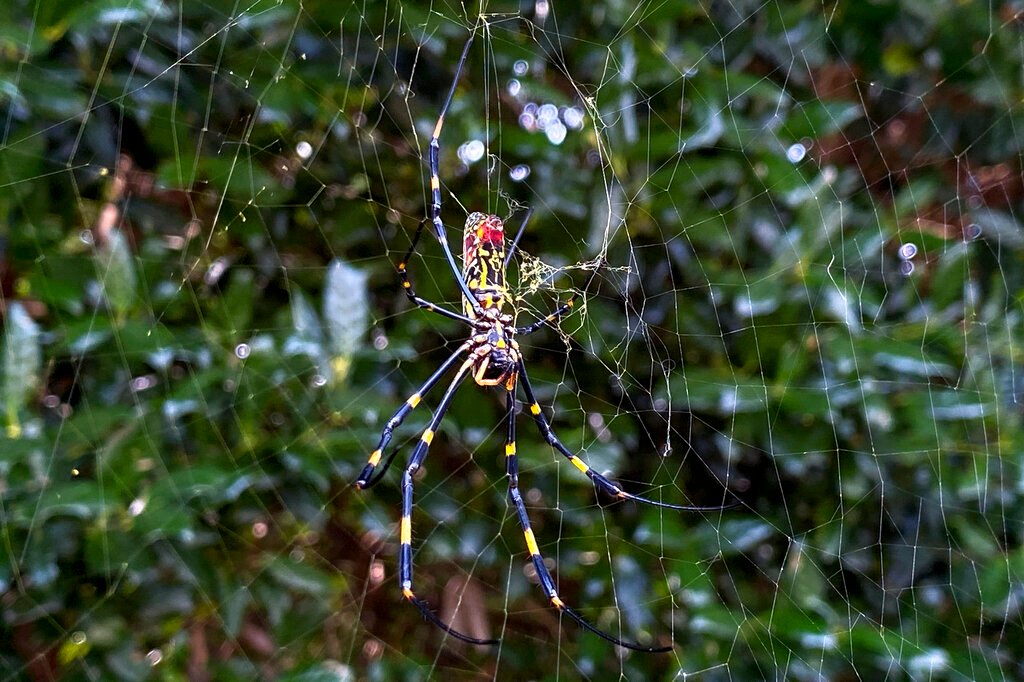
The idea of palm-sized airborne spiders sweeping from Georgia up the East Coast has attracted a lot of media buzz. But Andy Davis, the University of Georgia scientist whose recent study started it all, said people shouldn’t really be so concerned.
Davis generally studies animal physiology but got the idea to take a closer look at Joro spiders because they were all over his backyard in Athens, he said in a phone interview. Davis wondered if the palm-sized spider’s physiology would allow it to spread to colder climates up the East Coast.
He discovered that they could, but wanted to clarify that Joro spiders are airborne only when they’re babies seeking new territory. According to iNaturalist, a citizen scientist website, there have been four sightings of the Joro spider in the Chattanooga area, Davis found, and none in Northwest Georgia. Several Northwest Georgia agricultural extension agents also reported no sightings, despite the Joro spider, which arrived in the state in 2013, having found a solid foothold in Athens and Atlanta.
“Females will grow throughout the summer and fall, then they’ll lay some eggs before they die. They’ll die in November when the cold comes,” Davis said. “In the spring the eggs will hatch. The little babies will send up their parachute thingies – it’s like a little silk thread – and they’ll fly away. It won’t be until the summer, when the spiders get big enough, for people to start seeing them.”
All spiders are venomous – they must have venom to subdue their prey, wrote Nancy Hinkle, professor in the Department of Entomology at the University of Georgia College of Agricultural and Environmental Sciences, in an email. But Joro venom is not toxic to humans. Instead, it is designed to be effective against insects, Hinkle wrote. Other research from the University of Georgia indicates that the Joro spider won’t bite unless it’s cornered, and its fangs are generally not large enough to break human skin.