
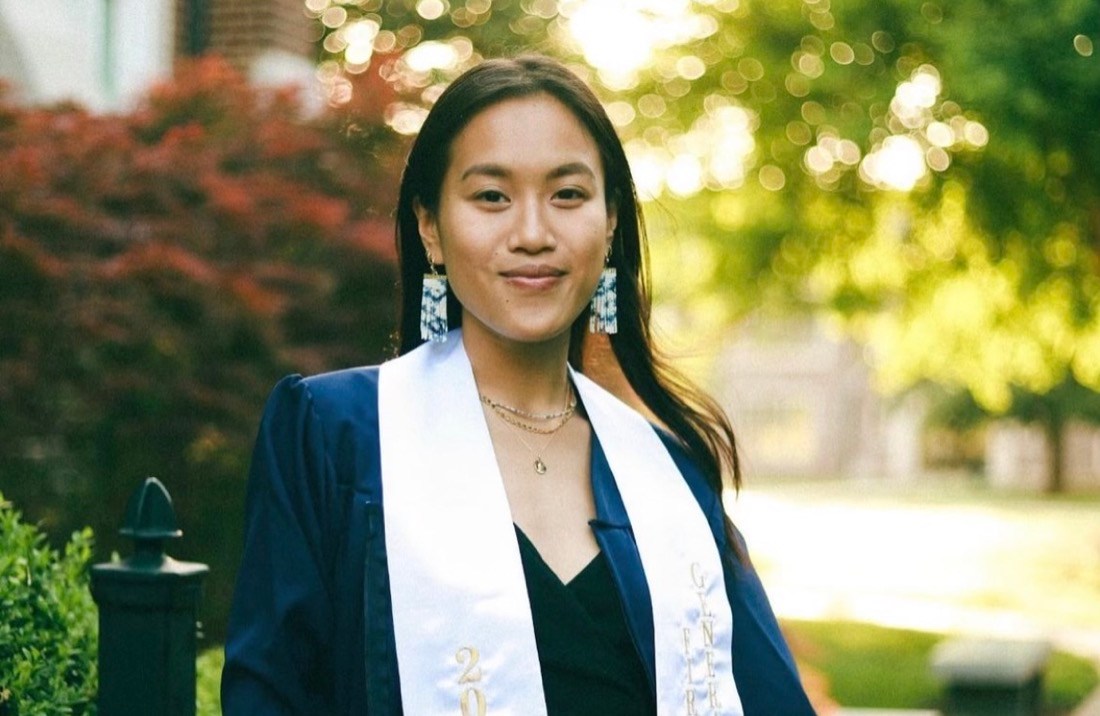
At age 24, Serretta Malaikham is coming to terms with her feelings about being from a family of Asian immigrants.
On one hand, she is proud of her Laotian heritage and her brave, hardworking refugee forebears. On the other hand, she said, it was hard to fit in socially in high school when your homemade lunch sometimes contained chickens’ feet.
“It’s definitely a double-edged sword,” said Malaikham, a recent graduate of the University of Tennessee at Chattanooga who aspires to be a photojournalist.
“It depends on how you look at it,” she said in a telephone interview. “As a teenager, I sometimes hated it. But now that I’ve graduated college, it has humbled me. I don’t look at it as a bad thing.”
Malaikham documented her family’s complicated history in a multimedia class at UTC called Rising Rock. She explains that her grandparents fled to the United States from war-torn Laos in the 1970s as the Cold War conflict in Vietnam bled into the their country.
They eventually resettled as refugees in Nashville, where they were employed as restaurant workers, window washers and packers at a former Dell computer fulfillment center — jobs that didn’t require much English mastery.
Malaikham was born in the United States, and her biological parents were killed in an episode of domestic violence when she was 3 years old. She is guarded about the details and remembers little about them.
She was raised in Nashville by her maternal grandparents who adopted her. She calls them Mom and Dad.
Her grandfather, Khampoon Sonexayarath, was a airplane mechanic for the Royal Laotian Air Force, she said, and a staunch anti-communist in the 1970s opposed to encroachment by Viet Cong, who were communist-backed forces based in neighboring Vietnam.
 Contributed Photo by Serretta Malaikham / After winning a Miss Lao New Year pageant in 2015, Serretta Malaikham, center, has her photo taken with her grandmother, Manichanh Sonexayarath, right, and her grandfather, Khampoon Sonexayarath.
When he was about 19, he and his wife, Manichanh, who was only 17 at the time, escaped the fighting in Laos and fled into neighboring Thailand, where they were eligible for relocation into the United States. They chose Nashville because they had family there.
Malaikham was born in Nashville. As a small child, she remembers being dropped off and picked up in the middle of the night when her parents got off work. In their tight-knit Asian immigrant community, even friends were considered family members. Makaikham said she grew up with a host of “aunts” and “uncles” that she realizes now might not have been blood kin.
As she got older, she assisted her grandparents as an interpreter. They expected a lot from her, she said. Sometimes, Malaikham said, she was asked to translate meetings between adults that she was too young to understand.
“Coming here, it was hard for them because they didn’t speak a lick of English,” Malaikham said. “I was their translator. I would go with them to doctors’ appointments.”
She also was somewhat sheltered, Malaikham said.
“I wasn’t allowed to spend the night with friends,” she said. “I (don’t) think I went to my first sleepover until I was 15 or 16.”
She felt pressure to succeed in school, she said. When it was time to enroll in college, she picked nursing as a major because her parents considered it a durable career. A year into her studies, she realized nursing was not the best choice for her. Instead, she took a gap year to travel in the Western United States, and when she returned to Chattanooga, she decided to study communications.
“It opened my mind to know that I have to live my life for me,” she said. Still, she said, “Every single day, I’m trying to prove to (my grandparents) that I can be successful.”
These days, her grandmother takes care of her grandfather, who has suffered a stroke. Malaikham said her grandfather has always been her best friend, and that he is well cared for by family and friends.
Malaikham said growing up amid the joys and hardships of an immigrant family has given her a perspective that she believes will be useful in her career.
“I feel like with how I’ve grown up, it’s given me a sense of empathy,” she said. “It’s helped me talk to people.”
Meanwhile, she said her grandparents are good examples of immigrants who came to America and made significant contributions to their adopted country.
“They immigrated to escape something traumatic,” she said. “… (And) served useful functions in our economy.”
The “Life Stories” column publishes on Mondays. To suggest a human interest story contact Mark Kennedy at mkennedy@timesfreepress.com.