
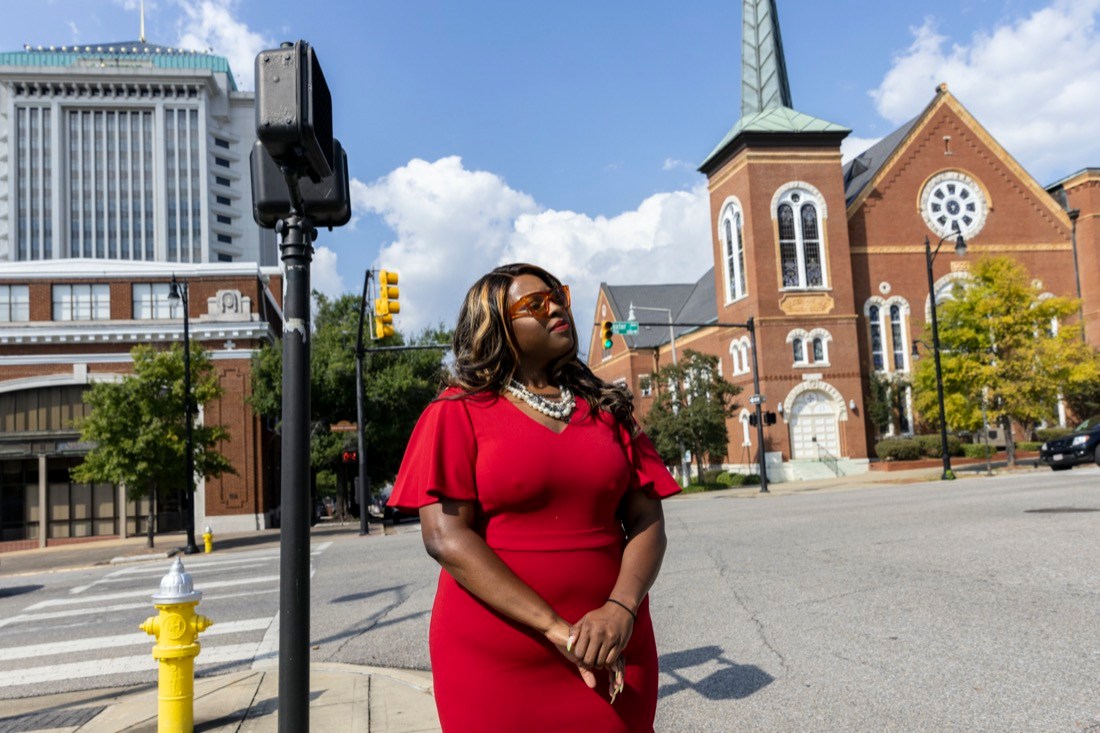
MONTGOMERY, Ala. (AP) — The invisible line dividing two of Alabama’s congressional districts slices through Montgomery, near iconic sites from the civil rights movement as well as ones more personal to Evan Milligan.
There’s the house where his grandfather loaded people into his station wagon and drove them to their jobs during the Montgomery Bus Boycott as Black residents spurned city buses to protest segregation. It’s the same home where his mother lived as a child, just yards from a whites-only park and zoo she was not allowed to enter.
The spot downtown where Rosa Parks was arrested, igniting the boycott, sits on one side of the dividing line while the church pastored by the Rev. Martin Luther King Jr., who led the protests, sits on the other.
The lines are at the center of a high-stakes redistricting case bearing Milligan’s name that will go before the U.S. Supreme Court on Tuesday, setting up a new test of the Voting Rights Act and the role of race in drawing congressional boundaries.
At the center of the case is a challenge by various groups arguing that the state violated the federal Voting Rights Act by diluting the political power of Black voters when it failed to create a second district in which they make up a majority, or close to it. African Americans account for about 27% of the state’s population but are the majority in just one of the state’s seven congressional districts.