
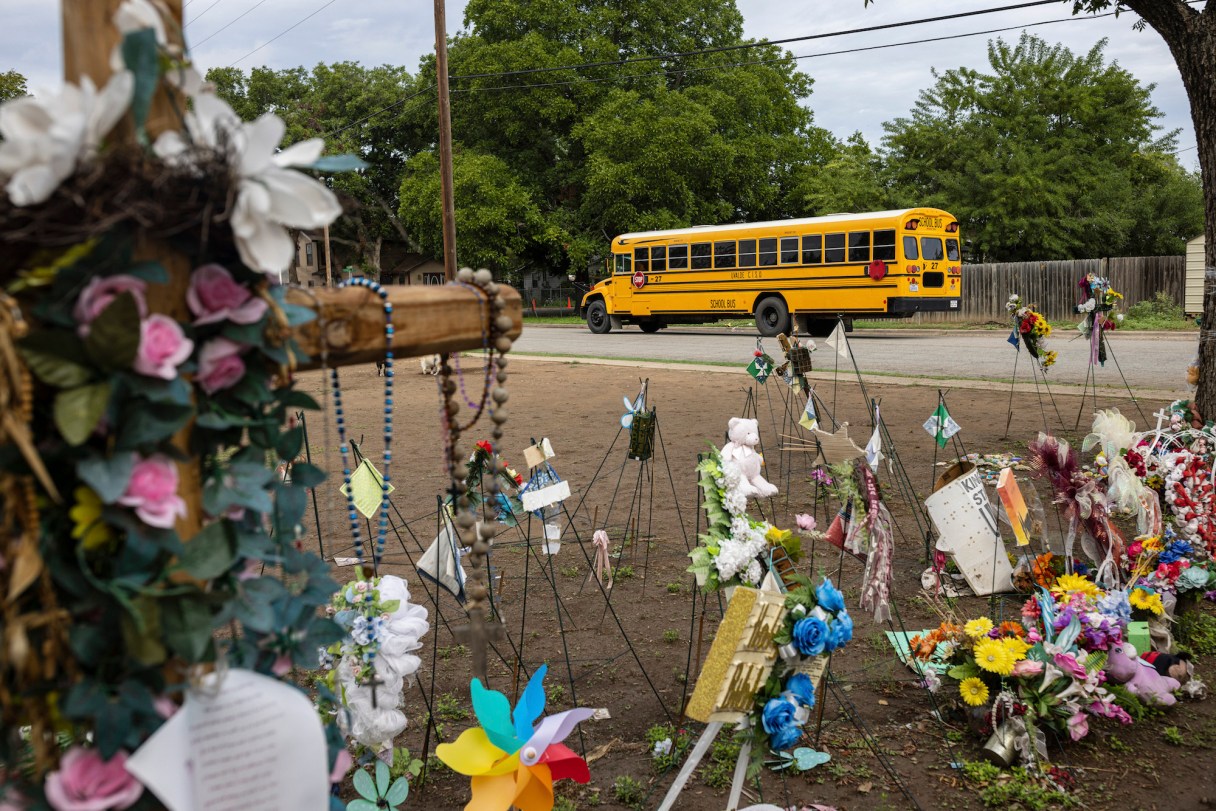
After 19 children and two teachers were gunned down in their fourth grade classroom in Uvalde, Texas, all of America was in an uproar over gun violence and screaming that something must be done to protect children from mass shootings in schools.
I, and a lot of people in this country, thought then that surely our lawmakers would go to great lengths to make darn certain every school in every community was made as safe as possible, and that no cost would be too much to protect the most vulnerable among us, our kids.
To its credit, Congress did act, passing the most significant bipartisan gun reform bill in decades and heavily investing in mental health intervention in schools, too. But those reforms were the lowest of low-hanging fruits, and by themselves will do little to make schools safer.
Real reforms will likely require action at the state level, and yet state lawmakers seem far more interested in meddling in other school-related issues — where kids go to the bathroom, whom they play with, what books they read and how much of American history they should be taught. But politicians think weighing in on those partisan conversations, issues that ought to be decided by school leaders, will earn them votes.
Where’s the talk about lives?
State lawmakers would do better concentrating on making sure students are safe.
But since that’s not happening, I was ecstatic to learn that more than 30 members of Congress have called for federal agencies to conduct a review of gun violence prevention strategies in all schools and establish a national plan that meets the holistic emotional, health and safety needs of students.
It’s a welcome sign that Congress is engaged in finding ways to ensure school safety. Besides, they aren’t looking to stipulate solutions, but rather to gather data about safety standards in every school, and to shine light on minimum best practices.
We know that just hardening schools alone is not enough.
After the 2018 massacre at Marjory Stoneman Douglas High School in Parkland, Florida, many states — including Kansas and Missouri — poured a total of $900 million into school security. The federal government also issued grants to help.
That’s the value of the proposal backed by the 30-some lawmakers. It would help identify the security situation and needs of every single school.
Most mass school shootings occur in small towns like Uvalde, which has a population of fewer than 16,000. A 2018 report by The Associated Press said that of the 10 deadliest school shootings, all but one occurred in places with populations under 75,000.
What’s clear about the scourge of mass shootings in America is that we need more, not less, information. For more than 20 years, a rule passed by Congress in 1996 known as the Dickey Amendment had prevented the Centers for Disease Control and Prevention from spending money to research gun violence as a public health threat. That only changed in 2018, when Congress made clear the amendment barred only advocacy, not research.
That cleared the way for Congress to finally authorize modest studies of gun violence by the CDC and National Institutes of Health in 2019.
Currently, the CDC has 18 research projects underway aimed at exploring solutions for gun violence in this country. Among the ideas coming out of these projects is data collection and promoting collaboration across multiple sectors.
That’s exactly what these lawmakers are suggesting should happen. They are on the right track. We should not be waiting around for the next tragedy before action is taken.
The Kansas City Star