
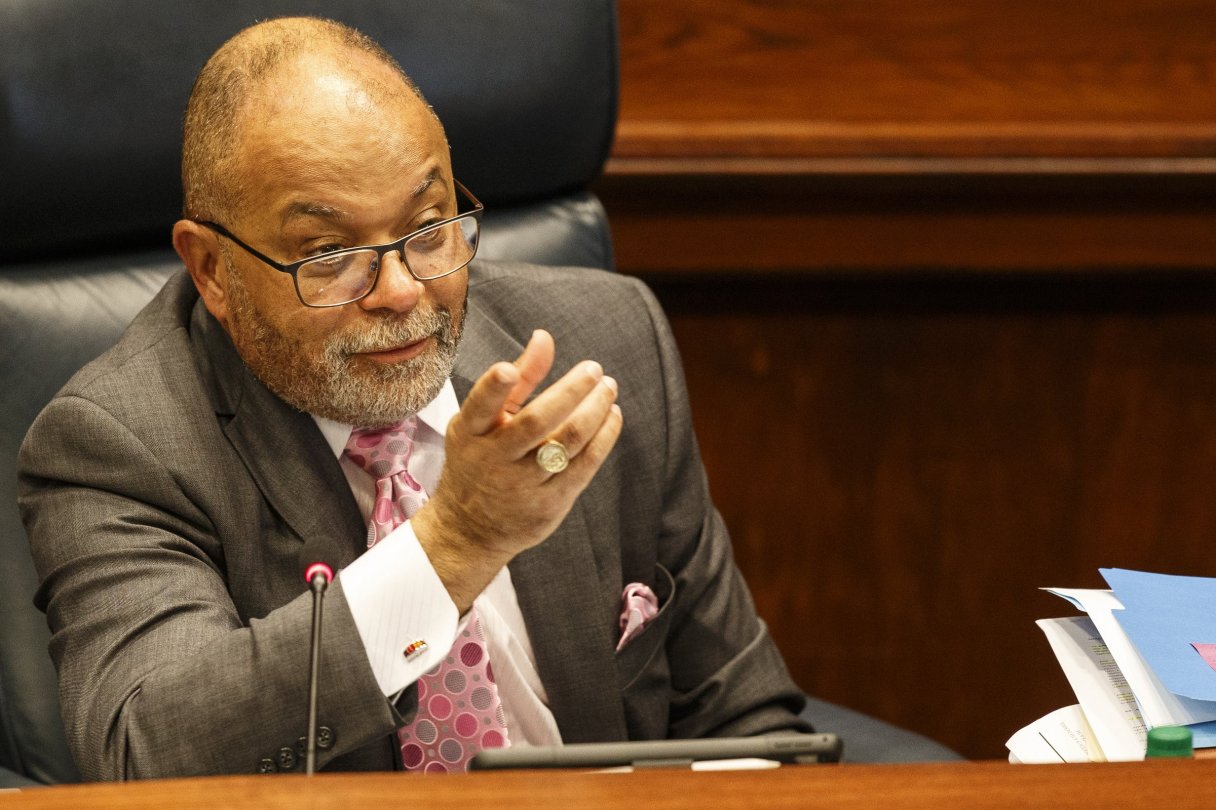

The Hamilton County Commission inaugurated on Sept. 1 forcefully showed this week it intends to be a co-equal partner in county government for the next four years.
Saying they were left out of the decision by Hamilton County Mayor Weston Wamp to fire longtime County Attorney Rheubin Taylor, county commissioners — after meeting with a private attorney — unanimously approved resolutions Wednesday that would keep the attorney in place through the rest of his contract (into 2025), protect his files (Wamp had him locked out of his computer) and set up a civil service system for employees of Hamilton County general government.
We believe all this might have been avoided if Wamp had approached the situation with an olive branch to the commission rather than a sledgehammer.
The county mayor has said Taylor was the only administrator in county government his transition team recommended that he not retain. Unfortunately, that public statement came about three weeks after rumors spread that he wanted Taylor out and to replace him with former Sessions Court Judge Gerald Webb.
Wamp apparently sat down with Taylor after his transition team’s advice and told him he’d like to hire his own county attorney, but Taylor evidently wanted to stay and fulfill his $180,400-per-year contract. That’s when the rumors started flying.
The mayor, instead, might have brought the matter before the commission as a request for support immediately rather than something he had made up his mind to do.
Since the county attorney’s contract states he can be terminated with the concurrence of the county mayor and a majority of commissioners or a two-thirds majority of the commission without the concurrence of the mayor, he might have gotten buy-in from some members of the commission.
However, Wamp felt the county attorney served at his pleasure and had gotten some legal advice from two different sources that appears to back his position.
Taylor, meanwhile, continued to work, and commissioners obviously felt spurned that they hadn’t been consulted on the decision. Taylor sat with other county officials at Wednesday’s meeting and gave the commission advice when requested.
Wamp has said that he chose not to retain the county attorney because he did private legal work during business hours, that he breached attorney-client privilege with the mayor’s office and because of previous admissions that his office had destroyed documents related to open-records requests.
The latter involved this newspaper’s requests for records and the finding that some of the records had been destroyed after the requests were made. It ultimately resulted in a state law that passed the state House unanimously and prohibited the destruction of such records in the future.
What is yet to be resolved is whether a transition in administrations cancels the contract the commission agreed to with former Mayor Jim Coppinger about Taylor’s extension. Wamp says it does. The commission says it doesn’t.
We believe it makes sense that the mayor be allowed to hire his own county attorney, one more in tune with his thinking.
However, the courts may have to resolve the decision in lieu of the contract and/or a change in state legislation may have to be made to allow such an action.
Perhaps Wamp — or the commission — should seek an opinion from the state attorney general who likely could clarify this issue once and for all and avoid costly legal fees.
In the meantime, $15,000 in taxpayer money already has been spent to sort out the situation, $5,000 by Wamp for the advice of a private attorney he got and $10,000 for the private attorney the commission retained that spurred their resolutions on Wednesday. Who knows how much more will need to be expended before a court ruling is made.
Taylor has served a county attorney for 29 years, following 15 years as a county commissioner, and is nearly four decades older than Wamp, who is 35. He replaced Mike Mahn, who stepped down after about 12 years in the office and returned to private practice.
Commissioners made the county attorney position full-time in 1981, replacing part-time attorneys Ward Crutchfield (1981), Whitney Durand (1980-1981) and John Henniss (1978-1980).
We hope this dispute — following a squabble in September about adding space on the commission dais for the mayor to sit — doesn’t portend what the next four years will be like. The county has too much important business to conduct — growth plans, McDonald Farm development, the Southside stadium, public education, etc. — to reduce every decision to the mayor vs. the county commission.