
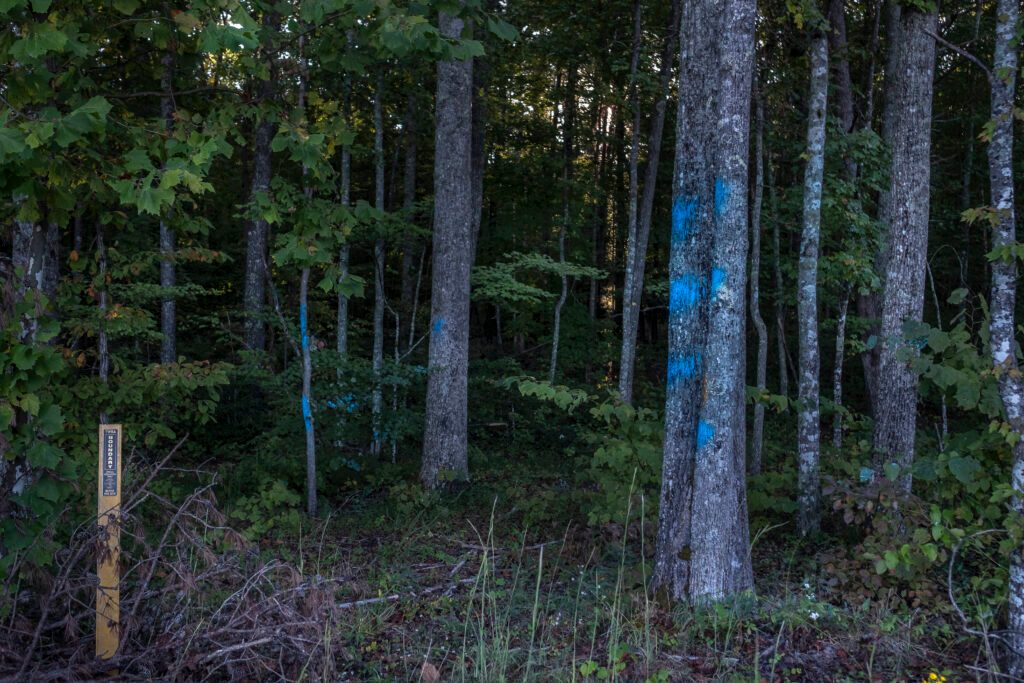
A federal appellate court says the Tennessee Valley Authority cannot escape a judicial injunction by repackaging its tree-cutting policy.
The 6th U.S. Circuit Court of Appeals is reinstating an injunction that barred TVA from carrying out its “15-foot rule,” which allowed the utility to cut down private landowners’ trees if it determined those trees might one day grow tall enough to interfere with power lines.
TVA claimed the injunction was no longer necessary because the utility had scrapped the “15-foot rule” and replaced it with a new policy — dubbed “alternative C Condition-based Control Strategy.”
But the 6th Circuit isn’t buying TVA’s claim.
“A closer look at (a TVA environmental impact study) reveals that Alternative C is likely just a differently packaged version of the 15-foot rule,” the appellate court stated. “The only notable difference between the 15-foot rule and Alternative C is that Alternative C allegedly permits landowners to keep some trees in the rights-of-way, but the EIS (environmental impact statement) later contradicts itself in several ways, including by failing to include any trees at all in the list of approved plants under Alternative C.”
(READ MORE: Signal Mountain explains tree removal on town property)
This isn’t the first time TVA has tried to work within the injunction — imposed in response to a lawsuit filed by 13 East Tennessee landowners — by claiming it had scrapped the 15-foot rule, the appeals court noted.
The utility argued in 2015 that it had ditched the aggressive tree-clearing policy and convinced U.S. District Judge Tom Varlan to dissolve the injunction. The landowners appealed, and in 2016, the 6th Circuit reinstated the injunction.
“We noted that the plaintiffs had provided ample evidence that enforcement of the 15-rule was ongoing, such as declarations from witnesses who had recently witnessed all trees cleared from buffer zones,” the 6th Circuit opinion stated.
For decades, TVA has removed trees directly under its power lines. But in 2012, the utility asserted the right to remove all trees from what TVA called “buffer or border zones” on private property if the trees had the potential to grow over 15 feet tall — even if those trees did not pose a threat to power lines, court records show.
(READ MORE: US to plant more trees as climate change kills off forests)
Landowners cried foul in a 2012 lawsuit, insisting the rule resulted in the unnecessary removal of century-old trees and argued TVA should have conducted an environmental impact study before enacting the 15-foot rule.
TVA initially claimed the 15-foot rule was not a new policy and, therefore, no environmental impact study or public deliberative process was required. When the 6th Circuit in a 2014 decision demanded proof to support TVA’s claim that the rule was not new, the utility conceded it didn’t have any.
“Instead of producing the administrative record on remand, TVA asserted that it could not produce an administrative record,” the latest 6th Circuit decision recounted.
TVA next claimed it had suspended use of the 15-foot rule, but the 6th Circuit disagreed.
“We again instructed the district court to require TVA to compile an administrative record of the agency’s decision to implement the 15-foot rule,” the 6th Circuit decision stated.
This go-around, TVA conceded the suing landowners had been right all along in their claim the utility had enacted the 15-foot rule in violation of the National Environmental Policy Act, the 6th Circuit stated.
(READ MORE: TVA seeks to extend the life of its oldest nuclear plant for decades)
The utility promised to conduct an environmental study of the 15-foot rule as required by that law and agreed to pick up the tab for the landowners’ legal fees.
“In 2019, TVA moved to dissolve the injunction,” the 6th Circuit opinion stated. “TVA claimed that it rejected the 15-foot rule and instead adopted a plan called Alternative C … (Judge Varlan) granted TVA’s motion to dissolve the injunction.”
But in its latest ruling, the federal appellate court noted the lack of substantive difference between the policies.
“From the face of (TVA’s own study) both the 15-foot rule and Alternative C cause the same result that formed the basis for this action in the first place — namely, preventing the plaintiffs from growing or maintaining any trees on their private property in the buffer zones,” the court ruled.
“Since Alternative C arguably has the same impact on the plaintiffs as the 15-foot rule, (Varlan) should make an actual finding on whether TVA has complied with NEPA before dissolving the injunction,” the 6th Circuit ruled.
TVA spokesman Scott Brooks said in a statement to the Tennessee Lookout that the utility is reviewing the court’s ruling.
“It is important to note that the (6th Circuit) did not question TVA’s compliance with the district court’s 2017 injunction order,” the statement read. “Instead, the 6th Circuit ordered (Varlan) to determine whether TVA’s August 2019 (environmental study) complied with NEPA.
“We are confident that we followed all NEPA requirements and look forward to providing the district court with the information it needs to make that determination,” the statement continued.
Read more at TennesseeLookout.com.