
Kyle Busch felt his team deserved better than two failed engines in the first round of NASCAR’s playoffs.
At least the Toyota driver with two Cup Series championships knew what happened to end his Saturday night at Bristol Motor Speedway and leave him “flabbergasted” at being eliminated from the playoff field.
Martin Truex Jr., one of Busch’s Joe Gibbs Racing teammates and the 2017 season champion, could only laugh as he stood in the garage alongside his disabled car as fellow Toyota driver Bubba Wallace of 23XI Racing came in for repairs.
“There’s another one,” Truex said with a smirk.
He also referred to Kevin Harvick’s words after the 2014 season champ’s Stewart-Haas Racing Ford caught fire in the playoff opener two weeks earlier at Darlington Raceway.
“Crappy parts.”
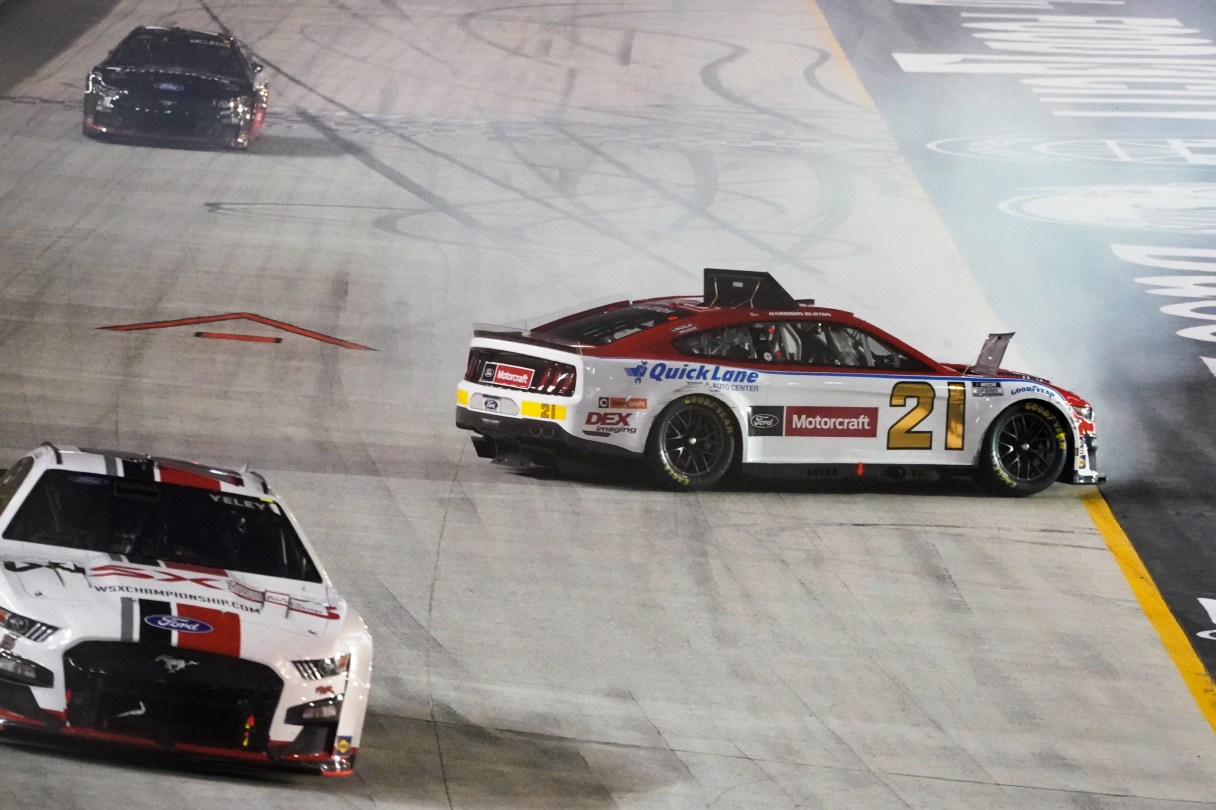
At least a dozen of the playoff drivers had some sort of problem with NASCAR’s first-year Next Gen car at Bristol, where the spec vehicle that has leveled the playing field was exposed again for the multiple durability concerns that have been present since the beginning of the season.
The Ford camp suffered a rash of blown tires, Toyota was plagued by power steering failures, drivers racing for the win were knocked from contention for any number of mechanical gremlins, and passing was a most difficult task. The 12 lead changes were the fewest at the Tennessee short track in more than a dozen years, and only four of those passes were under a green flag.
“Just difficult to pass,” Harvick said. “The car is way too fast through the corners. Can’t race.”
Harvick, desperate to win so he could remain a title contender, was in position to race for the victory until a wheel fell of his car during the final round of pit stops and eliminated him from the playoff field.
Now there’s a new round of questions surrounding the Next Gen, an industry-wide project to develop a car of single-source parts that both contains costs and helps small teams close the gap on the powerhouse NASCAR organizations. It has worked, with Chris Buescher on Saturday night becoming the record-tying 19th driver to win at least one Cup Series points race this season.
However, Buescher’s win also marked the first time in this playoff format that drivers not competing for the title swept the entire round. Erik Jones won at Darlington and Wallace at Kansas Speedway; neither is a playoff driver, nor is Buescher, who scored his second career victory on the top circuit in his 250th start.
He did so by stretching his final two-tire pit stop the last 61 laps of the 500-mile race, as a lack of tire wear (except for that rash of blown right fronts on the Fords) kept runner-up Chase Elliott — on four new tires in his Hendrick Motorsports Chevrolet — comfortably in his rearview mirror.
There have been questions about Next Gen safety concerns since rumors of disastrous crash tests during the development phase, and those have only ratcheted since July, when a crash in qualifying gave 2004 Cup Series champion Kurt Busch of 23XI Racing a concussion that has kept him out of competition for nearly two months. Other drivers have reported they are feeling the force of impact during crashes far worse than ever before, and a spate of car fires at Darlington led NASCAR to make a series of rules changes.
Now there are a fresh batch of complaints after Saturday’s race, which was followed by Harvick, Kyle Busch and Richard Childress Racing teammates Austin Dillon and Tyler Reddick being eliminated from the playoff field.
The second round of the playoffs starts next Sunday at Texas Motor Speedway and will be followed by races at Talladega Superspeedway and Charlotte Motor Speedway’s Roval course before four more drivers are eliminated. The 12 remaining contenders are Elliott, Joey Logano, Ross Chastain, Kyle Larson, William Byron, Denny Hamlin, Christopher Bell, Ryan Blaney, Chase Briscoe, Alex Bowman, Daniel Suarez and Austin Cindric.
Hamlin, who drives for Joe Gibbs Racing and co-owns 23XI Racing, took to Twitter to call for “NextGen 2.0” but acknowledged the financial challenges of that undertaking in the same post. His car had a blown tire at Bristol, but in comments after the race, he pointed to a larger problem.
“Passing was just impossible,” Hamlin said. “I would like to see the racing improve overall. Some lap time variation a little bit. We’re just running around there, and it’s like we’re running faster in the corners than we are on the straightaways
“We had some steering issues, and it looks like our Toyota teammates also had steering issues.”
RFK Racing driver Brad Keselowski, the 2012 Cup Series champ who has an ownership stake in his team, won the first stage at Bristol for his first stage victory of the season and was contending for his first win this year when his car had a blown tire with 87 laps to go.
He acknowledged passing was tricky but also said it isn’t supposed to be easy. That doesn’t mean he’s fully satisfied with the present situation.
“Would I like to see us continue to work on the cars? Absolutely. I’ve said this to NASCAR and I’ve said it to the media before, and I’ll say it again: ‘If the Next Gen car looks the same as it does this year, then we’ve failed,'” Keselowski said. “We should continue to grow. We should continue to learn. We should continue to make it better. There’s probably some car owners that don’t want to hear it because it costs money to change the cars.
“There’s the ‘Everything is wrong with this car’ camp and there’s the ‘Nothing is wrong with this car’ camp. I’d like to keep working on it. It seems like, much like many things today, that polarization means there’s no room for middle ground. In my eyes, I’d like to see some small tweaks, but I’m thankful and proud of our sport and where the Next Gen car has taken us so far.”